

What factors should I consider when selecting a powder type for high temp applications?
Select a powder type by matching its continuous operating temperature and peak heat exposure to the metal component’s service conditions, then assess thermal cycling, chemical resistance, substrate compatibility and required finish. The coating specification should also account for the curing temperature and method, as these affect adhesion, durability and whether the component can be processed safely.
Selecting a powder type for a high-temperature application means choosing a resin system and formulation that will retain its protective and mechanical properties after repeated heat exposure. The decision should be based on the component’s operating environment, the required service life, the desired appearance, and the practical limits of the coating process, rather than on the stated temperature rating alone.
Start with the powder’s resin chemistry. High-temperature powders are commonly formulated around resin systems such as silicone, modified silicone, epoxy, polyester or blends. Silicone-based formulations are often considered where resistance to sustained or intermittent heat is the main requirement, while other chemistries may be selected where abrasion resistance, corrosion protection, appearance or general durability has greater importance. A conventional decorative powder should not be assumed to be suitable simply because it can be applied to a metal component.
The resin is only one part of the formulation. Pigments, fillers and additives can affect how the coating behaves when heated. Some colours may change shade, lose gloss or become visibly chalked before the coating has failed structurally. If colour consistency matters, request heat-exposure information for the specific colour and formulation rather than relying on a generic statement about the powder family.
Consider what must remain intact after heating. A coating may tolerate high temperatures but still be unsuitable if it becomes brittle, softens, cracks or loses adhesion after repeated use. For components that are handled, assembled or exposed to vibration, retention of mechanical strength may be as important as thermal stability. Where parts rub against one another or are subject to impact, ask for evidence of abrasion and impact performance after heat exposure, not only before it.
- Appearance: establish whether colour retention, gloss level and visual uniformity are essential, or whether protective performance takes priority.
- Mechanical durability: check resistance to impact, abrasion, chipping and handling damage at the expected operating condition.
- Corrosion protection: confirm that the selected system provides appropriate protection for the surrounding atmosphere and any contaminants encountered in use.
- Electrical requirements: determine whether the coating must provide insulation, controlled conductivity or a particular dielectric performance.
- Cleanability: assess whether the finish will need to withstand repeated washing, degreasing or contact with process residues.
Review the full temperature profile, not just a headline rating. The technical data should explain how the rating was established and whether it refers to continuous exposure, intermittent exposure or a particular test method. Ask how the coating behaves after prolonged heating, how it responds to repeated heating and cooling, and whether its properties change as the component ages. Two powders described as high-temperature products may therefore be intended for very different duties.
The heat source and the way heat reaches the part can also influence the choice. Direct flame, radiant heat, hot air, exhaust gases and heated fluids place different demands on a coating. Local hot spots may be more significant than the average component temperature. A specification should identify the hottest areas, any temperature gradients and whether the coating is exposed to heat from one side or around its entire surface.
Check the coating thickness requirements. A high-temperature powder may need a controlled film build to balance protection, appearance and flexibility. Excessive thickness can increase the risk of runs, trapped gases, cracking or uneven appearance, particularly on complex fabrications. Insufficient thickness may leave edges and exposed areas with inadequate protection. The applicator should confirm the target film build and whether the selected powder is suitable for the component’s geometry.
Part design can introduce further issues. Deep recesses, enclosed sections, sharp edges, welds and areas containing oils or fabrication residues may affect the final coating even when the powder itself is technically suitable. Vented or enclosed components may also need particular attention because trapped air or contaminants can affect coating quality during processing. These matters should be reviewed before the powder is selected, rather than treated as defects after application.
Assess the consequences of failure. For a non-critical guard or bracket, a change in colour may be acceptable. For a component that protects metal from corrosion, supports a process, contains heat or forms part of an industrial assembly, coating failure may have wider consequences. The higher the cost or disruption associated with failure, the more important it is to specify documented performance, carry out representative testing and avoid selecting solely on purchase price.
Ask for the powder manufacturer’s technical data sheet, application guidance and test information for the intended use. Useful details include the recommended film thickness, permitted processing conditions, expected appearance after exposure, mechanical properties, storage requirements and any limitations on use. If the component is unusual or the operating conditions are severe, a test panel or sample part can help reveal colour change, adhesion loss, blistering, pinholing or surface deterioration before a production batch is coated.
Finally, make sure the powder specification is compatible with the complete production process. The powder, pretreatment, application equipment, part preparation and cure must work as one system. A technically suitable powder can still produce a poor result if the metal is contaminated, the film build is inconsistent or the component cannot be processed uniformly. Providing the coater with drawings, component dimensions, intended use, operating conditions and any appearance requirements allows the specification to be assessed on the actual part rather than in isolation.
For manufacturers and fabricators, the most reliable selection is usually the one supported by documented test data and a clear understanding of the component’s duty. A specialist powder coater can help compare suitable formulations, identify processing constraints and arrange sample work where the application cannot be judged adequately from a product description alone.
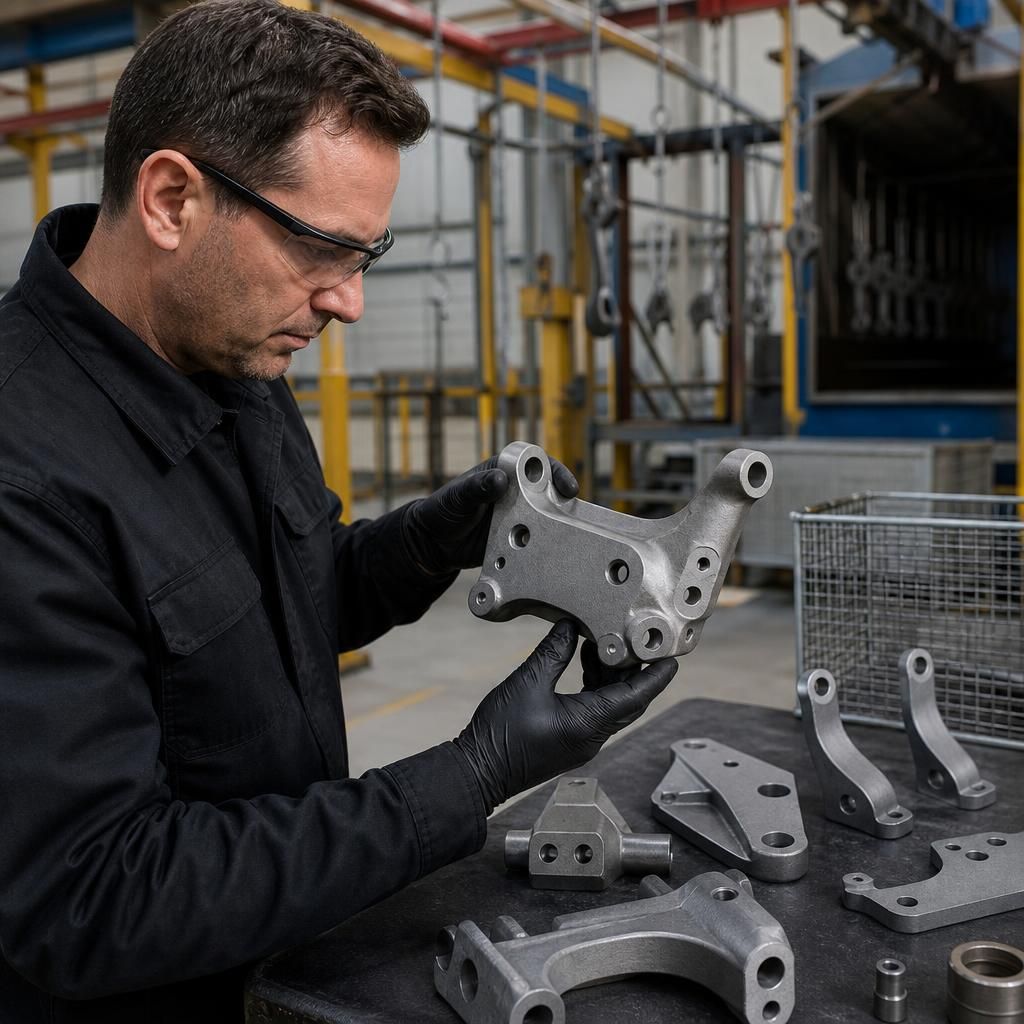
Check that the required cure will not damage the component. A powder may be suitable for the intended service temperature but impractical if its curing cycle could affect heat-treated metal, precision dimensions, welded assemblies or attached components. Review the complete part before selecting the formulation: remove heat-sensitive seals, bearings, fasteners or inserts where possible, and confirm that the substrate can tolerate the specified oven conditions without distortion or loss of performance.
This is particularly important for assembled or fabricated parts that cannot be stripped down easily. The powder specification should therefore be assessed alongside the component’s manufacturing history and construction, not as a separate material choice. A representative sample or test piece can help confirm that the chosen cure produces the required finish without compromising the part itself.
Discuss the Right Powder Type for Your High-Temperature Application
Discuss your component and operating conditions with a specialist powder coater to confirm which high-temperature formulation and application process are appropriate. A technical review can also identify whether sample work or further testing is needed before production coating.