

What specific types of powder coatings are best suited for outdoor applications involving steel and aluminium frames?
Exterior-grade polyester powder coatings are generally best suited to outdoor steel and aluminium frames because they provide strong resistance to UV exposure, weathering and moisture. Where prolonged sunlight and demanding conditions are expected, a super-durable polyester formulation is usually preferable; epoxy-based coatings are better reserved for sheltered or internal applications because they can degrade under sustained UV exposure.
The most suitable outdoor powder coating depends on the frame material, exposure conditions, required appearance and the level of corrosion protection specified. For most external steel and aluminium frames, the practical choice is a polyester-based system selected according to the severity of the environment. More demanding sites may require a super-durable or high-weatherability formulation, while steel exposed to moisture may need a primer-and-topcoat system rather than a single decorative layer.
Standard durable polyester is appropriate for many general outdoor applications, including architectural frames, fabricated metalwork, guards and equipment housings. It provides a balance of colour retention, surface hardness and resistance to rain and atmospheric moisture. The exact grade should be matched to the intended exposure rather than selected solely by colour or gloss level.
Super-durable polyester is preferable where the frame will experience extended exposure to sunlight, temperature changes, pollution or repeated wetting. It is commonly considered for prominent external elevations, commercial structures, transport-related installations and components where maintaining the appearance over a longer service period is important. The coating specification should identify the required durability classification and application thickness rather than relying on the general description “outdoor grade”.
High-weatherability fluoropolymer powder coatings can be considered for projects with particularly demanding appearance-retention requirements. These formulations are used where resistance to colour change, chalking and gloss loss is a central part of the specification. They may be unnecessary for less exposed frames, so the additional performance should be weighed against the project’s cost, appearance and service requirements.
Steel often benefits from a multi-layer corrosion-protection system. This may comprise a suitable pretreatment, an anti-corrosion or zinc-rich powder primer and a compatible polyester topcoat. A zinc-rich primer can provide additional protection where the coating is damaged, but it is not a substitute for sound steel preparation, correct edge coverage and a properly applied topcoat. The primer and finish coat must be tested or specified as a compatible system; mixing unrelated products can affect adhesion and long-term performance.
For aluminium frames, the priority is usually a coating system that bonds reliably to the prepared surface and accommodates the metal’s naturally protective oxide layer. Aluminium should be properly cleaned and chemically pretreated before powder application. Where the frame forms part of an architectural installation, the specification may also need to address colour uniformity between batches, coating on sharp profiles and the visual effect of gloss or texture across adjoining components.
Finish selection also affects outdoor performance. Smooth finishes are generally easier to wash and inspect, while textured finishes can disguise minor handling marks and provide a different visual character. Very dark colours may become hotter in direct sunlight, which can matter where the frame surrounds seals, glazing or temperature-sensitive components. Metallic finishes may require tighter process control because orientation and application can influence the apparent shade.
Coastal, industrial and high-traffic locations require more than a change of powder type. Salt deposits, airborne chemicals, standing water and abrasion can all shorten the useful performance of a coating if the design or preparation is unsuitable. The specification should therefore consider:
- the exposure to salt, pollutants, chemicals and persistent moisture;
- whether the steel requires a primer beneath the polyester topcoat;
- the required pretreatment for steel or aluminium;
- drainage, ventilation and the avoidance of water traps in the frame design;
- coverage of edges, welds, joints, fixings and recessed areas; and
- the required colour, gloss, texture and appearance consistency.
Specialist powders such as nylon can provide useful abrasion and chemical resistance, but they are not automatically the best option for exposed frames. Their suitability depends on the formulation, the expected ultraviolet exposure and the performance required from the finished component. Epoxy-containing systems are similarly best assessed against the specific environment rather than chosen as a general-purpose exterior finish.
Before selecting the coating, the fabricator or coating specialist should confirm the frame metal, expected exposure, dimensional tolerances, joining method and any requirements for masking or threaded areas. The final recommendation should cover the complete process—from preparation and pretreatment through primer, topcoat and curing—because outdoor durability depends on the system and application quality, not the powder chemistry alone.
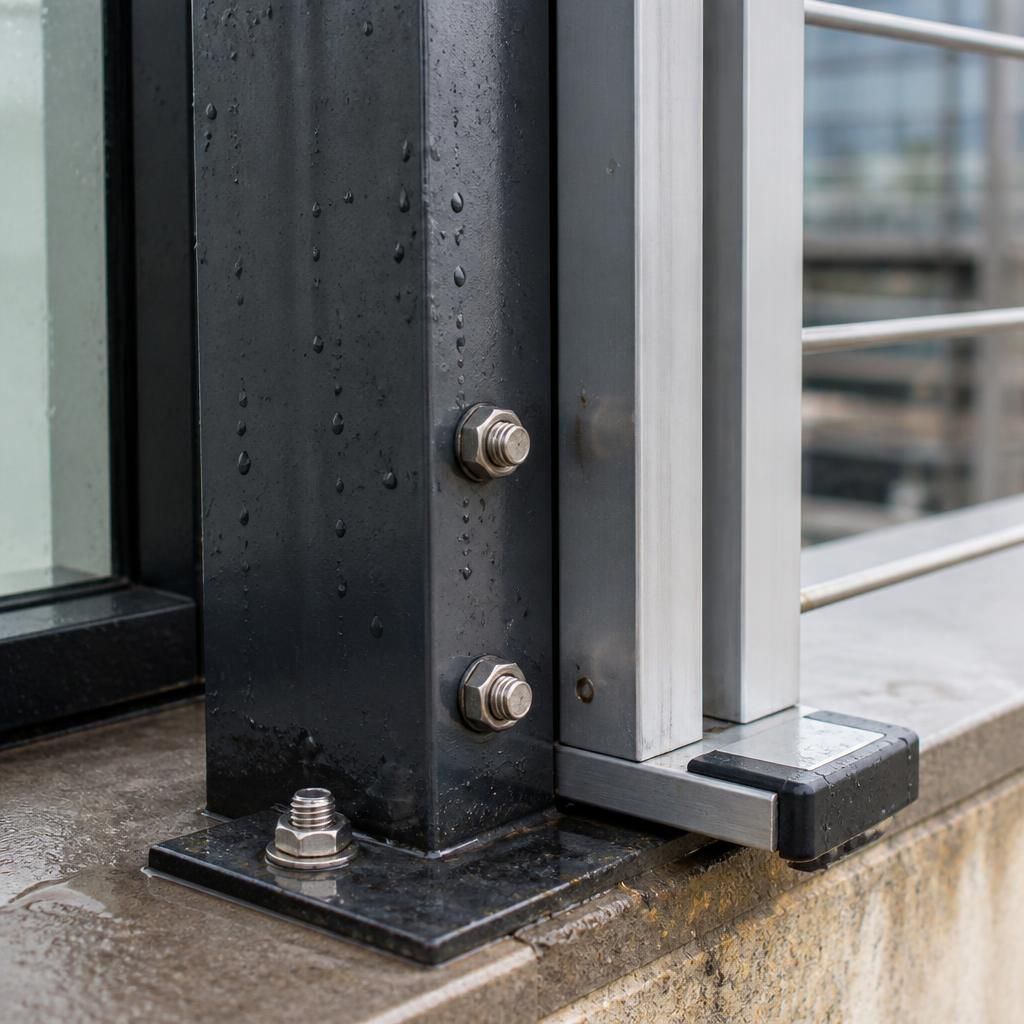
Where outdoor frames combine steel, aluminium and dissimilar fixings, the coating specification should also account for galvanic corrosion. A continuous, well-adhered powder coating can help isolate the metal surface from moisture, but exposed cut edges, drilled holes, fasteners and damaged areas may still permit electrical contact and corrosion. The selected system should therefore be compatible with the substrate, applied after suitable preparation and supported by appropriate seals or isolating components at metal-to-metal interfaces. This is particularly important for frames exposed to rain, condensation or salt-laden air, where small breaks in the protective layer can allow corrosion to develop beneath adjoining parts.