

What factors should be considered when selecting a stainless steel high temp powder coating for specific industrial applications?
Select a stainless steel high-temperature powder coating by assessing the component’s operating temperature, thermal cycling, exposure to chemicals or moisture, required durability and the intended finish. Also confirm compatibility with the stainless steel grade, surface-preparation process, application method and any industry-specific performance requirements.
Selecting a stainless steel high-temperature powder coating requires matching the coating system to the complete service specification, not simply choosing the highest quoted temperature rating. The decision should account for the heat profile, component design, substrate condition, coating thickness, cure requirements, chemical exposure, appearance and the consequences of coating failure in the finished application.
Define the operating temperature accurately. Establish the normal temperature, peak temperature, duration of each heat cycle and whether the component is heated uniformly. A coating that tolerates a short peak may not be suitable for continuous exposure at a lower temperature. Also distinguish between the temperature of the surrounding air and the actual temperature reached by the stainless steel surface. Temperature mapping on representative components can help identify hot spots around welds, edges, fasteners and enclosed sections.
Assess thermal movement and component design. Stainless steel and the coating expand and contract at different rates. Repeated heating and cooling can therefore place stress on the coating, particularly at sharp edges, corners, welds, joints and areas where the metal changes thickness. A suitable system should be evaluated for adhesion and flexibility under the expected thermal cycling rather than judged only by a static heat-resistance claim. Design details such as drainage, trapped moisture, narrow gaps and contact between coated parts can also influence long-term performance.
Check compatibility with the stainless steel specification. Stainless steel grades differ in surface condition, alloy composition, finish and welding characteristics. Mill scale, heat tint, polishing compounds, passivation residues and embedded contaminants can all affect adhesion. The coating specification should therefore identify the substrate grade and the condition in which it will arrive at the coater. Welded assemblies need particular attention because weld zones may respond differently from the surrounding material during preparation and heating.
Consider the full exposure, not heat alone. Industrial components may encounter oils, fuels, cleaning chemicals, solvents, process vapours, salts, condensation or abrasive dust while hot or during cooling. Review the concentration, contact time and temperature of each substance. Chemical resistance can vary significantly between coating formulations, so the coating supplier should provide relevant technical data or agree a representative compatibility test where the exposure is severe.
Match the finish to the function. Gloss level, colour stability, texture and visual uniformity matter where coated parts are visible, but appearance should not override service performance. Some finishes can show greater changes in colour or gloss after prolonged heating. For functional parts, specify whether the priority is insulation, cleanability, abrasion resistance, low-friction contact or corrosion protection. Confirm that the required finish remains acceptable after the intended heat exposure.
Specify film thickness and dimensional tolerances. The coating thickness must be sufficient to provide the required protection without interfering with assembly, clearances, threads, sliding surfaces, hinges or contact points. Excessive build can be especially problematic on mating parts and precision-fabricated components. Identify areas that must remain uncoated and define masking requirements before production so that the finished part can be installed without additional reworking.
Review the curing process. Powder coating is cured in an oven, and the relevant condition is the metal temperature and time at that temperature rather than the oven setting alone. Large, heavy or complex stainless steel parts may heat differently from small sections. Confirm that the coating can be fully cured without distorting the component or affecting seals, inserts, bearings and other heat-sensitive elements. If the assembly cannot tolerate the required cure schedule, an alternative coating approach or a revised production sequence may be necessary.
Account for fabrication and handling. The specification should cover lifting points, masking, weld spatter removal, edge treatment and protection of the coating during transport and installation. Powder coating is applied before some components are assembled, so the order of fabrication can determine whether every required surface is accessible. Parts that will be welded after coating may require defined uncoated zones and a plan for protecting or repairing those areas.
Ask how performance will be verified. For critical applications, agree acceptance criteria before coating begins. These may include visual inspection, coating thickness checks, adhesion testing, cure verification and examination of edges, welds and masked areas. Where the part will face severe heat or thermal cycling, testing a representative sample or a production trial is more informative than relying solely on a generic data sheet. The trial should reproduce the substrate, geometry, preparation, coating build and service cycle as closely as practical.
Consider maintenance and replacement conditions. The selected system should be compatible with the cleaning method used on site. High-pressure washing, alkaline cleaners, abrasive contact and repeated shutdown condensation can all affect the coating over time. Establish how damage will be identified and whether local repair is acceptable or whether the complete component must be recoated. Keeping the coating specification, cure details and inspection records with the component documentation can simplify future replacement work.
For industrial procurement, the final specification should record the stainless steel grade, component dimensions, service temperature profile, chemical and moisture exposure, required appearance, tolerances, masking, curing constraints, inspection requirements and test evidence. A specialist coater can then assess whether the proposed system and production process are suitable for the actual parts, including batch work and larger fabricated components. Businesses across the Midlands can also discuss collection and delivery arrangements when planning the coating of production components.
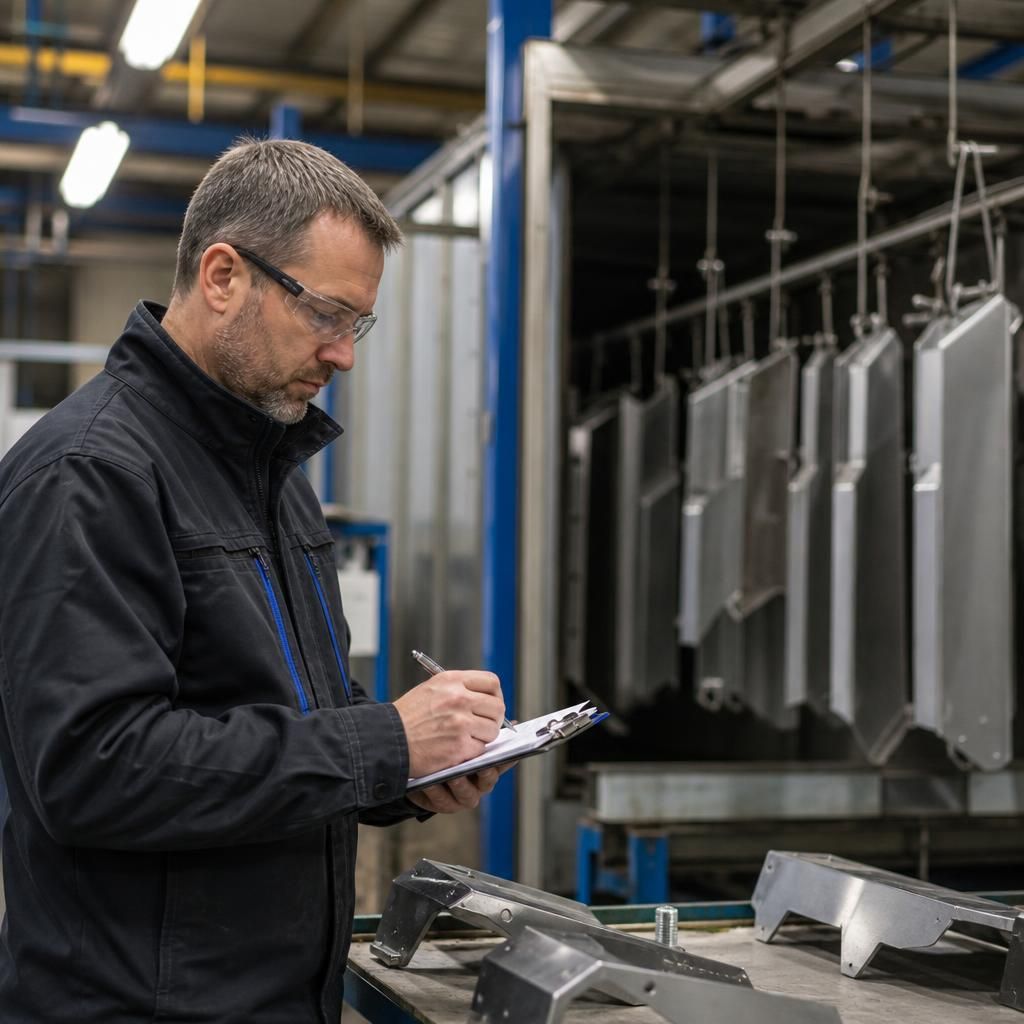
Application-specific compliance and traceability can be decisive when selecting a stainless steel high-temperature powder coating. If the component forms part of safety-critical, regulated or quality-controlled equipment, the coating specification should identify the required technical documentation, inspection records and evidence that the finished system is suitable for its intended service.
Before production, confirm which records must accompany the coated parts. These may include the stainless steel grade, preparation method, coating product details, cure conditions, film-thickness results and agreed acceptance criteria. This is particularly important where coated components are supplied in batches, incorporated into larger assemblies or may need investigation after extended exposure to heat.
- Define the performance requirements that are mandatory for the application.
- Separate essential evidence from preferences such as colour or gloss.
- Agree how non-conforming areas, repairs and rejected parts will be recorded.
- Retain the specification so replacement or repeat batches can be assessed consistently.
Discuss your stainless steel high-temperature powder coating requirements
Discuss your component’s stainless steel grade, service conditions and production requirements with a powder-coating specialist before finalising the specification. Providing drawings or representative parts can help establish a suitable high-temperature coating system and process.