

What preparation steps are crucial for ensuring optimal adhesion of powder coating on galvanised steel?
Optimal adhesion of powder coating on galvanised steel depends on removing oils, dirt, white rust and other contaminants before creating a clean, lightly keyed surface. The steel should then be thoroughly dried, inspected for defects and pre-treated with a process suitable for galvanised surfaces before powder application and controlled curing.
For powder coating on galvanised steel, the crucial preparation work is controlling the zinc surface condition before coating. This includes identifying how the steel was galvanised, checking whether the surface has been passivated or weathered, establishing a suitable surface profile, managing trapped gases and moisture, and correcting defects that could compromise the coating system.
Confirm the galvanising condition first
Hot-dip galvanised steel can vary considerably depending on its age, storage conditions and the galvaniser’s finishing treatment. Newly galvanised components may retain processing residues or have a particularly smooth zinc layer. Older items may show white corrosion products, staining or localised weathering. The preparation method should therefore be selected after inspecting the actual surface rather than treating every galvanised component identically.
Any passivation, quenching or post-galvanising treatment should be identified where possible. Some treatments can interfere with coating adhesion and may need to be removed or addressed before powder coating. If the history of the component is unknown, a coating specialist may recommend a small trial area or test panel before processing the full batch.
Create a controlled mechanical key
Galvanised zinc is often relatively smooth, so powder coating benefits from a controlled surface texture. Light abrasive preparation can provide a mechanical key, but excessive blasting can remove too much zinc, expose the underlying steel or create an uneven surface. Abrasive selection, pressure, distance and direction should be controlled to produce an even result across the component.
The aim is not to strip the galvanising. It is to produce a uniform, receptive surface while retaining the protective zinc layer wherever possible. Sharp blasting, aggressive abrasives or inconsistent operator technique can leave areas with different levels of roughness, which may contribute to variations in coating appearance and performance.
Deal with outgassing risks
Galvanised steel can contain gases or moisture within surface irregularities, overlaps, welds, seams and recessed sections. During the powder curing cycle, these can expand and escape through the uncured film. The result may be pinholes, bubbles, craters or small ruptures in the finish.
Good preparation includes reviewing the design for hollow sections, drain holes, venting and enclosed areas. Fabricated components should have suitable drainage and venting before galvanising and coating. Where the design cannot be changed, a controlled pre-heating or outgassing stage may be considered. This allows trapped gases and moisture to escape before the final powder film is applied, reducing the risk of defects.
Pre-heating must be assessed carefully because the component temperature, dwell time and powder system affect the final result. It should not be treated as a substitute for proper surface preparation or used without considering the specified curing schedule.
Check edges, welds and fabrication marks
Adhesion problems often begin at fabrication features rather than on the broad faces of the steel. Weld spatter, sharp edges, burrs, deep scratches and raised galvanising deposits can create thin areas or interruptions in the powder film. These locations should be reviewed before coating and corrected where practical.
Welded joints may also retain flux, slag, oils or residues that are difficult to remove from crevices. Drainage and access should be considered around overlapping joints and boxed sections. If a defect cannot be removed without damaging the galvanised layer, it should be assessed as part of the coating specification rather than concealed beneath powder.
Use a compatible pre-treatment system
A pre-treatment for galvanised steel should be selected specifically for zinc-coated surfaces. Its purpose is to improve the chemical compatibility between the substrate and the powder coating, not simply to provide general cleaning. The process may involve a conversion treatment or another system recommended for the particular powder and galvanised finish.
Compatibility matters because a treatment designed for bare steel may not perform correctly on zinc. The chemical stage also requires proper control of concentration, contact time, rinsing and drying. Residual treatment chemicals, salts or rinse water can become a source of adhesion failure or surface contamination if they remain on the component.
Control handling and storage after preparation
Once prepared, galvanised components should be handled in a way that avoids recontamination. Bare hands, dirty gloves, unclean slings and contact with dusty work surfaces can transfer substances back onto the zinc. Components should be supported so that prepared faces do not rub against one another or collect moisture.
Storage conditions are also relevant. Condensation, rainwater and high humidity can alter the prepared surface before powder is applied. Parts should be allowed to reach a suitable temperature and should not enter the coating stage with visible moisture, especially in joints, folds, recesses or hollow sections.
Inspect before powder application
Final inspection should confirm that the surface is visually consistent, free from loose residue and suitable for the selected powder system. It should also check the condition of edges, welds, recesses, vent holes and any areas that were repaired or masked. A documented preparation specification can help maintain consistency across repeat batches, particularly where components arrive from different fabrication or galvanising processes.
For a new combination of galvanised substrate, pre-treatment and powder, a trial piece is useful. It can reveal issues such as outgassing, poor wetting, localised adhesion loss or an unsuitable cure before production quantities are processed. The test should reflect the actual substrate and preparation route, rather than relying solely on a sample made from untreated mild steel.
In practice, the most reliable results come from treating galvanised steel as a distinct coating substrate. Retaining the zinc protection, managing its surface chemistry, preventing gas-related defects and maintaining control between preparation and curing are all essential to achieving a sound powder-coated finish.
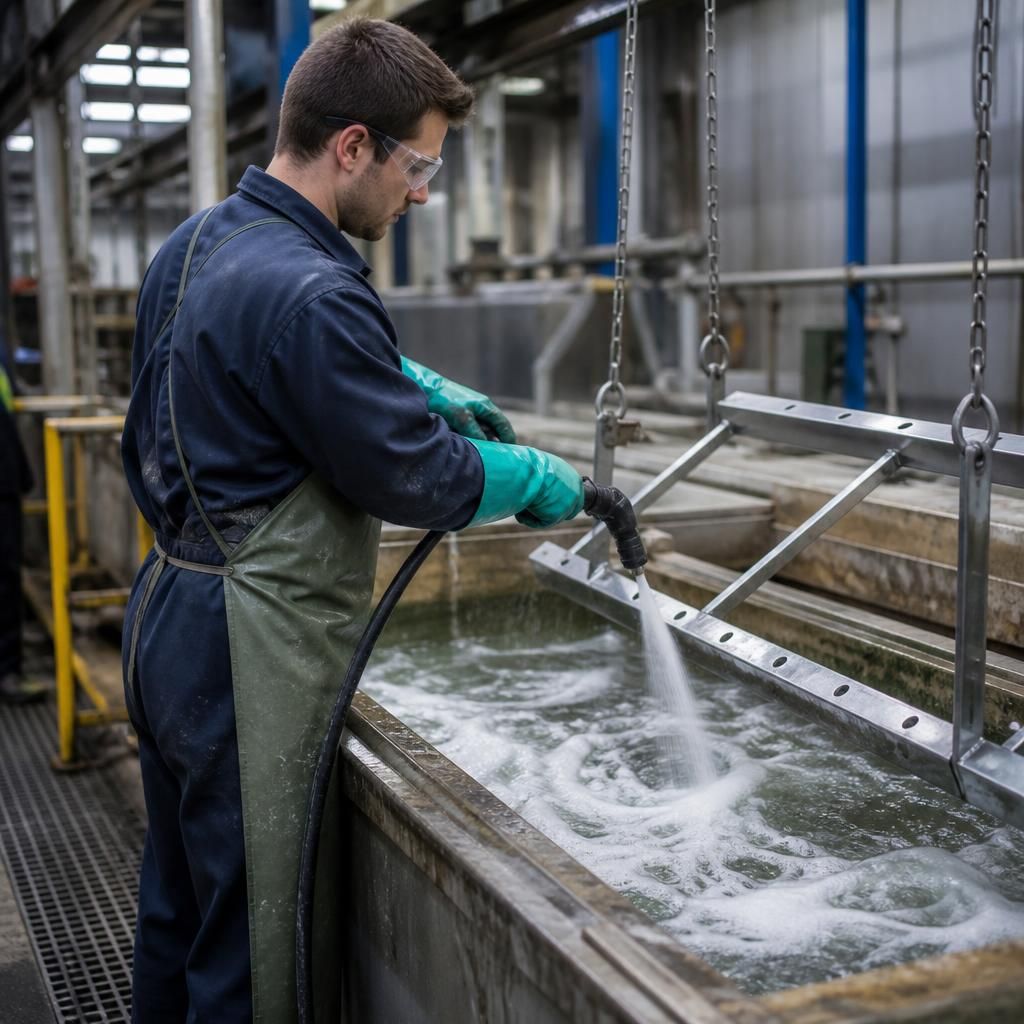
Cleaning chemistry is a critical part of preparing galvanised steel because zinc can be affected by unsuitable degreasers, acidic cleaners or strongly alkaline solutions. The cleaner should be compatible with the zinc coating and the planned pre-treatment, applied at the specified concentration and contact time, then removed thoroughly by rinsing. Any chemical residue left on the surface can form a weak boundary between the galvanised steel and powder film, even when the component appears visually clean.
- Use a cleaning system intended for zinc-coated surfaces.
- Prevent cleaner or rinse water from drying on the component.
- Pay particular attention to joints, folds, recesses and perforations where residues can remain.
- Confirm that the final rinse leaves no visible deposits before the component proceeds to coating.
Discuss your galvanised steel powder coating preparation requirements
Discuss your galvanised steel powder coating preparation requirements with the team, providing details of the component design, galvanising condition and intended coating system. This allows the preparation route and any trial work to be considered before production coating begins.