

What are the advantages of electrostatic powder painting over traditional liquid painting methods?
Electrostatic powder painting typically provides a tougher, more uniform finish than traditional liquid painting, with strong adhesion and resistance to wear, corrosion and impact. It can also reduce overspray waste and avoid liquid solvents, making it an efficient option for many industrial metal components.
Electrostatic powder painting has several practical advantages over traditional liquid painting, particularly for metal components that can tolerate oven curing. The powder is electrically charged and attracted to an earthed component before being melted and cured into a continuous coating. This process gives manufacturers greater control over application, finish selection and production handling than many conventional wet-paint systems.
Key advantages include:
- Consistent film application: Electrostatic attraction helps powder reach the component evenly, including edges and less exposed faces. When the coating system is correctly specified and applied, this can produce a more repeatable result across batches than manually applied liquid paint.
- No liquid drying stage: Liquid paint generally requires solvents or water to evaporate before the coating can be handled or overcoated. Powder is converted into its final film during the curing stage, so the process does not depend on the same air-drying conditions. This can simplify production planning where the components, coating specification and oven capacity are suitable.
- Strong control of finish characteristics: Powder systems are available in different colours, textures, gloss levels and functional formulations. This allows the coating to be selected for appearance as well as for the intended service environment. Textured finishes can also help disguise minor surface irregularities that would remain visible beneath a smooth liquid coating.
- Reduced risk of runs and sags: Wet paint can move on a surface while it is drying, particularly when too much material has been applied or the component has complex angles. A correctly applied powder coating does not behave as a liquid film during the curing process, reducing this particular application risk.
- Cleaner process conditions: Powder is supplied as a dry material rather than as paint diluted with liquid carriers. This can reduce the handling of flammable coating liquids and the associated vapour-control requirements, although extraction, housekeeping and suitable personal protective equipment remain important.
- Potentially simpler coating build: Many powder specifications can achieve the required coating build in one application and cure cycle, whereas a liquid system may involve primer, intermediate and topcoat stages. Whether this is possible depends on the required performance, substrate, geometry and powder system, so the specification should be agreed before production.
- Good suitability for repeatable batch work: Once the preparation, application settings and cure schedule have been established, the same process can be applied consistently to repeated metal parts. This is useful for fabricated assemblies, manufactured components and other items produced to a common specification.
The comparison is not simply a choice between two paints. Surface preparation, substrate condition, component size, required coating thickness, service temperature and final use all affect the result. Powder painting normally requires the component to be heated during curing, so it is generally unsuitable for heat-sensitive materials or assemblies containing parts that could be damaged by the oven cycle. Liquid paint may remain the more practical option for large items that cannot be accommodated in the available equipment, for on-site application or where a low-temperature system is essential.
Component design also matters. Powder can be highly effective on accessible metal surfaces, but enclosed cavities, narrow recesses and Faraday areas may need careful gun positioning and process control. Threads, mating faces and masking points should be identified before coating so that the finished part remains suitable for assembly.
For a fair comparison, a business should assess the complete coating process rather than the material price alone. Relevant factors include preparation requirements, masking, colour changes, curing conditions, inspection, handling and the consequences of rework. Electrostatic powder painting is often preferred where repeatable factory application, a broad choice of finishes and a solvent-free powder formulation align with the component and production method.
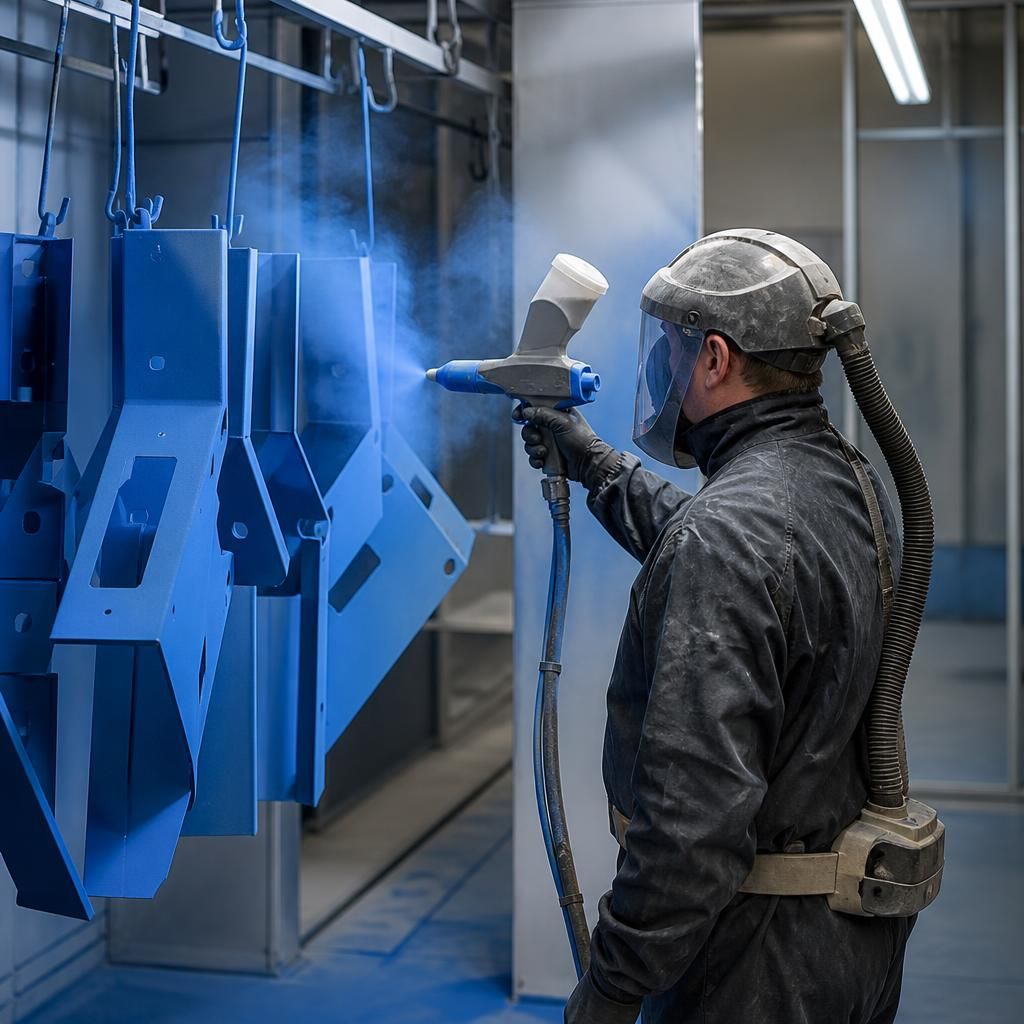
A further advantage of electrostatic powder painting is that the coating process can be standardised around defined application and curing parameters. Powder type, electrical settings, gun movement, film thickness and oven conditions can be recorded as part of the production specification, helping operators reproduce the same finish when components are coated in separate batches. This is particularly useful where parts must match after manufacture, inspection or replacement.
The benefit depends on controlling the complete process rather than relying on electrostatic attraction alone. Components need suitable preparation, reliable earthing and correctly managed curing conditions. When these factors are established, the finished coating can provide a more predictable result than a liquid system whose application may be affected by viscosity, mixing and solvent evaporation.
Discuss Your Electrostatic Powder Painting Requirements
If you are comparing powder painting with liquid paint, discuss your component material, dimensions, required finish and production volumes with a specialist to assess process suitability. Powder-coatings.co.uk can review these requirements and advise whether electrostatic powder painting is appropriate for your parts.