

What specific properties of epoxy powder coating make it suitable for your project needs?
Epoxy powder coating is suitable for projects requiring strong adhesion to prepared metal, a hard protective surface and resistance to many chemicals. Its electrical insulating properties can also make it appropriate for metal components where isolation from electrical current is required.
Epoxy powder coating is most suitable where a metal component needs a tightly bonded, chemically resistant and electrically insulating thermoset finish, particularly in controlled or sheltered environments. Its suitability depends on the balance between the coating’s properties, the substrate, the operating conditions and the required appearance.
One important property is its ability to form a continuous film during curing. The powder melts and flows over the prepared surface before cross-linking into a solid coating. This can produce an even finish with good coverage around profiles, edges and formed sections, provided the component has been correctly cleaned and the coating thickness is controlled. The resulting film has dimensional stability, so it does not soften or flow under ordinary service conditions once fully cured.
Epoxy coatings are also valued for their resistance to many oils, solvents, acids, alkalis and other chemicals. The precise level of resistance depends on the chemical, its concentration, contact time, temperature and the formulation selected. A project involving regular exposure should therefore be assessed against the actual substances present rather than relying on the general term “chemical resistant”. The same consideration applies to cleaning agents and process fluids used during manufacture or maintenance.
The coating’s hardness can help it retain a clean, precise surface on components subject to handling, rubbing or contact with other parts. Epoxy formulations can also provide useful impact and abrasion performance, although these properties vary between products and should be checked where components will experience repeated impact, flexing or sliding contact. A rigid coating may be less appropriate for metalwork that is repeatedly bent after coating, because movement can cause cracking or loss of the film.
Epoxy powder coating is generally better suited to internal components, machinery, electrical enclosures, plant and other applications where prolonged direct sunlight and weathering are limited. Standard epoxy can lose gloss, change colour or chalk under ultraviolet exposure, even when the underlying protection remains. For exposed external work, the specification may need to consider a different powder chemistry or a suitable coating system designed for UV and weather resistance rather than selecting epoxy solely for its chemical performance.
Several practical properties should be reviewed before specifying it:
- Surface compatibility: the metal must be suitable for the selected preparation method, and contamination, mill scale, rust, oil and moisture must be removed to allow the coating to perform consistently.
- Film thickness: the required thickness should reflect the level of protection, profile of the component and dimensional tolerances. Excessive build can affect fit, edges and moving interfaces, while insufficient coverage can reduce protection.
- Curing behaviour: the powder must reach the specified curing condition throughout the component. Large, heavy or complex parts may heat differently from thin sections, so the coating specification needs to account for the metal temperature rather than only the oven setting.
- Appearance: epoxy powders are available in different colours, gloss levels and textures. The desired appearance should be agreed alongside functional requirements, particularly where components are assembled together or inspected as part of a finished product.
- Service temperature: continuous and peak temperatures should be compared with the powder manufacturer’s technical data. Heat can affect colour, gloss, flexibility and long-term coating performance.
- Post-coating operations: drilling, cutting, welding or forming after application can expose bare metal and may require a revised production sequence or local repair treatment.
In practice, epoxy powder coating is a strong choice when internal durability, chemical exposure, surface hardness and electrical isolation are more important than long-term resistance to direct sunlight. A coating specialist can help match the formulation and preparation method to the metal, environment, thickness and end use, while identifying cases where an epoxy-based system should be combined with, or replaced by, another powder coating type.
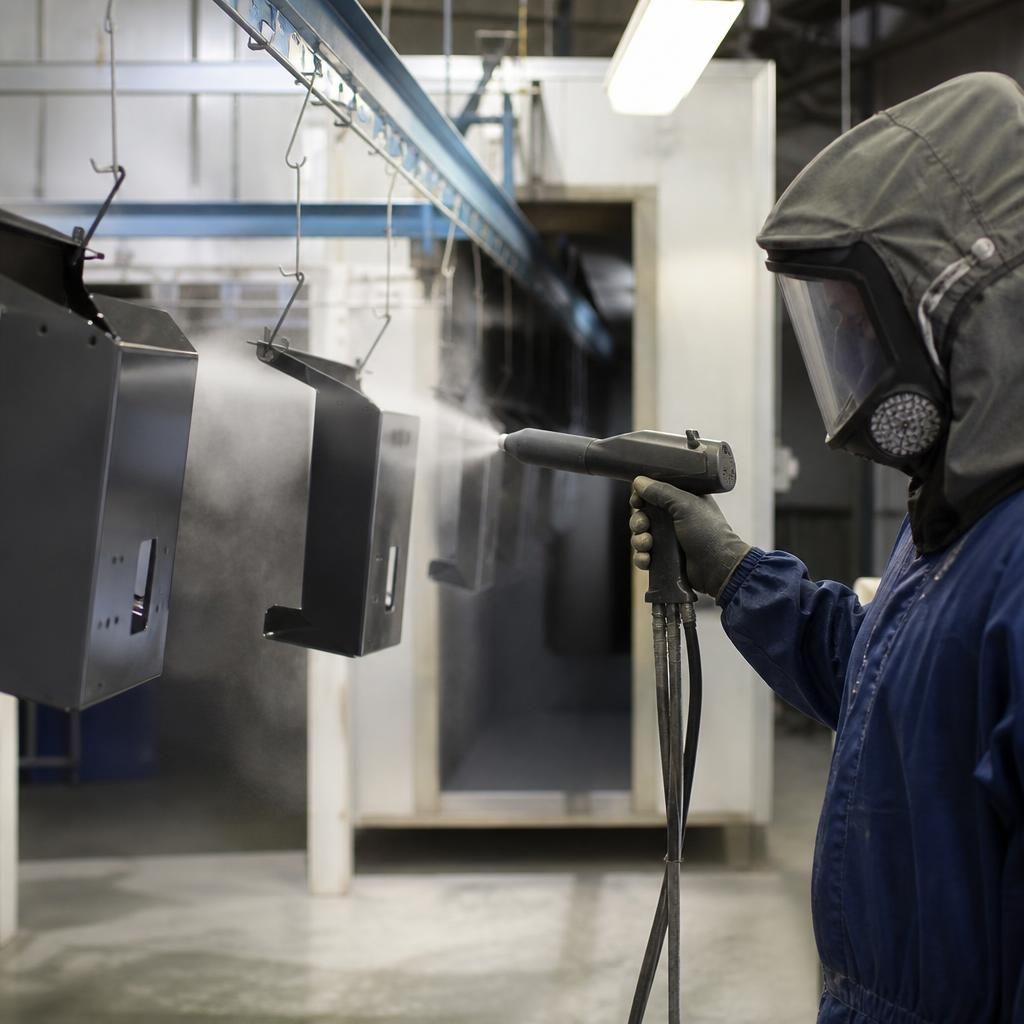
Epoxy powder coating provides a dense barrier that helps limit the movement of moisture, oxygen and contaminants towards the metal surface. This barrier property can support corrosion protection on prepared steel and other suitable substrates, particularly in internal or sheltered applications where the coating is not exposed to prolonged weathering. Its effectiveness depends on continuous coverage, sound pretreatment and protection of vulnerable areas such as edges, joints and drilled holes.
For components where corrosion control is a primary requirement, the coating specification should consider the substrate, preparation method and likely exposure conditions together. Damage, sharp edges or uncoated interfaces can create routes for corrosion beneath the film, so the design and post-coating handling of the component are part of achieving the intended performance.