

What specific protective powder coating options are available for different environmental conditions?
Protective powder coating options are selected according to the main exposure: epoxy coatings suit many indoor, damp and chemically demanding applications, while polyester coatings generally provide better resistance to sunlight and weather for outdoor use. For more severe conditions, a zinc-rich primer with a compatible topcoat, or a duplex powder system, can add corrosion protection where components face moisture, salt, abrasion or industrial contaminants.
Protective powder coating options are selected by the environmental stresses a metal component will experience, including moisture, ultraviolet exposure, chemicals, salt, abrasion, temperature and impact. The most suitable specification is therefore a complete coating system rather than a colour choice alone: substrate preparation, pretreatment, primer, topcoat, film build and curing all affect long-term protection.
For dry indoor environments, a standard decorative powder coating may be sufficient where parts are protected from persistent humidity, chemicals and mechanical wear. This can suit general plant equipment, fabricated frames, housings and components used in controlled areas. If the space has condensation, wash-down activity or occasional chemical contact, a more chemically resistant formulation and a higher level of corrosion preparation should be considered instead of treating it as a dry indoor application.
For damp or condensation-prone areas, the specification should account for water remaining on the surface, trapped moisture in joints and corrosion beginning at cut edges or fixing points. Effective pretreatment is particularly important, while the design should minimise crevices and provide drainage. A compatible primer and topcoat system can offer greater protection than relying on a single decorative layer, provided the products are designed to work together and are applied to a correctly prepared substrate.
For chemical exposure, the chemical itself, its concentration, temperature and contact time all need to be identified. Powder coatings suitable for oils, cleaning agents or mild industrial chemicals may not withstand solvents, acids or alkalis under continuous exposure. Epoxy-based systems are often considered where chemical resistance is a priority, but the exact formulation must be checked against the substances involved. A sample or laboratory compatibility assessment may be appropriate for process equipment exposed to aggressive chemicals.
For outdoor and high-UV locations, colour retention and gloss stability become important as well as corrosion resistance. Super-durable polyester formulations are commonly specified for external metalwork, with the precise grade selected according to the expected weathering conditions. Where appearance must remain stable for a demanding architectural or exposed application, a higher-performance exterior system may be more appropriate than an internal-grade coating. The specification should also consider water run-off, joint design and the risk of damage that could expose the metal beneath.
For coastal or salt-laden environments, the coating system needs to resist both airborne salt and the corrosion that can develop beneath a damaged film. This usually requires rigorous preparation, suitable conversion treatment and a compatible multi-layer system rather than a basic finish. Welds, folded edges, drilled holes and concealed faces deserve particular attention because incomplete coverage in these areas can become the starting point for corrosion. Stainless or galvanised substrates may also require a different preparation route from untreated steel.
For abrasive or high-contact applications, the priority may be resistance to scuffing, impact and repeated friction rather than weathering alone. Nylon powder coatings can be considered for specialist applications where a tough, low-friction or wear-resistant surface is required. They are not automatically the best choice for prolonged outdoor exposure, so the operating environment and expected sunlight should be assessed alongside the mechanical demands. For heavy handling, the component design and packing method are also important because even a robust coating can be damaged by sharp contact.
For high-temperature service, the coating must be matched to the actual operating temperature, including peaks during start-up, shutdown or cleaning. Conventional powder coatings are not interchangeable with high-temperature formulations; excessive heat can cause loss of colour, softening, embrittlement or reduced adhesion. Silicone-modified or other heat-resistant powder technologies may be suitable for some equipment, but the manufacturer’s stated service limits and the substrate’s own thermal expansion must be considered.
For impact-prone components, flexibility and adhesion can be as important as surface hardness. A coating that is extremely hard but brittle may chip when the part is handled or struck. The chosen system should reflect whether the item will be assembled, transported, bolted or exposed to vibration after coating. Rounded edges, adequate edge coverage and controlled curing help reduce weak points.
Environmental selection should be based on the worst credible exposure, not the most common one. A component used indoors may still need outdoor-grade protection if it is stored externally, transported uncovered or installed in a wash-down area. The coating specification should record the substrate, preparation standard, exposure conditions, chemicals, temperature range, required appearance and likely mechanical damage. This gives the coater enough information to select a compatible system and identify where a test panel or sample approval would reduce risk.
For manufacturers, fabricators, construction firms and automotive businesses across the Midlands, collection and delivery can be arranged as part of the powder coating service. Supplying drawings, material details and the intended environment allows the coating requirement to be assessed against the component’s actual use rather than chosen solely by colour or price.
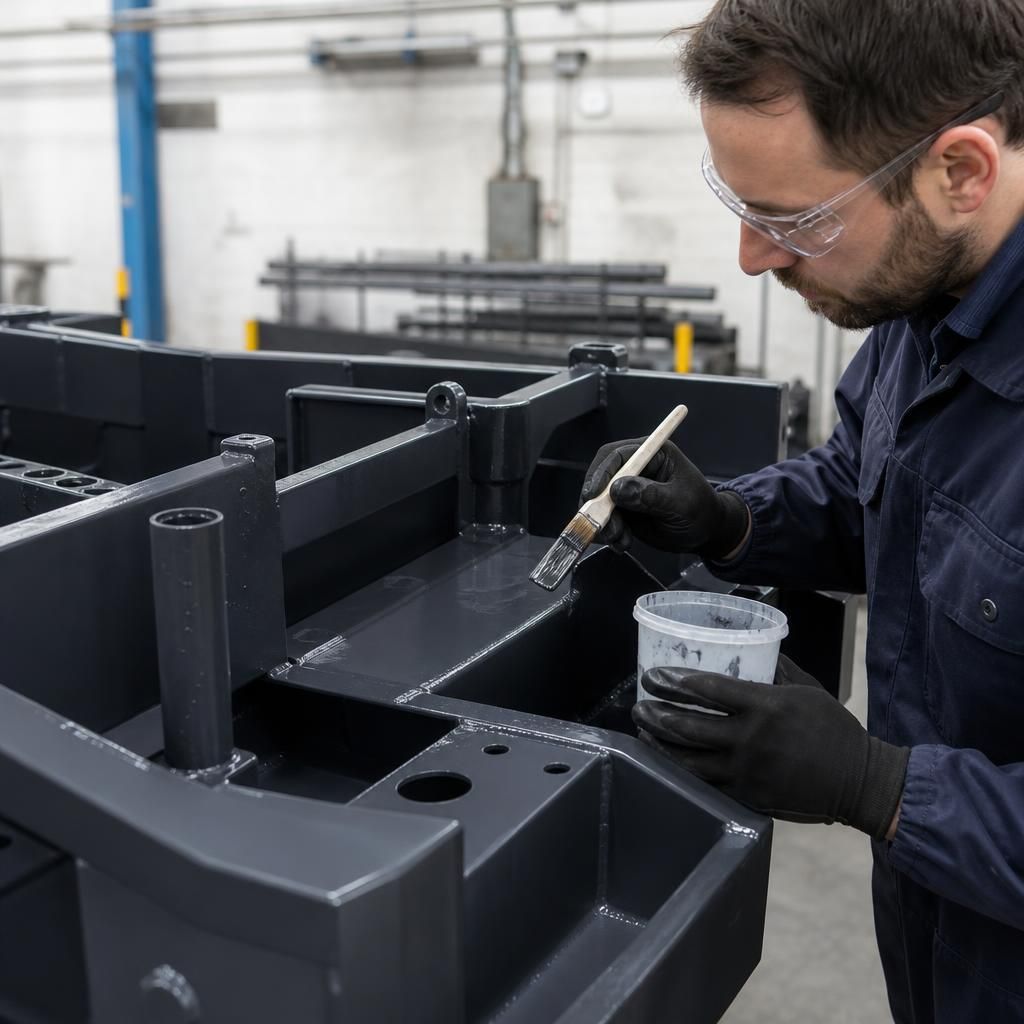
The selected protective powder coating should also be assessed for maintainability after installation. In service, impact, drilling, handling or abrasion can expose the substrate even when the original system was suitable for the environment. A specification should therefore identify how local damage will be inspected, prepared and repaired without creating an incompatible patch.
Site-applied repairs may use a compatible touch-up material rather than powder coating, since the original heat-curing process is not normally practical once the component is installed. The repair method should be checked for adhesion, chemical compatibility, appearance and resistance to the same moisture, salt or industrial contaminants affecting the main coating. This is particularly relevant for fabricated assemblies with fixing points, service access or areas that may need future modification.
For larger projects, agreeing the repair procedure alongside the initial coating specification helps maintain protection throughout the component’s service life. It also prevents an apparently suitable coating option from becoming difficult to manage after installation.