

What are the specific benefits of choosing protective and anti-rust powder coatings over traditional liquid paint options?
Protective and anti-rust powder coatings provide a tougher, more uniform barrier against moisture, corrosion, chipping and abrasion than traditional liquid paint. The dry-powder application and curing process also produces a durable finish with minimal overspray waste and no solvent-based drying stage.
Protective and anti-rust powder coatings can offer a more consistent, durable and efficient finish than traditional liquid paint, particularly for metal components exposed to handling, weather or industrial conditions. Their main advantages are repeatable film formation, strong adhesion when the substrate is correctly prepared, efficient application to production batches and reduced dependence on solvent-based paint handling.
More predictable film formation is a key difference. Powder particles are applied to the prepared metal and then heated so they melt, flow and cure into a continuous coating. This allows the applicator to control the finish through established settings for powder delivery, gun movement, part positioning and oven curing. Liquid paint relies more heavily on viscosity, spray technique, flash-off and solvent evaporation, so variations in application can produce runs, sags, pinholes or uneven build.
For anti-rust work, continuity is particularly important. Any exposed steel, thin area or defect can provide a route for moisture and contaminants to reach the substrate. A correctly specified powder system can form a coherent protective layer over the component, while suitable pre-treatment improves adhesion and helps the coating resist lifting from the metal. The coating itself is not a substitute for preparation: oil, scale, oxides, dirt and existing corrosion must be removed or treated according to the metal type and the required service conditions.
Powder coating can also provide practical production benefits over liquid paint:
- Repeatable batch finishing: once the application and curing parameters have been established, similar parts can be processed using the same controlled sequence.
- Efficient application: powder that does not adhere during spraying may be recoverable in suitable systems, reducing material waste compared with liquid paint that has been mixed, thinned or lost as overspray. Recovery depends on the equipment and powder system used.
- Reduced drying-stage handling: after the coating has completed its cure and the parts have cooled sufficiently, components can proceed to inspection, assembly or packing without waiting for liquid solvents to evaporate.
- Useful film build in a single process: the required protective thickness may be achieved without applying several liquid coats, although the specification and coating system determine the appropriate build.
- Cleaner process control: powder is supplied as a dry material, so there is no need to manage liquid paint thinners or adjust viscosity during spraying.
Another benefit is the range of coating systems available for different exposure conditions. A standard decorative powder may be suitable for indoor components, whereas external, industrial or corrosion-sensitive parts may require a system selected for weathering, chemical contact, humidity or other specific risks. This makes it possible to match the coating to the component’s environment rather than treating every application as a general-purpose paint job.
Powder coatings can be advantageous where parts will be handled during manufacture, transport or installation. A properly cured coating generally withstands routine contact better than a conventional decorative liquid paint film, helping to preserve the protective layer during subsequent operations. The actual result depends on curing, coating thickness, substrate preparation, component design and the severity of service conditions. Sharp edges, recessed areas, welds, joints and crevices require particular attention because they can be more difficult to cover and are common locations for early corrosion.
Liquid paint can still be the more suitable option in some situations. It may be preferable for heat-sensitive materials, very large assemblies that cannot be placed in a curing oven, on-site repairs or work requiring rapid colour changes and small touch-up areas. Powder coating normally requires the component to tolerate the curing cycle, and repairs to damaged powder are often made with a compatible liquid system rather than by reprocessing the whole item. These factors should be assessed before specifying the finish.
For a fair comparison, the choice should therefore consider more than the coating material alone. The required corrosion performance, metal type, component dimensions, curing requirements, operating environment, colour and finish, production volume, repair method and inspection criteria all affect suitability. Powder coating is usually most beneficial when the parts can be properly cleaned and pre-treated, processed through a controlled curing operation and coated with a system selected for the conditions in which they will be used.
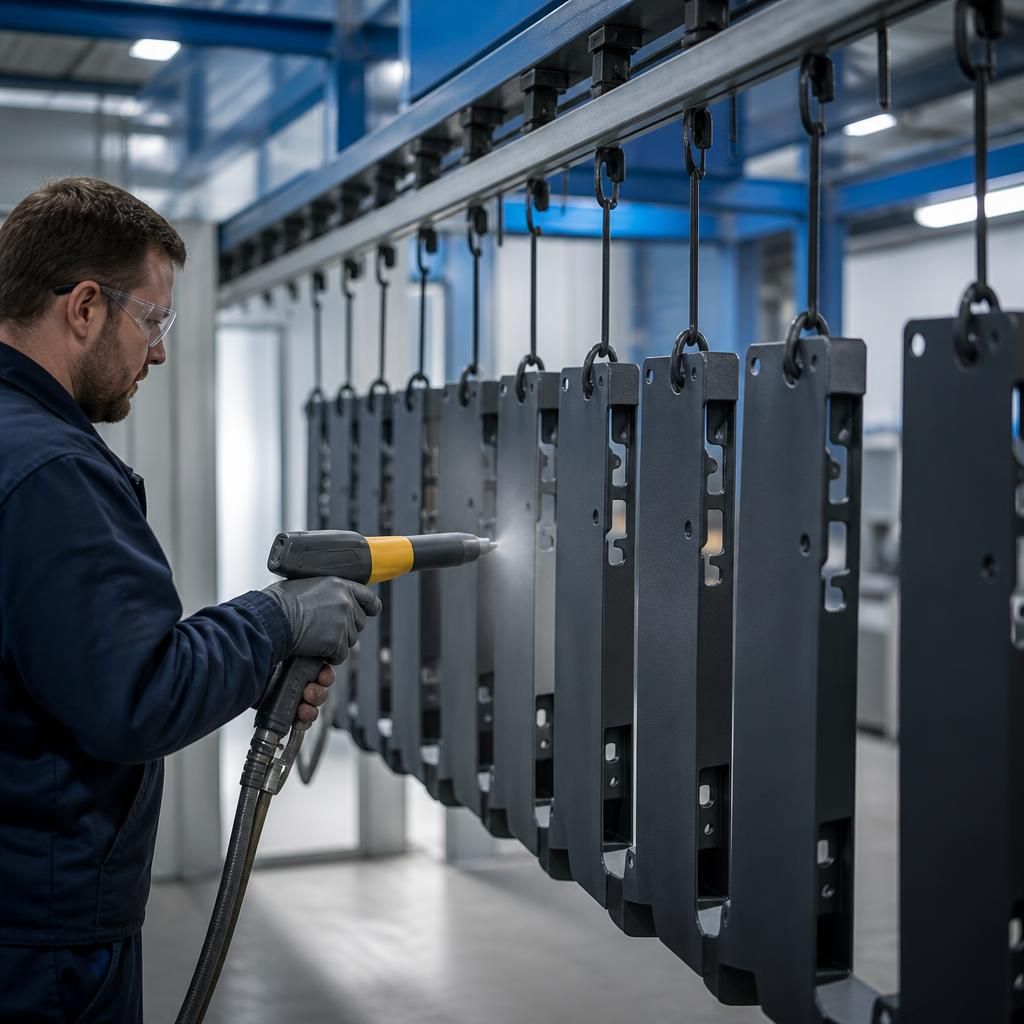
A further benefit of protective powder coating is that the corrosion-control system can be matched to the exposure rather than relying on a single decorative paint layer. For steel components facing demanding conditions, a compatible primer and powder topcoat may be specified together. The primer supports adhesion and corrosion protection, while the topcoat provides the required colour, finish and resistance to weathering or routine contact.
This layered approach is useful where the component will face persistent humidity, outdoor exposure, industrial contamination or contact with corrosive substances. It also helps the coating specification reflect the complete service environment, including the metal substrate, component design and likely routes for moisture ingress. The selected products must be compatible and applied over properly prepared metal, as a high-performance topcoat cannot compensate for contamination, untreated corrosion or inadequate preparation beneath it.
Discuss Your Protective and Anti-Rust Powder Coating Requirements
Discuss your component material, dimensions, service environment and required corrosion performance with the powder-coating.co.uk team to assess whether a protective and anti-rust powder coating is suitable. They can help identify the relevant coating specification and preparation requirements for your parts.