

What are the essential factors to consider when selecting the appropriate abrasive media for blast cleaning?
Select abrasive media by considering the metal substrate, existing coating or contamination, the required surface profile and cleanliness level, and the finish needed for reliable powder coating adhesion. Also assess media hardness and shape, equipment suitability, dust and waste implications, operator safety, and overall process cost before blasting.
The appropriate abrasive media for blast cleaning is selected by matching the blasting action to the part’s geometry, dimensional requirements, coating specification, contamination, production method and post-blasting handling. The correct choice should remove unwanted material without deforming edges, altering critical dimensions or leaving residues that interfere with the subsequent powder-coating process.
Start with the component’s function and specification. A decorative enclosure, structural fabrication, machined component and automotive part may require different treatment even when they are made from similar metals. Review the coating manufacturer’s preparation requirements, the specified surface condition and any engineering drawings before choosing the media. Where the part has sealing faces, threaded holes, bearing seats or close-fitting joints, abrasive selection must take account of the areas that cannot tolerate rounding, peening or dimensional change.
Consider the geometry of the part. Abrasive particles do not reach every feature in the same way. Recesses, narrow channels, folded sections, perforations and internal corners can retain spent media or receive less impact than exposed faces. A media that works well on open plate may be unsuitable for a fabrication with delicate fins or intricate sections. The operator may need to combine the principal abrasive with a different application technique, alter the blasting sequence or protect selected areas before processing.
- Edges and corners: sharp edges can receive more direct impact and may be rounded or excessively eroded if the media and process are too aggressive.
- Thin sections: excessive impact can contribute to distortion, particularly where the component has low stiffness or a large unsupported surface.
- Holes and cavities: the media must be capable of being removed fully, since trapped particles can affect assembly or contaminate later stages.
- Welded fabrications: weld spatter, heat-affected areas and changes in surface texture may require consistent coverage without overworking the surrounding parent metal.
Check dimensional and cosmetic tolerances. Media selection is not only about how quickly a coating or corrosion layer is removed. It also determines how much mechanical action the surface receives. If a component has a specified roughness, edge condition, flatness or appearance, record those requirements before processing and use them when comparing media. Parts that are later machined, assembled or visually inspected need a different risk assessment from robust items where a more forceful treatment is acceptable.
Assess the material being removed. Old powder coating, liquid paint, mill scale, rust, weld residue, grease and mixed layers do not respond identically to abrasion. A hard, tightly bonded layer may require a different approach from a friable coating or loose corrosion. If several contaminants are present, selecting media solely on the basis of the most obvious layer can result in uneven removal or unnecessary treatment of the underlying metal. Identify whether the goal is complete removal, preparation of sound existing material or treatment of a localised defect.
Examine the media’s cleanliness and contamination risk. Abrasive that has previously been used on incompatible materials or contaminated with oil, salts, paint residues or other debris can transfer unwanted material to the component. This is particularly important where the blasted surface will be powder coated without an extended delay. Establish how new or reclaimed media is controlled, how contamination is identified and whether separate media streams are needed for different types of work.
Match the media to the intended coating system. Powder coating performance depends on more than visible removal of the old surface. The blasted component must be suitable for the pretreatment and coating stages that follow. Ask whether the selected abrasive can leave a consistent base for the specified powder system and whether it creates any residue or surface condition that would require additional preparation. The media should support a repeatable process rather than produce an acceptable result on one part and a substantially different result on the next.
Take account of production and quality control. For batch work, consistency between loads is often more important than the fastest result on an individual item. The selection should allow the operator to maintain a repeatable process as the abrasive is consumed or reclaimed. Useful controls include documenting the media type, monitoring its condition, checking representative parts and recording any changes to the blasting process. Test pieces or sample components can reveal problems with edge treatment, inaccessible areas and subsequent coating appearance before a full batch is processed.
Review reclaim and segregation arrangements. Where abrasive is recovered for reuse, its performance can change as particles fracture, become rounded or collect removed coating. The recovery system must therefore be suitable for the chosen media and the material being removed. If different abrasives or substrates are processed through shared equipment, consider whether cross-contamination could affect later work. Segregating media by application can be important when components have demanding finish or contamination requirements.
Consider operator and site controls as part of selection. The abrasive should be compatible with the available enclosure, extraction, recovery and personal protective equipment arrangements. The relevant question is not simply whether a media can clean the part, but whether it can be used in a controlled manner that protects people, nearby equipment and the prepared surface. Safety data, handling requirements and disposal arrangements should be reviewed before introducing an unfamiliar abrasive.
A practical selection process is to:
- Define the component material, geometry, tolerances and areas requiring protection.
- Identify every layer or contaminant that must be removed and distinguish sound material from defective material.
- Confirm the required post-blast condition with the coating and engineering specification.
- Compare suitable media against the risk of distortion, edge change, residue and trapped particles.
- Check compatibility with the blasting plant, recovery arrangements and segregation controls.
- Run a controlled trial on a representative part or test panel, then inspect both the prepared surface and the resulting powder-coated finish.
- Document the selected media and process settings so that repeat batches can be assessed against the same requirements.
When the component has complex geometry, tight tolerances or several layers of contamination, a trial is usually more informative than selecting media by name alone. The best abrasive is the one that achieves the specified preparation consistently while preserving the component’s function, allowing reliable downstream coating and avoiding avoidable rework.
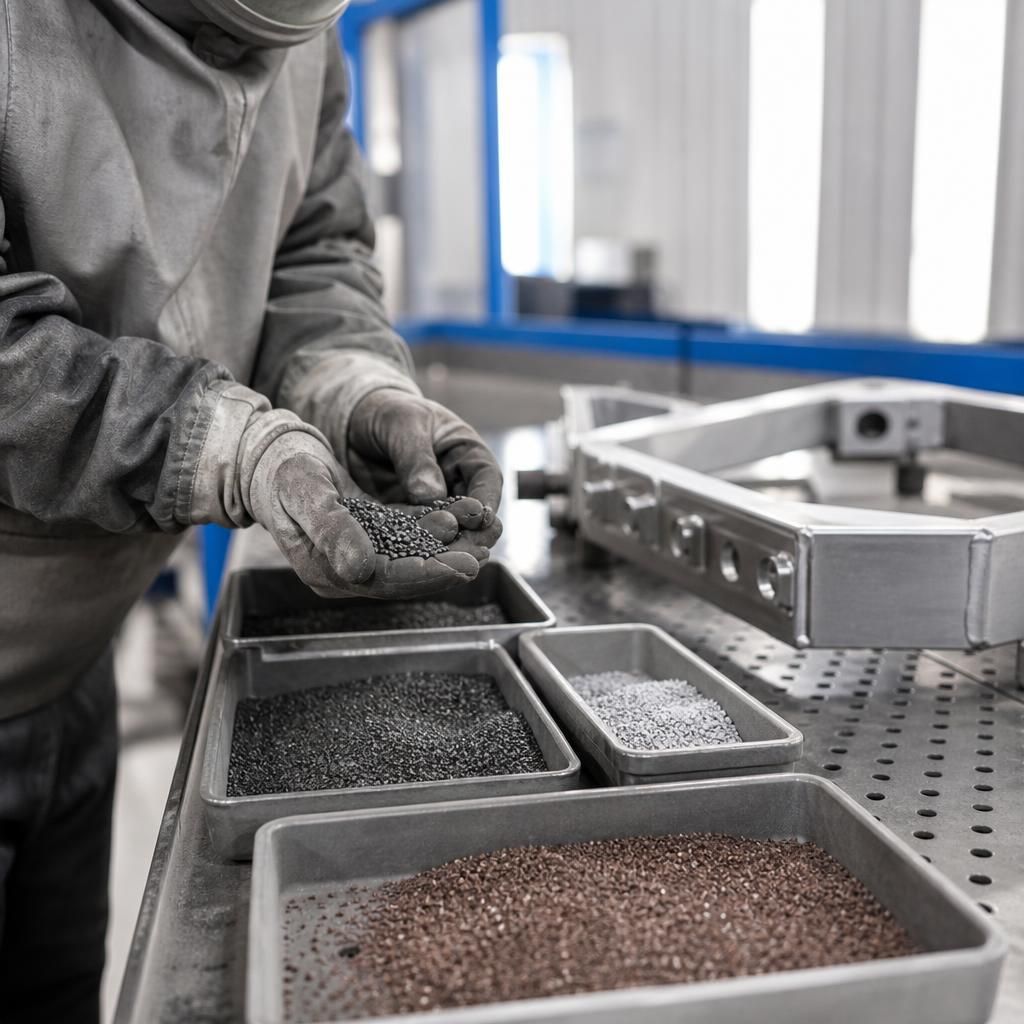
Particle size and shape are key factors because they control how abrasive energy is transferred to the metal. Angular particles tend to cut into a surface and create a more pronounced mechanical key, while rounded particles deliver a more peening action and may be preferable where cutting must be limited. Finer media can reach smaller features and provide a less aggressive treatment; coarser media generally delivers greater impact but can alter edges or delicate sections if the process is not controlled.
Hardness and friability should also be considered. A very hard abrasive may remain effective for longer but can be unnecessarily aggressive for thin sections or softer substrates. A friable abrasive breaks down during use, changing its particle size and performance as the batch progresses. This can affect cleaning consistency, surface texture and dust generation. The chosen media should therefore be assessed not only when new, but throughout its usable life, with spent or degraded abrasive removed according to the site’s control procedures.
Compare particle characteristics with the specified preparation standard and the part’s most sensitive features. A controlled trial can show whether the media achieves adequate removal and a suitable surface condition without excessive impact, particularly around edges, recesses and finished faces.
Discuss the right abrasive media for your blast-cleaning requirements
Discuss your component material, dimensions, existing coatings and required finish with the Powder-coatings.co.uk team to identify a suitable blast-cleaning approach. Providing these details can help establish whether a trial or further preparation assessment is appropriate for your parts.