

What types of powder coatings are most suitable for enhancing both the durability and appearance of metal components in industrial applications?
For industrial metal components, polyester powder coatings are generally the most suitable for attractive, durable exterior finishes, while epoxy and epoxy-polyester hybrid powders are better suited to interior components or applications prioritising adhesion and chemical resistance. Where a higher-quality decorative appearance is required alongside durability, the choice should also consider the component’s exposure, substrate, operating conditions, colour and required texture or gloss.
The most suitable powder coating depends on the component’s exposure, required service life, appearance and performance demands. Polyester powders are usually the strongest all-round choice where metal parts need an attractive finish with good resistance to sunlight and weather. Epoxy, epoxy-polyester hybrid, polyurethane, acrylic, nylon and specialist multi-layer systems become more suitable when the component has particular requirements such as chemical resistance, wear protection, low friction or enhanced corrosion control.
Polyester powder coatings for exterior components
Polyester is widely selected for outdoor metalwork because it provides good colour and gloss retention under ultraviolet exposure. It is suitable for items such as fabricated enclosures, external equipment, architectural metalwork, vehicle components and construction-related parts. Polyester powders are available in smooth, textured, matt, satin and gloss finishes, allowing the appearance to be matched to the component’s design and intended environment.
There are different polyester formulations. Exterior-grade powders are developed for weathering resistance, while standard grades may be intended for less demanding conditions. The specification should therefore identify the expected exposure rather than simply stating “polyester”. Colour choice also matters: some bright, dark or highly saturated colours can show fading or visual change more readily than others in intense sunlight.
Epoxy powders for adhesion and chemical resistance
Epoxy powder provides strong adhesion and good resistance to many chemicals, oils and solvents. It is commonly considered for internal components, machinery parts, brackets, pipework and items protected from direct sunlight. Its hard film can provide a durable functional surface, but prolonged ultraviolet exposure may lead to chalking or loss of appearance. For that reason, epoxy is generally not the first choice for an exposed decorative finish unless its weathering limitations are acceptable or it is covered by a suitable topcoat.
Epoxy-polyester hybrid coatings
Hybrid powders combine characteristics of epoxy and polyester. They can provide good flow, adhesion and mechanical performance, making them useful for indoor metal furniture, electrical housings, shelving, racking and general industrial components. Hybrids can produce a consistent decorative finish, but they are normally selected for internal or sheltered use because their outdoor colour and gloss retention is more limited than that of an appropriate exterior polyester.
Polyurethane and acrylic powders for refined finishes
Polyurethane powders can be considered where a smooth, attractive finish is required alongside good weathering and abrasion performance. They are useful for applications where surface appearance is important and where the coating must tolerate regular handling or environmental exposure. Acrylic powders are also used in specialist decorative applications where a very smooth finish, clarity or particular visual effect is required. These systems need careful control of application and curing because surface defects can be especially visible on high-gloss finishes.
Nylon and other thermoplastic coatings for protection
Nylon powder coatings are selected for performance rather than purely decorative value. They can offer useful resistance to impact, abrasion, moisture and certain chemicals, with a relatively smooth or slightly functional surface depending on the formulation. Typical considerations include components exposed to repeated contact, sliding, scraping or demanding handling. Nylon is not automatically suitable for every metal substrate or operating temperature, so the coating’s chemical compatibility, service temperature and required film thickness should be checked before specification.
Other thermoplastic powders, including polyethylene or polypropylene-based systems, may be used where thicker protection, flexibility, insulation or resistance to aggressive environments is needed. These coatings can behave differently from conventional thermosetting powders: they may require a different application method, produce a heavier film and have a more limited range of decorative effects.
Primers and multi-coat systems for corrosion control
Where steel components face moisture, salt, condensation or difficult service conditions, a single decorative topcoat may not provide the most appropriate system. A compatible primer followed by a polyester or other topcoat can improve corrosion protection, particularly at edges, joints and areas vulnerable to coating damage. Zinc-rich and other protective primer technologies may be considered where the substrate and exposure justify them, but compatibility between layers is essential.
A multi-layer system should be specified as a complete coating scheme rather than as two unrelated products. The substrate preparation, primer type, topcoat chemistry, film thickness, curing schedule and required testing all influence the result. Applying an unsuitable topcoat over a primer can cause poor adhesion, surface defects or premature failure.
How to select the right coating type
- Outdoor exposure: choose an exterior-rated polyester, polyurethane or specialist system with appropriate resistance to ultraviolet light and weathering.
- Indoor chemical exposure: consider epoxy or a suitable hybrid after checking the specific chemicals, concentration and contact conditions.
- Wear, impact or sliding contact: investigate nylon, thermoplastic or reinforced systems rather than relying on a decorative powder alone.
- High decorative requirements: define the required gloss, texture, colour stability, smoothness and acceptable visual variation before coating.
- Severe corrosion risk: consider a tested primer-and-topcoat system and give particular attention to welds, recesses, edges and drainage.
- Heat or process constraints: confirm the component can tolerate the required curing temperature and that assembled parts will not be damaged during processing.
The coating type is only one part of the specification. Cleaning and pretreatment determine how well the powder bonds to the metal, while correct application and oven curing determine whether the coating develops its intended properties. The component’s material, geometry, masking requirements and areas of handling should therefore be reviewed alongside the chosen powder. For industrial batches, a clear coating specification should record the powder chemistry, colour, texture, gloss level, film-build range, pretreatment and inspection requirements so that appearance and performance remain consistent from one production run to the next.
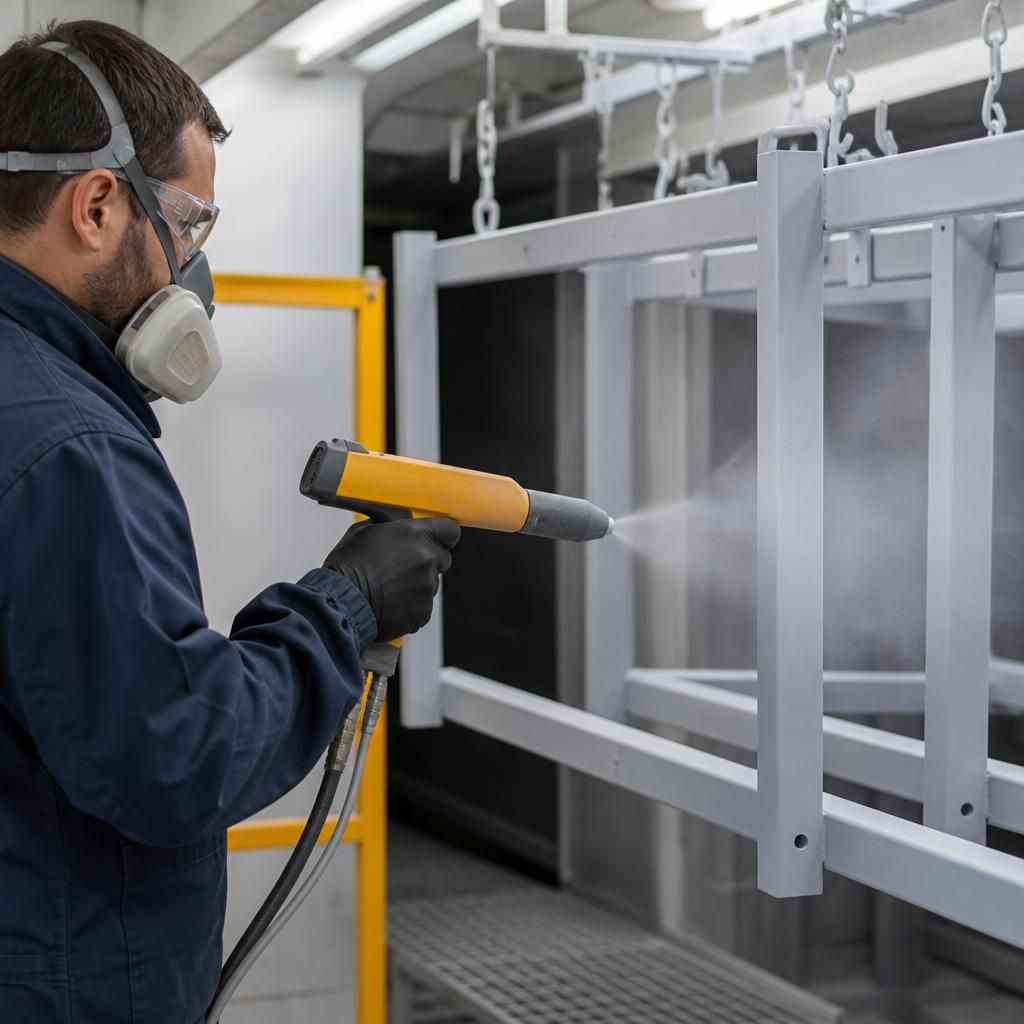
A suitable powder coating must be compatible with the base metal as well as the component’s working environment. Steel, aluminium, galvanised and cast components can respond differently during preparation and curing, affecting adhesion, surface appearance and the risk of defects. The coating system should therefore be selected alongside the substrate specification, particularly for mixed-metal assemblies or previously coated parts.
Visible surfaces and functional areas may also require different treatment. For example, contact surfaces, threaded sections and close-fitting interfaces may need masking or a separate coating specification so that the finished component retains both its appearance and its required fit.
Discuss the Right Powder Coating for Your Metal Components
Discuss your component’s substrate, operating environment and required finish with the powder-coating.co.uk team to help identify a suitable coating specification. Collection and delivery options are available for businesses across the Midlands and surrounding areas.