

What initial settings should I use on my powder coating gun feed setup for aluminium applications?
Begin with the powder gun’s recommended baseline settings, using a low-to-moderate powder feed and conveying air level so the aluminium receives an even, controlled cloud rather than heavy deposition. Test on a prepared sample, then adjust powder flow, air pressure and electrostatic output in small steps to achieve consistent coverage without back-ionisation, poor transfer or excessive overspray.
For aluminium applications, start with the powder gun manufacturer’s standard aluminium or general-purpose preset, then reduce the powder feed and conveying air to produce a stable, lightly concentrated cloud. Set the electrostatic output conservatively, confirm that the aluminium component is properly earthed, and make a test pass before coating production parts. The correct starting point depends on the gun, powder formulation, nozzle and component geometry, so the equipment manual and powder technical data sheet should take priority over generic settings.
Use these settings as a starting framework:
- Powder feed: Begin at a low-to-moderate feed level rather than opening the powder delivery fully. Aluminium surfaces can show uneven deposition if too much powder reaches the part before the electrostatic field has established a controlled layer.
- Conveying air: Use only enough air to carry powder smoothly through the hose. Excessive conveying air can make the cloud turbulent, increase overspray and reduce transfer efficiency. Powder should leave the nozzle evenly, without pulsing or surging.
- Atomising or pattern air: Keep this low initially and increase it only if the spray pattern is too narrow or concentrated. Too much pattern air can dilute the powder cloud and disturb powder already deposited on the aluminium.
- Electrostatic output: Start with the gun’s conservative setting for conductive metal and increase it gradually if transfer is weak. Excessive voltage or current can contribute to back-ionisation, uneven film formation and difficulty coating recessed areas.
- Spray pattern: Select a nozzle that gives a controlled, even pattern for the part size. A broad pattern may suit larger flat sections, while a more focused pattern can give better control around profiles, apertures and edges.
Before adjusting the gun, check the aluminium itself. The part should be clean, dry and suitably pre-treated for the powder system. Oils, machining residue, oxide contamination and moisture can affect adhesion and make a feed problem appear to be a gun-setting problem. Masking should also be secure, particularly around earth points, threaded holes and areas that must remain free of coating.
Grounding is especially important with aluminium because the component must accept and dissipate the electrostatic charge. Attach the earth connection to clean, exposed metal rather than relying on a coated rack, dirty hook or contaminated contact point. Check the contact between the hanger and the component, and ensure that the rack itself provides a sound path to earth. Poor grounding can cause weak transfer, inconsistent coverage and powder build-up in unwanted areas even when the feed settings appear correct.
Use a prepared test panel or representative aluminium component to establish the initial profile. Apply the powder with steady gun movement and a consistent gun-to-part distance, covering broad faces before spending additional time on edges, recesses and complex profiles. Inspect the uncured film for light areas, heavy accumulation, powder cloud instability and signs of back-ionisation. After curing according to the powder supplier’s instructions, assess coverage, appearance and adhesion rather than judging the finish by uncured powder alone.
Make one adjustment at a time. If the film is too light but the spray cloud is stable, increase powder feed slightly before changing the electrical output. If the powder is difficult to carry or pulses at the nozzle, check the hose, pump, powder condition and air balance before increasing feed. If powder accumulates heavily on edges or appears to reject from the surface, reduce the electrostatic setting and review grounding, gun distance and application technique. Recording the settings used on the test piece makes the final profile easier to reproduce across a batch.
Aluminium components often need different treatment from simple flat steel panels because their shape can include thin sections, sharp edges, deep recesses and enclosed profiles. Use a lower, more controlled output around Faraday areas and avoid directing the gun directly into a recess. A short, angled pass can allow powder to enter the area more effectively than forcing a dense cloud into it. Edges may attract more powder, so keep the gun moving and use overlapping passes rather than dwelling at corners.
Also verify the condition of the powder before fine-tuning the gun. Powder that has absorbed moisture, compacted in storage or become contaminated can flow irregularly and produce symptoms that resemble incorrect air settings. Keep the powder fluid, check that the feed system is clean and confirm that the hose and nozzle are free from restrictions. A stable powder cloud, reliable earth path and consistent gun movement should be established before making detailed changes to voltage, current or air volume.
There is no single numerical setting that suits every aluminium application. The final profile should be based on the powder formulation, required film build, component geometry, booth recovery arrangements and curing specification. For repeat work, document the selected feed, air and electrostatic settings alongside the powder batch and component type, then use the same preparation, grounding and spray technique for subsequent parts.
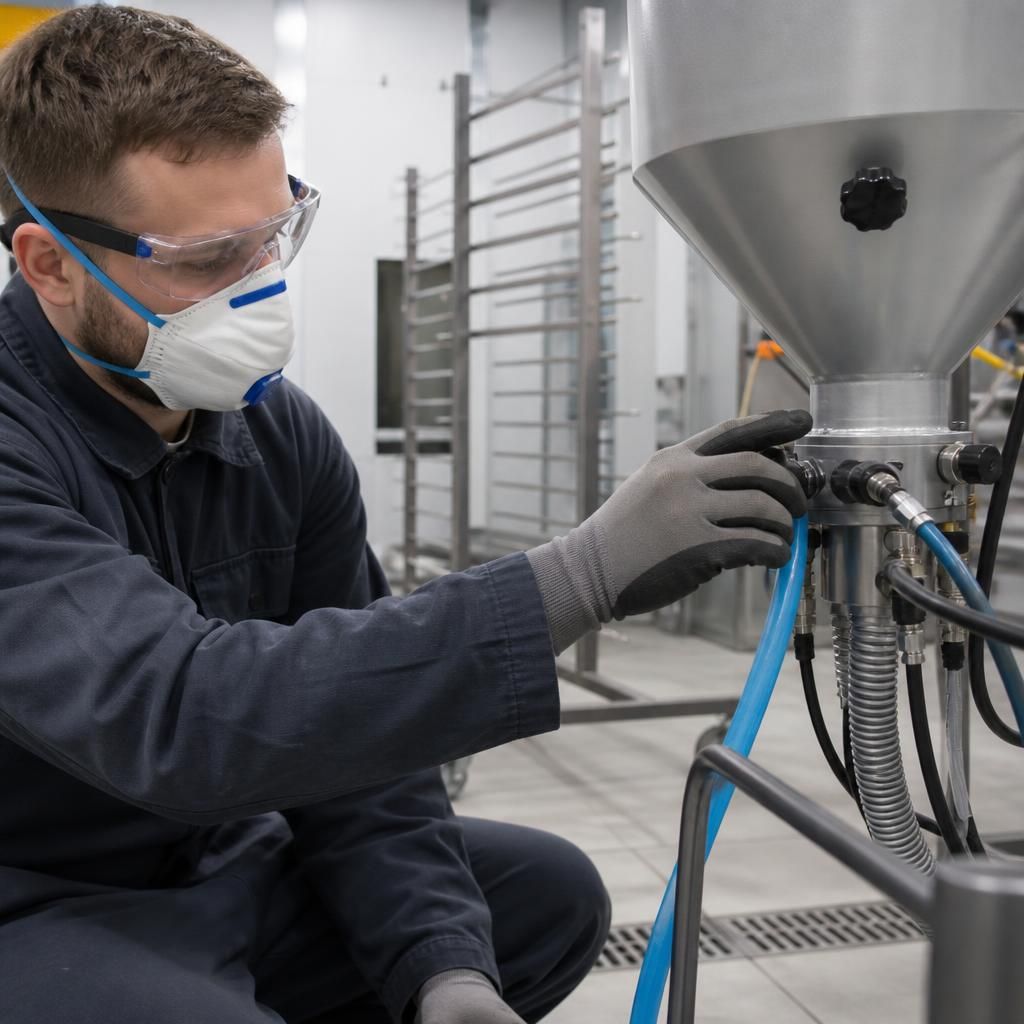
Set the powder hopper’s fluidising air before fine-tuning the gun. Use only enough air to keep the powder loose and able to move consistently towards the pickup tube; excessive fluidisation can make the powder behave like a boiling liquid, causing surging at the pump and an unstable spray cloud. If the powder does not move freely, increase the setting in small increments rather than compensating by opening the powder feed fully. Once the feed is steady, leave the fluidising air unchanged while adjusting the gun’s conveying air or electrostatic output.