

What role does pre-treatment play in the powder coating manufacturing process?
Pre-treatment prepares metal surfaces for powder coating by removing contaminants and creating a suitable surface for the powder to bond to. It improves adhesion, helps protect against corrosion and supports a more consistent, durable finish after curing.
Pre-treatment is the controlled preparation stage carried out between manufacture of the metal component and application of powder. Its role is to establish a clean, chemically suitable and dimensionally stable surface so that the subsequent coating stages can be carried out consistently. In a manufacturing process, it is not a single cleaning operation but a sequence selected according to the metal, the condition of the part, the intended service environment and the powder system.
The main stages of pre-treatment
A typical process can include several of the following stages:
- Initial inspection: The component is checked for oil, grease, weld residues, mill scale, rust, oxides, swarf, marking fluids and other substances that could interfere with preparation.
- Cleaning and degreasing: Alkaline, acidic or solvent-based methods may be used to remove manufacturing residues. The choice depends on the substrate and the type of contamination present.
- Rinsing: Rinsing removes loosened contamination and residual treatment chemicals. Poor rinsing can leave deposits that affect the surface during later stages.
- Surface conversion: A conversion treatment can modify the outer surface of the metal and provide a more suitable base for the powder film. Different chemistries are used for steel, galvanised steel and aluminium.
- Final rinsing and drying: The component must be free from treatment residues and fully dry before powder is applied. Moisture trapped in seams, cavities or folded sections can cause defects during heating.
The sequence is adjusted rather than applied identically to every component. Bare mild steel may require removal of oil and oxidation, whereas galvanised material can need a process designed to avoid attacking the zinc layer. Aluminium has its own oxide behaviour and may require a different preparation chemistry. Previously coated or heavily contaminated parts may also need mechanical preparation, stripping or additional inspection before they enter the normal line.
Why control of the process matters
Pre-treatment links the condition of the incoming component to the performance of the finished product. If cleaning is incomplete, residues can remain beneath the powder film. If a conversion stage is uneven, the surface may respond differently from one area to another. If rinsing or drying is inadequate, trapped chemicals or moisture can become visible only after the component has been heated and cured.
These problems can present as pinholes, craters, blistering, loss of gloss, staining, uneven colour or localised coating breakdown. They may also be mistaken for faults in the powder or curing cycle. For this reason, investigating a coating defect should include the pre-treatment stages, not just the spray equipment and oven settings.
Factors that determine the correct treatment
- The base metal and its surface condition.
- The amount and type of oil, grease, scale or oxidation present.
- The geometry of the component, including joints, recesses, hollow sections and drainage points.
- The required appearance and the conditions in which the part will be used.
- The powder chemistry and the curing schedule specified for the coating system.
- Whether the component has been previously treated, stored outdoors or exposed to handling contamination.
Component design also affects the result. Crevices that retain liquid, inaccessible internal faces and poor drainage can make it difficult to rinse and dry the part thoroughly. Fabricators can support the process by providing suitable drainage and ventilation holes where appropriate, avoiding unnecessary pockets and identifying areas that must remain uncoated. Weld spatter, sharp edges and heavy burrs should be addressed before treatment because pre-treatment is not a substitute for sound fabrication.
Monitoring and verification
Reliable pre-treatment depends on controlling variables such as bath concentration, temperature, contact time, rinse quality and drying conditions. Operators may use chemical checks, visual inspection, water-break testing or other process controls to identify contamination and uneven wetting. The prepared components should also be handled in a way that prevents fingerprints, oil from equipment or workshop dust from being reintroduced before powder application.
For batch production, documented control of these stages helps maintain the same preparation standard between loads and makes it easier to trace the source of a defect. For one-off or specialist components, the treatment may need to be reviewed individually, particularly where different metals, castings, weldments or unusual surface residues are involved.
In practical terms, pre-treatment determines whether the rest of the powder coating process starts with a controlled surface or an unknown one. Correct preparation cannot compensate for unsuitable powder selection or incorrect curing, but it gives application and curing a stable foundation. It should therefore be specified as part of the complete manufacturing process, rather than treated as a minor step immediately before spraying.
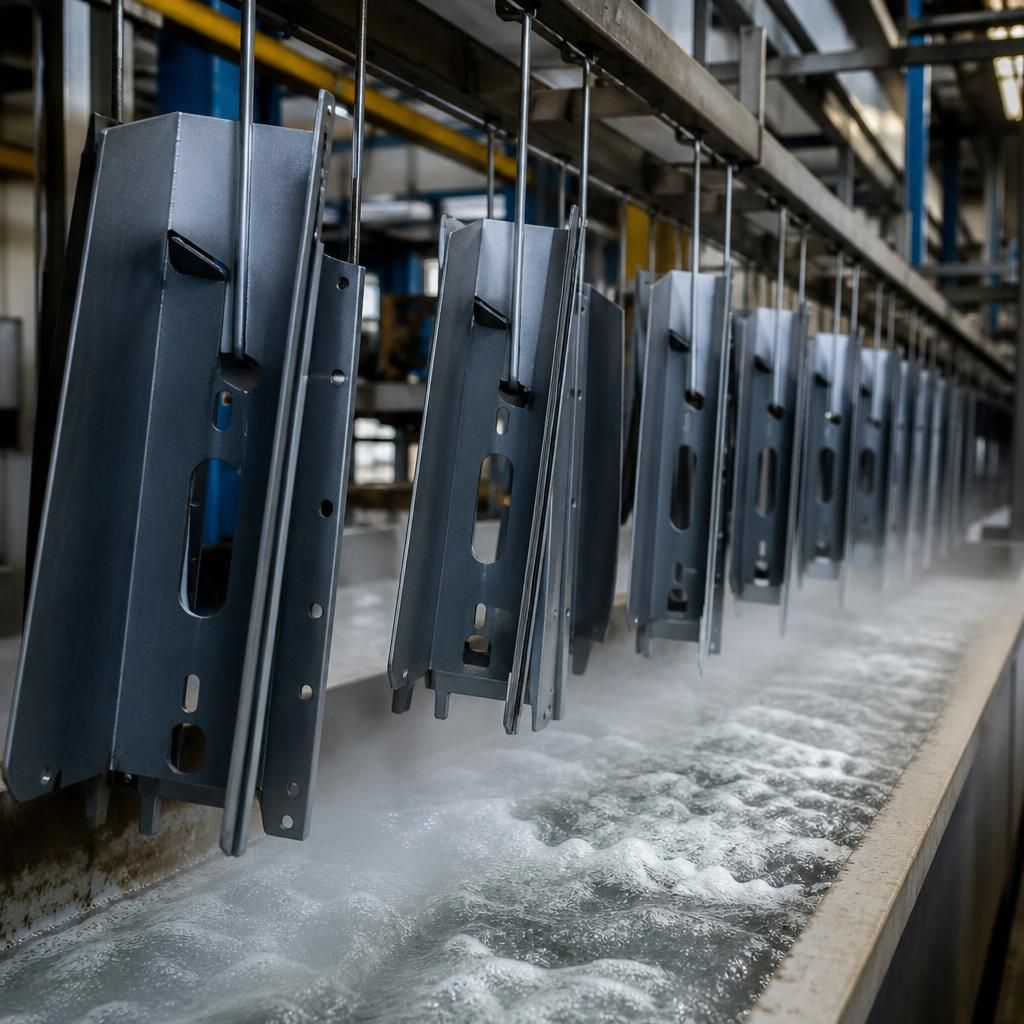
Pre-treatment contributes to corrosion protection by improving the interface between the metal and the powder film. Cleaning removes substances that could create weak points, while a suitable conversion treatment can provide a more receptive surface beneath the coating. This helps limit the paths through which moisture and contaminants may reach the substrate if the finish is scratched or locally damaged.
The treatment must match the metal and the intended service conditions. A process suitable for mild steel may not be appropriate for aluminium or galvanised steel, and an unsuitable chemical system can damage the substrate rather than protect it. Pre-treatment should therefore be specified alongside the powder system, component design and expected exposure, rather than selected as a separate, standard operation.