

What common challenges might users face when incorporating mini powder coating machines into their production lines?
Common challenges include integrating the machine with existing workflow, maintaining consistent coating thickness and finish, and matching its capacity to production demand. Operators may also need to manage powder changes, curing requirements, equipment cleaning and suitable extraction without disrupting other production processes.
Incorporating a mini powder coating machine into a production line can create challenges around part preparation, grounding, component handling, process control, operator training and quality assurance. The machine may coat small or specialist components effectively, but it still needs to work within the requirements of the wider manufacturing process rather than being treated as an isolated item of equipment.
Preparing parts consistently
Powder coating performance depends heavily on the condition of the metal before it reaches the machine. Oil, grease, rust, mill scale, moisture and residues from fabrication can prevent the powder from adhering correctly. A mini machine may expose these preparation problems more clearly because small components can have a high surface-area-to-weight ratio and may include several edges, recesses or drilled features.
Production planning should therefore define how parts are degreased, treated, dried and protected between preparation and coating. If components arrive from different fabrication processes, their surface condition may vary, making it difficult to identify whether a defect came from the coating equipment or from upstream work.
Achieving reliable grounding and electrical continuity
Electrostatic powder coating relies on a suitable electrical relationship between the charged powder and the earthed workpiece. Poor contact through hooks, racks, masking points or painted surfaces can reduce transfer efficiency and leave thin areas, particularly on corners and internal sections. Contamination on hanging equipment can also increase electrical resistance over time.
This means that racking and hanging arrangements need to be designed as part of the production process. Parts must be supported securely without creating excessive uncoated contact marks, while contact points need to remain accessible for inspection and cleaning. A small machine does not remove the need for proper earthing checks.
Coating complex shapes and recessed areas
Mini powder coating machines may be used for brackets, fittings, frames, panels and other components with awkward geometry. Electrostatic charge can cause the powder to concentrate on exposed edges while making it harder to reach deep recesses, narrow cavities or areas behind a return flange. This is commonly known as the Faraday cage effect.
Operators may need to adjust gun distance, angle, voltage and application technique for different component shapes. Masking may also be necessary to protect threads, bearing seats, electrical contact points and close-tolerance surfaces. These additional steps can become a production constraint if the parts were not designed with coating access in mind.
Providing suitable utilities and workspace
A machine needs an appropriate installation area, electrical supply, compressed air where required, and sufficient clearance for loading, unloading and inspection. The surrounding layout must also allow operators to move coated and uncoated parts without crossing paths or damaging the finish.
Limited floor space can encourage businesses to place the equipment too close to other operations. This may restrict access for servicing, make it harder to position racks safely or expose finished components to dust and impact. Utility requirements should be checked before installation, including the capacity of the electrical circuit and the quality of compressed air used by the equipment.
Connecting the machine to production controls
A mini machine may operate independently while the rest of the factory uses production schedules, work orders or digital traceability systems. This can create gaps in records if coating settings, operator details, batch identification and inspection results are recorded manually or inconsistently.
Clear process documentation helps address this problem. Each job should identify the component, coating specification, preparation method, application settings, curing requirement and inspection criteria. Where the equipment cannot exchange data directly with existing systems, a controlled paper or electronic record may be needed to preserve traceability.
Managing operator skill and repeatability
Although a mini machine may have a smaller footprint than a full-scale coating line, good results still depend on operator technique. Variations in gun movement, overlap, distance, charging settings and part positioning can produce differences between operators or between separate production runs.
Training should cover equipment controls, grounding checks, powder handling, masking, defect recognition and the limits of the particular coating process. Work instructions should use defined settings and visual examples rather than relying solely on individual experience. This is especially important when several people share the equipment or when coated parts have different acceptance standards.
Maintaining inspection and quality control
Small components can be difficult to inspect quickly, particularly when they contain internal faces or multiple critical dimensions. A visually acceptable coating may still be unsuitable if it interferes with assembly, covers a threaded hole or fails to meet the specified thickness and adhesion requirements.
Inspection plans should identify the characteristics that matter for each component. Depending on the specification, checks may include appearance, coverage, adhesion, thickness, cure and dimensional fit. Samples should be taken from representative locations rather than only from the easiest surface to reach. Any recurring defect should be traced through preparation, application, curing and handling instead of being attributed to the machine without evidence.
Controlling contamination and powder recovery
Powder residue can contaminate racks, work areas and components if it is not controlled. This becomes more complicated where different finishes or materials are processed through the same equipment. Even a small amount of unwanted powder can affect the colour, texture or appearance of a subsequent job.
Businesses should establish defined cleaning points, dedicated or clearly controlled accessories where appropriate, and procedures for storing, labelling and disposing of powder. Reclaiming powder is not automatically suitable for every specification, so its use should follow the coating supplier’s technical requirements and the customer’s quality standard.
Allowing for maintenance and service access
Fitting a machine into a compact area can make routine access difficult. Filters, hoses, electrical connections, spray equipment, racks and other wear items still require inspection even when the equipment has a modest capacity. If access is restricted, basic checks may be postponed and minor faults can interfere with production.
The layout should leave enough room for safe inspection and component replacement. Maintenance records should identify recurring faults, changes in transfer performance and deterioration in contact points. Keeping suitable replacement consumables available can also reduce the effect of avoidable stoppages, although maintenance planning should remain consistent with the equipment manufacturer’s instructions.
Planning for future production changes
A mini machine may be appropriate for a defined range of components but become restrictive if product sizes, coating specifications or order volumes change. Before installation, businesses should consider the largest and smallest parts, the type of racking required, the number of finishes processed and whether future products will need automated handling or additional inspection.
The most effective approach is to define the machine’s role clearly: for example, specialist components, short runs, development work or parts that cannot be processed efficiently on a larger line. That scope allows the surrounding production process, quality checks and material handling arrangements to be designed around realistic operating conditions rather than assuming that one compact machine will suit every coating requirement.
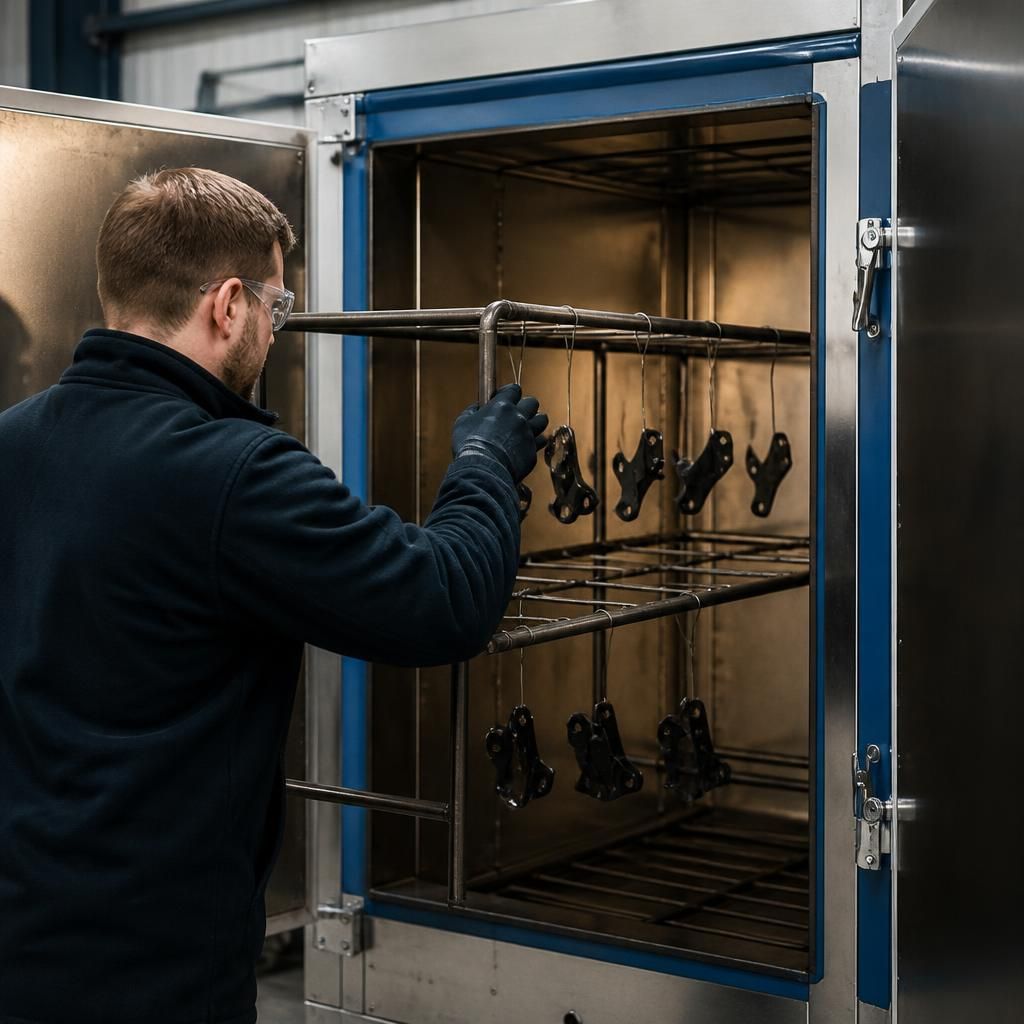
Integrating the curing stage is a common challenge when adding a mini powder coating machine to an existing production line. Powder must reach the specified cure schedule across the whole component, so application cannot be assessed separately from oven capacity, temperature control and part loading.
Parts with different thicknesses, materials or thermal masses may heat at different rates. If the oven is unsuitable or loaded inconsistently, the coating can be under-cured, over-cured or unevenly finished. The process should therefore define the approved cure requirement for each coating, identify how parts are positioned in the oven and include checks to confirm that the required conditions are achieved without creating a bottleneck for the rest of the line.
Discuss Your Mini Powder Coating Integration Requirements
Discuss your component types, coating specifications and production requirements with Powder-coatings.co.uk to assess whether integrating a mini powder coating machine is appropriate for your process. Where in-house equipment is not suitable, their powder coating service can provide an alternative for specialist or batch work.