

How does improper degreasing impact the overall quality and durability of powder-coated surfaces?
Improper degreasing leaves oils, grease and other contaminants on the metal, preventing the powder coating from forming a clean, continuous bond with the surface. This can cause adhesion failure, blistering, peeling and surface defects, reducing the coating’s protective performance and service life.
Improper degreasing reduces powder-coated surface quality by interfering with wetting, film formation, curing and corrosion protection. The result may be visible immediately as uneven appearance or may develop later as premature deterioration, particularly where residues remain in seams, recesses, weld areas or other difficult-to-clean locations.
Degreasing is not limited to removing obvious oil. The process must also deal with machining fluids, fingerprints, polishing compounds, drawing lubricants, waxes and handling residues. If a thin film remains, the powder may not flow evenly across the metal during curing. This can produce craters, fisheyes, pinholes, uneven gloss, localised texture changes or other blemishes that affect both appearance and the continuity of the protective film.
The type of residue left behind is important. An inadequately rinsed alkaline cleaner, acidic solution or solvent residue can alter the surface chemistry and interfere with subsequent pretreatment. Salts and detergent residues may attract moisture, while trapped liquid in joints or hollow sections can contribute to corrosion beneath the coating. This is particularly significant on components exposed to rain, condensation, road contamination or industrial moisture, because a small preparation fault can become a starting point for localised degradation.
Degreasing can also affect the consistency of the cured coating. Contamination may cause local differences in powder melt and flow, leaving areas with a different sheen, texture or film appearance from the surrounding surface. Excessive chemical action presents a separate risk: an unsuitable cleaner or overly aggressive process can attack sensitive substrates, leave etching or create a surface condition that needs additional treatment before coating.
Durability is further reduced when degreasing is followed by poor handling. A correctly cleaned component can be recontaminated by bare hands, dirty supports, oily hooks, workshop dust or contact with unclean packaging. Delays before coating can also allow moisture or airborne contamination to settle on the prepared metal. These issues are easy to overlook because the surface may appear clean under ordinary lighting.
A reliable preparation process therefore controls more than the choice of degreaser. Important checks include:
- selecting a cleaner compatible with the metal and the planned pretreatment;
- providing sufficient contact time and mechanical action to remove embedded or tenacious films;
- rinsing thoroughly so that cleaner, dissolved contaminants and salts are not left behind;
- drying recesses, joints, holes and enclosed sections rather than assessing only the easily visible faces;
- preventing contact with unclean equipment or bare skin after degreasing; and
- checking the surface for visible residue, water-break behaviour, staining, flash corrosion and other signs of incomplete preparation.
Inspection should take place before powder application, not only after curing. A uniform water film during a suitable water-break check can indicate that the surface is free from some oily contamination, although it does not replace the specified cleaning and pretreatment controls. Parts showing patches, beading, residue, discolouration or trapped moisture should be investigated and reprocessed where necessary.
For batch and fabricated components, the risk is not always uniform across the whole load. Different alloys, weld zones, cut edges, formed sections and previously handled areas may respond differently to the same cleaning cycle. Process control should therefore consider the component’s material, geometry, original contaminants and intended service environment. Thorough degreasing gives the powder system a consistent, chemically suitable surface on which to form an even, durable protective layer.
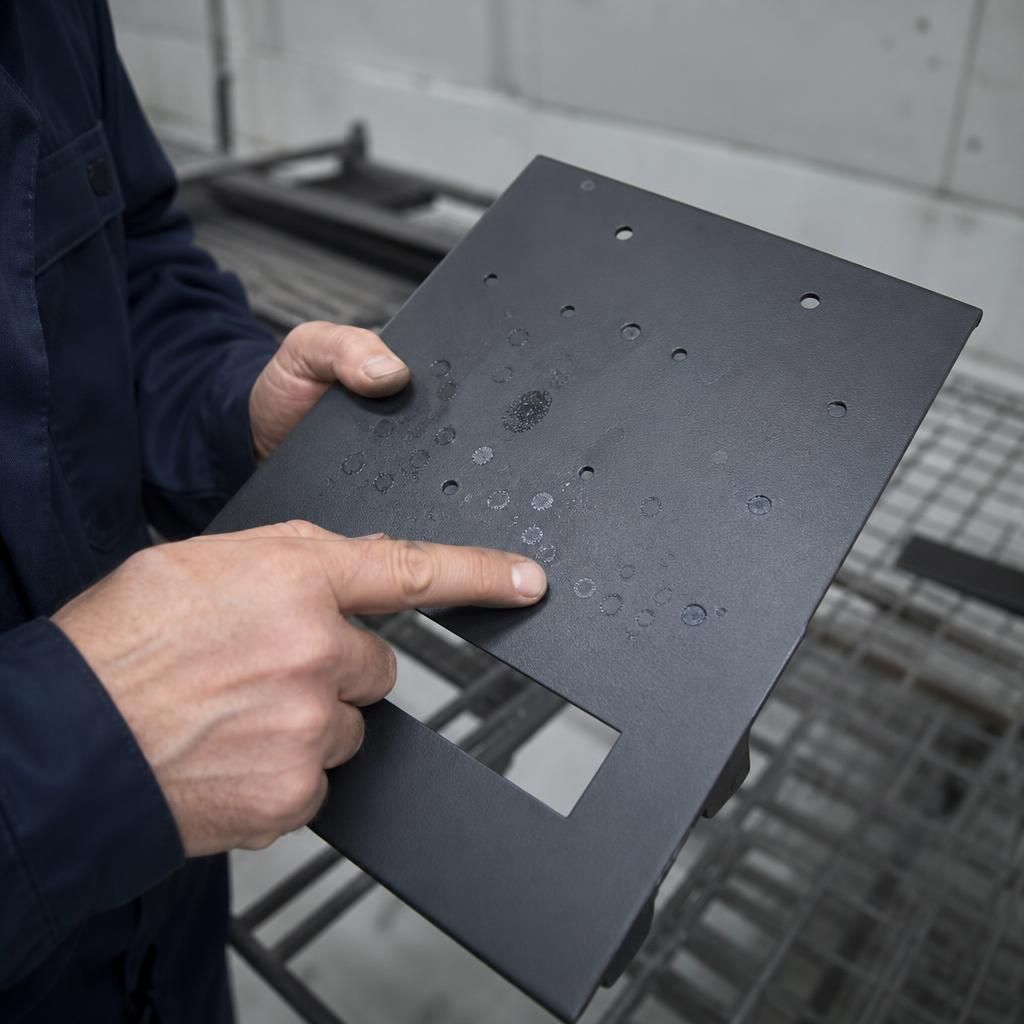
Improper degreasing can create defects that are only identified after curing, turning a preparation fault into a rework problem. Once powder has cured over contaminated areas, wiping the surface will not restore adhesion; the affected coating normally needs to be assessed, removed where necessary and prepared again before recoating.
Rework can also affect component function, especially where coating build is critical. Excess material around threads, mating faces, slots, holes or accurately formed edges may interfere with assembly or movement. For this reason, quality control should consider both the visual finish and the component’s dimensional and functional requirements, with particular attention to areas that must remain clean or within a defined tolerance.