

What quality control measures do you implement post-surface clean pretreatment to ensure perfect metal finishing?
After surface-clean pretreatment, we inspect metal components for remaining oil, dirt, rust, chemical residue, moisture and visible surface defects. Parts are checked for a clean, dry and uniformly prepared surface before powder application, helping support consistent adhesion, coverage and finish quality.
Post-surface clean pretreatment quality control is managed as a staged release process: metal parts are only progressed to powder application when the pretreatment condition, drying, handling and process records meet the agreed coating requirements. This controls the factors that influence adhesion, corrosion protection, colour uniformity and the finished appearance.
Pretreatment process checks
- Bath condition: Cleaning and pretreatment solutions are monitored against the process requirements for concentration, temperature and contact time. This helps ensure that each batch receives a repeatable treatment rather than relying solely on visual judgement.
- Rinse effectiveness: Rinse stages are checked to reduce the risk of cleaner, salts or treatment chemicals being carried forward onto the component. Where applicable, water condition is monitored using suitable indicators such as conductivity or pH.
- Process records: Relevant checks are recorded against the job or batch. Records can include the substrate, treatment route, processing conditions and any observations made during release inspection, providing traceability if a finish needs to be reviewed.
Drying and handling controls
After treatment, components must be properly dried before coating. Particular attention is given to joints, folds, cavities, threaded holes and other areas where moisture can remain concealed. Parts are handled using suitable methods to avoid introducing fingerprints, handling marks or new contamination after they have been prepared.
Racking and positioning are also considered as part of quality control. The contact points must provide a reliable electrical path for powder application without creating unacceptable marks on visible faces. Components are positioned to allow powder to reach the required surfaces and to support effective curing, while masking is used where specified for threads, bores, machined faces or other areas that must remain free of coating.
Specification and sample checks
Before production coating proceeds, the required finish is confirmed against the job specification. This may include the powder colour, gloss level, texture, coating areas, masking requirements, film thickness range and any performance requirements set by the customer. A test piece, first-off component or representative sample can be used where the geometry, substrate or finish warrants an additional check.
These checks are important because a surface can appear acceptable while still presenting a risk to the final finish. For example, a complex fabricated assembly may require different inspection points from a flat pressed component, while galvanised or previously treated steel may require closer attention to outgassing and surface condition.
Coating and curing verification
Quality control continues after pretreatment has been approved. During powder application, operators check that the coating is being deposited consistently and that difficult areas such as edges, recesses and internal corners are receiving the specified coverage. Film thickness is checked using an appropriate gauge when required by the specification.
Curing is verified in relation to the powder manufacturer’s stated requirements and the component’s metal mass and geometry. The relevant oven conditions and production settings are monitored so that the coating achieves the intended properties without over-curing or under-curing. Where appropriate, finished parts may be assessed for adhesion, surface appearance, film thickness and other agreed performance characteristics.
Final release inspection
- Colour, gloss and texture are compared with the approved requirement or reference standard.
- Visible defects such as runs, pinholes, inclusions, bare areas, excessive orange peel and handling damage are assessed.
- Masked areas, threaded features, contact points and dimensional interfaces are checked for suitability.
- Packaging and protection are reviewed so that an accepted finish is not damaged during movement or delivery.
If a result falls outside the agreed acceptance criteria, the part is held for investigation rather than automatically released. The review considers the substrate, pretreatment route, handling, powder application and curing conditions. Depending on the defect and the specification, the appropriate action may be rework, additional preparation, recoating or rejection. This staged approach links post-cleaning control with the complete finishing process and gives manufacturers, fabricators, construction firms and automotive businesses a clearer basis for consistent batch quality.
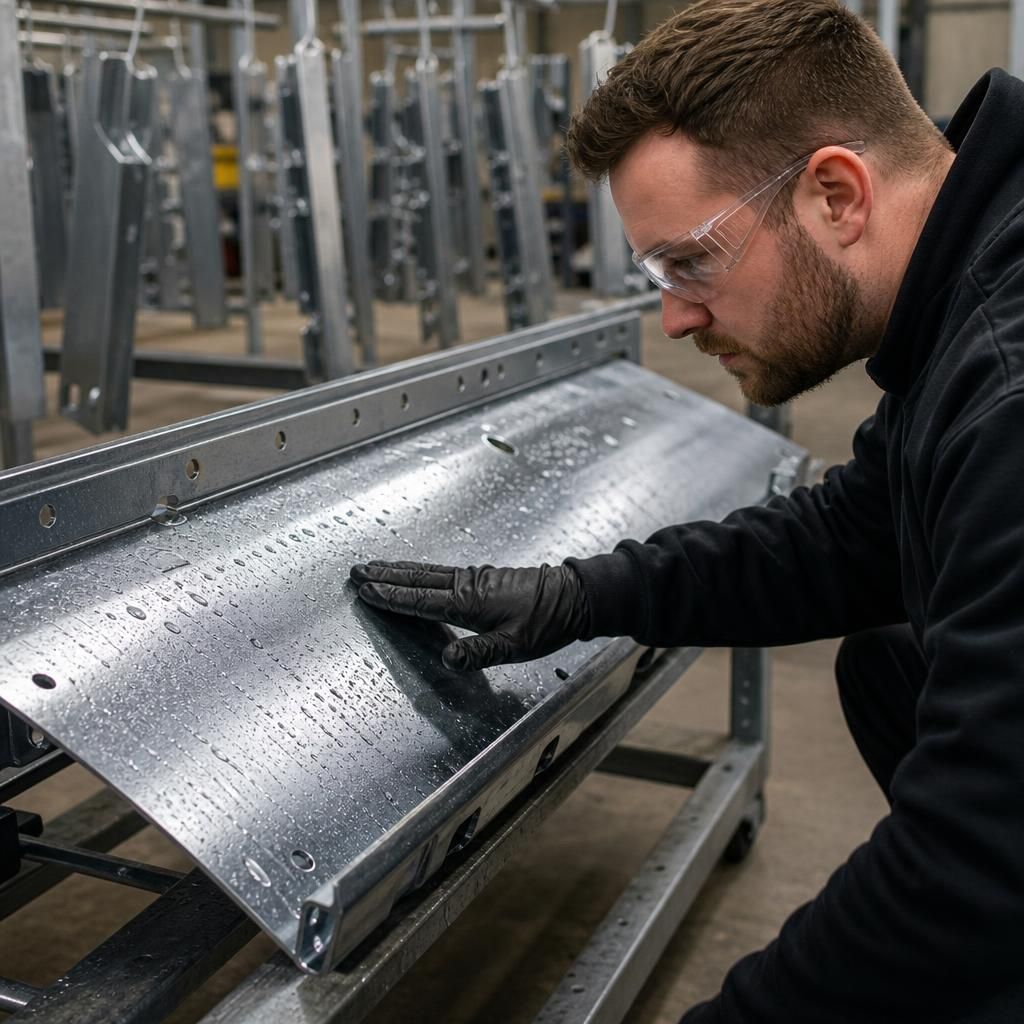
Visual inspection alone cannot always confirm that a metal surface is ready for powder coating. Where the specification or substrate requires additional evidence, surface-cleanliness checks can supplement the normal post-pretreatment inspection and help identify contamination that may otherwise affect adhesion.
A water-break assessment is one practical example. When clean water forms a continuous film across the surface, it indicates that the surface is broadly free from oil-based contamination; beading or rapid breaks in the film can indicate residual grease or other residues. The result must be interpreted alongside the metal type, pretreatment system and coating specification rather than used as a standalone pass or fail test.
For work where corrosion protection is particularly important, soluble-residue testing may also be specified to identify salts or other ionic contamination that is not obvious by sight. Using the appropriate supplementary check for the component and finish requirement gives the release decision a stronger technical basis without relying solely on appearance.