

How do sand blaster services improve the aesthetics of metal components?
Sand blaster services improve metal component aesthetics by removing rust, old coatings, scale and surface contamination, exposing a cleaner, more uniform substrate. This creates a consistent surface profile that supports an even, professional-looking finish when the component is powder coated.
Sand blaster services improve the appearance of metal components by creating a controlled, visually consistent surface for the chosen coating system. The blasting stage affects how evenly powder coating covers the part, how the finish appears across different sections and how clearly features such as welds, edges, recesses and profiles are defined.
A powder coating can only look as consistent as the surface beneath it. Variations in texture, oxidation or remnants of a previous finish may alter the way light reflects from the coated part. Controlled blasting helps reduce these visual variations, so the final coating is less likely to show patchy areas, contrasting textures or visible preparation marks.
The process can also improve the appearance of fabricated components by treating areas that are difficult to finish uniformly through mechanical preparation alone. Welded joints, brackets, corners, drilled sections and formed edges can have different surface conditions from the surrounding metal. Appropriate blasting helps bring these areas into a more consistent condition, supporting a continuous appearance once the coating has been applied.
Surface texture is an important part of the result. The blasting method and abrasive selected influence the profile left on the metal. A suitable profile gives the powder coating a stable surface to cover without creating an unnecessarily coarse appearance beneath the finish. If the profile is too pronounced, it may remain visible through a thin or smooth coating; if preparation is inadequate, differences in surface condition may remain apparent after curing. Media selection therefore needs to reflect the metal substrate, component design and intended finish.
Blasting is particularly useful when the visual standard requires repeatability across batches. Components produced at different times can develop differing levels of mill scale, oxidation or handling contamination. Bringing them to a comparable preparation standard helps the coated parts present a more uniform colour and texture, which is important for panels, frames, enclosures, brackets and other components that are viewed together or assembled into one product.
The process may also make existing defects easier to assess before coating. Pitting, porosity, sharp edges, weld spatter and mechanical damage can become more apparent once the surface has been prepared. This is beneficial from an aesthetic point of view because it allows unsuitable areas to be corrected before powder coating, rather than leaving a defect sealed beneath a new finish. Blasting cannot remove deep dents or restore metal that has already been lost through corrosion, so those issues may require separate fabrication or repair work.
Good blasting practice includes controlling the equipment, working distance, angle and treatment level so that thin sections, edges and detailed features are not unnecessarily altered. Excessive treatment can soften sharp definition or produce inconsistent texture, while insufficient treatment can leave visible differences between adjacent areas. Professional preparation is therefore a balance between achieving the required surface condition and preserving the component’s original geometry.
The appearance of the bare blasted metal is not necessarily the intended final appearance. Blasting can leave a matte, evenly textured surface, but the final colour, gloss level and visual character come from the powder coating selected and the way it is applied and cured. Effective preparation provides a reliable foundation for that finish rather than replacing the coating itself.
For the best visual result, the component should be assessed as a complete item before preparation. Factors such as the base metal, previous coating, weld quality, exposed edges, recesses, required colour and expected viewing distance all affect the appropriate blasting approach. Powder-coating specialists can use this assessment to prepare metalwork consistently for a professional finish, with collection and delivery options available to businesses across the Midlands and surrounding areas.
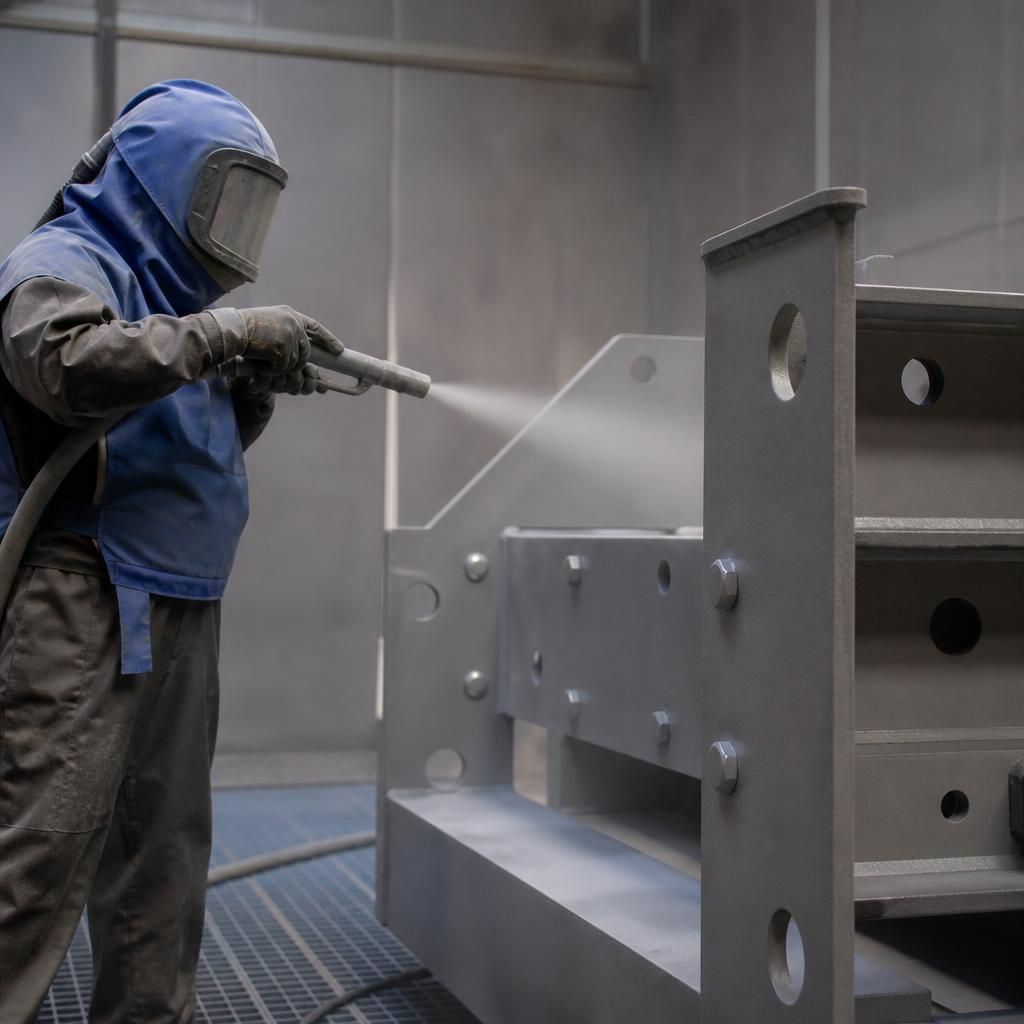
Sand blasting improves aesthetics not only by removing existing contamination, but also by preparing the component for clean coating application. Dust, loose abrasive or detached particles left on the surface can become trapped in the powder film, creating raised specks, pinholes or rough areas that affect the finished appearance.
Post-blast cleaning and careful handling are particularly important around holes, threaded sections, folded returns and mating faces. Preventing debris from collecting in these areas helps maintain clear transitions between coated and uncoated surfaces while preserving the component’s intended fit. The visual result therefore depends on the complete preparation sequence, including inspection and cleanliness between blasting and powder coating.