

What role does shot blasting media play in enhancing the longevity of a powder coating finish?
Shot blasting media helps a powder coating last longer by removing rust, mill scale, old coatings and other contaminants while creating a suitable surface profile. The correctly selected media improves mechanical adhesion and leaves the metal better prepared to resist peeling, corrosion and wear in service.
Shot blasting media contributes to the service life of a powder coating by controlling the condition and texture of the metal immediately before coating. Its influence continues beyond initial adhesion: the correct media helps produce a consistent surface, limits coating defects, reduces the risk of corrosion developing beneath the film and supports an even powder layer on parts exposed to handling, weather, chemicals or abrasion.
A suitable surface profile gives the cured coating a stable mechanical key without creating unnecessarily deep valleys. If the profile is too shallow or inconsistent, the coating may have less effective support at the metal interface. If it is excessively rough, powder may bridge the highest points while leaving thinner coverage in recesses. Those thin areas can become preferential sites for wear or corrosion. Media selection and blasting pressure therefore need to be matched to the metal, the component’s geometry and the required coating system.
Media condition is also important. Worn abrasive produces a different impact pattern from new or correctly graded media, while contaminated or poorly maintained media can introduce unwanted material to the workpiece. In a production process, monitoring media breakdown, dust loading and particle size helps maintain repeatable preparation from one batch to the next. Consistency matters because variations in the prepared surface can lead to differences in coating appearance and performance across components that are intended to have the same finish.
The media must be appropriate for the substrate. A robust abrasive suitable for structural steel may be unnecessarily aggressive for aluminium, thin sheet or finely machined components. Excessive impact can alter edges, round sharp features, affect dimensional tolerances or leave a profile that is disproportionate to the coating thickness. Softer or finer media may be more suitable where preserving the underlying form is more important than producing a pronounced texture. The objective is controlled preparation, not the greatest possible blast intensity.
Correct preparation also supports corrosion resistance at vulnerable areas such as welds, corners, joints and recessed sections. These features can behave differently during blasting and powder application, so an unsuitable media or blasting method may leave variations that are not obvious until the component is exposed to service conditions. A controlled, uniform finish helps the powder form a more dependable protective layer around these features, subject to correct application and curing of the coating itself.
Shot blasting media cannot compensate for later process faults. Long-term performance still depends on factors including:
- the powder coating being suitable for the intended exposure;
- complete and even powder coverage, particularly at edges and complex profiles;
- correct curing according to the coating manufacturer’s requirements;
- appropriate handling after preparation to prevent recontamination; and
- protection from damage during storage, transport and installation.
For this reason, media selection should be considered alongside the complete preparation and coating specification. The relevant questions are not simply whether a surface looks clean, but whether the chosen abrasive produces a repeatable profile, preserves the component’s dimensions, avoids harmful residues and remains compatible with the powder system and service environment.
In practical terms, the most durable result comes from matching the abrasive grade and blasting parameters to the substrate and component design, then controlling the process consistently. This reduces variability at the coating interface and gives the powder finish a sound basis for resisting peeling, corrosion and mechanical wear throughout its intended use.
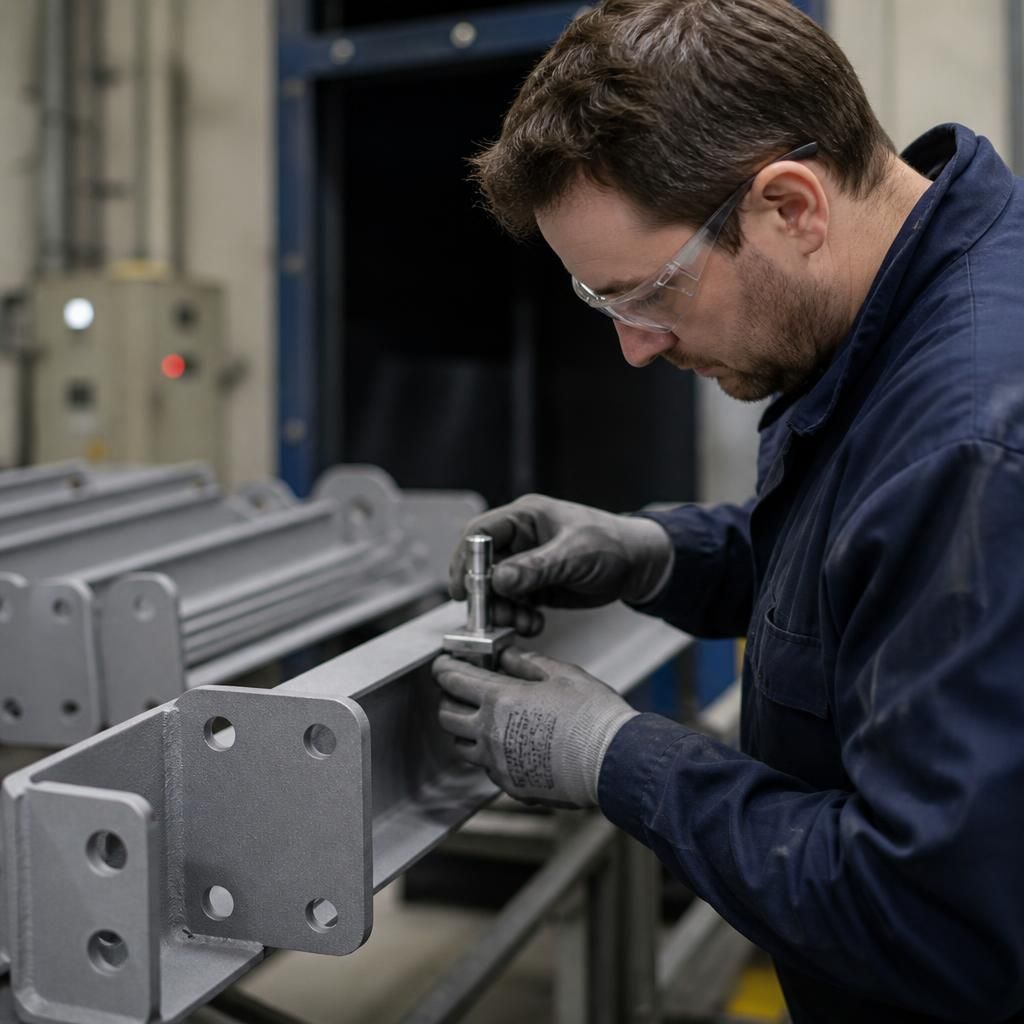
The longevity benefit of shot blasting media is confirmed through inspection before powder coating begins. Checking the prepared surface helps identify an unsuitable profile, remaining dust or embedded abrasive before these defects become part of the coating interface.
Inspection should assess both cleanliness and surface texture rather than relying on appearance alone. A profile check can confirm that the blasted surface is suitable for the planned coating thickness, while dust and residue checks help prevent weak areas beneath the powder film. Particular attention is useful around welds, recesses, edges and other features where preparation may be less uniform.
Recording these checks for each batch also helps link coating performance to the blasting process. If a finish later shows premature wear or adhesion loss, preparation records can indicate whether media condition, blasting settings or surface cleanliness require investigation. This verification step makes the durability gained from correctly selected media more consistent across production work.
Discuss the Right Shot Blasting Media for Your Powder Coating Finish
Share your component details, substrate and intended service conditions with a powder coating specialist before finalising the preparation specification. Contact Powder-coatings.co.uk to discuss a suitable shot blasting and coating approach for your next batch.