

How does the pretreatment process differ for various types of metals in powder coating?
Metal pretreatment for powder coating differs according to each substrate’s surface chemistry, reactivity and existing contaminants. Steel commonly requires degreasing, rinsing and a conversion treatment to support corrosion resistance, while aluminium, galvanised steel and other non-ferrous metals need compatible cleaning and conversion processes that avoid damaging the surface or interfering with adhesion.
The main difference is that pretreatment must be matched to the metal’s chemistry rather than applied as a single standard recipe. The treatment has to remove the particular oils, oxides, scale or residues present, create a suitable surface for powder adhesion and provide an appropriate level of corrosion protection without etching or destabilising the substrate.
Mild and carbon steel
Steel is often affected by mill scale, flash rust, welding residues, abrasive dust, oil and grease. The preparation may therefore involve alkaline cleaning, mechanical removal of heavy oxide or scale, rinsing and a conversion treatment. Phosphate-based systems have traditionally been used for steel because they produce a receptive crystalline layer, although other conversion chemistries may be selected according to the required corrosion performance, process equipment and coating specification.
Particular attention is needed around welds, sharp edges, folded sections and crevices. Weld heat can leave discolouration and residues that are not removed by degreasing alone. Any remaining scale or embedded contamination can create weak points beneath the powder film, so heavily oxidised steel may need additional abrasive preparation before chemical treatment.
Galvanised and zinc-coated steel
Galvanised steel has a zinc surface rather than exposed iron or steel. It should not automatically be treated using the same chemistry or dwell times as mild steel, because aggressive treatment can attack the zinc layer and reduce its protective value. Preparation generally focuses on removing passivation residues, storage oils, white corrosion products and other surface contamination while retaining a sound zinc coating.
The condition of the zinc is important. Freshly galvanised surfaces, weathered galvanised surfaces and zinc-coated components that have been stored or handled can require different cleaning approaches. Localised white rust, sharp zinc runs and heavy deposits may also need controlled mechanical preparation. Thorough rinsing is essential because alkaline or acidic residues left on the surface can interfere with adhesion and contribute to defects after curing.
Aluminium
Aluminium forms a tenacious oxide layer quickly when exposed to air. This oxide is not necessarily a problem in itself, but uncontrolled or contaminated oxide can reduce coating adhesion. Aluminium pretreatment therefore uses chemistry designed to clean the surface and establish a stable conversion layer without excessive attack or uneven etching.
Care is needed with alkaline cleaners, as aluminium can be darkened, etched or dimensionally affected if the chemistry is too aggressive or remains in contact for too long. The alloy also matters: aluminium containing significant amounts of copper, silicon or other elements may respond differently from a relatively pure grade. Cast aluminium can have a porous surface that retains mould release agents, machining fluids or blasting media, making cleaning and rinsing particularly important.
Stainless steel
Stainless steel relies on a chromium-rich passive oxide film for its resistance to corrosion. Pretreatment must remove grease, handling marks and fabrication residues without contaminating the surface with free iron or damaging the passive layer. Ordinary steel shot or contaminated tools can transfer iron particles, which may later rust and appear as staining beneath or around the powder coating.
Where stainless steel has been welded, heat tint and oxide residues may require dedicated mechanical or chemical removal before coating. The chosen process should be compatible with the particular stainless grade and the intended finish. A treatment suitable for carbon steel should not be assumed to provide the same result on stainless steel.
Cast iron and heavily machined components
Cast iron often has a rough, porous surface that can retain oil, coolant and moisture. Degreasing may need to be more thorough than for a smooth rolled section, and abrasive cleaning can help expose a sound surface where residues or loose corrosion are present. Components with blind holes, porous castings or complex geometry also require careful draining and rinsing so that treatment chemicals do not remain trapped.
Machined parts may carry cutting fluids or protective oils in grooves and recessed areas. If these are not removed, they can cause cratering, pinholing, poor adhesion or contamination released during oven curing. The preparation method should account for the component’s shape as well as its nominal metal type.
Mixed-metal assemblies
Assemblies containing steel, aluminium, zinc-coated parts or stainless components are more difficult because one chemical stage may not be ideal for every exposed surface. The process must avoid over-treating the most reactive metal while still preparing the least reactive one adequately. In some cases, separating components before coating provides better control and prevents trapped solution, galvanic interaction or inaccessible contamination.
Where dissimilar metals remain joined, the pretreatment specification should be assessed against the complete assembly. Gaps, joints and fastener areas can retain moisture or chemicals, while contact between different metals may increase corrosion risk if the coating system is damaged.
How the correct process is selected
A suitable specification considers the metal grade, surface condition, previous treatment, fabrication method, component geometry and the environment in which the finished part will be used. It should define the cleaner, conversion treatment, rinsing requirements and any drying or holding controls rather than referring simply to “metal pretreatment”.
- Identify the substrate and any coatings, platings, oils or temporary corrosion inhibitors already present.
- Remove scale, weld residues, rust and embedded contamination by a method that will not damage the base metal.
- Use a cleaner and conversion chemistry compatible with the substrate.
- Control concentration, temperature, contact time and rinsing to prevent residues or excessive etching.
- Inspect the treated surface for water-break-free cleanliness, staining, powdery deposits and areas that have been missed.
- Confirm adhesion and corrosion performance using a process validation method appropriate to the coating specification.
The same powder can therefore require different preparation routes on different metals, even when the parts have similar dimensions. Pretreatment is successful when it leaves each substrate clean, chemically suitable and consistently receptive to the powder coating, rather than when every material has passed through identical stages.
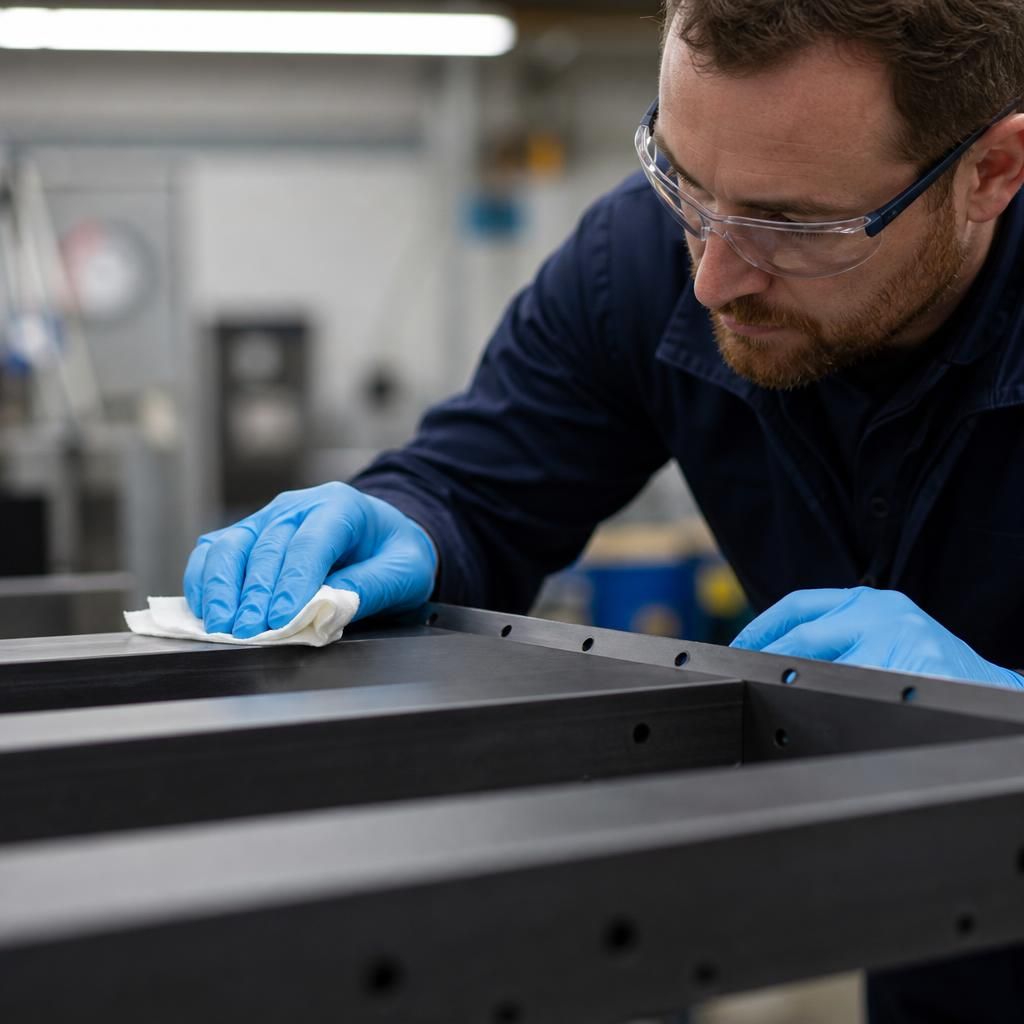
A clean appearance does not prove that pretreatment is suitable. Conversion layers on powder-coated metals may be extremely thin or barely visible, so a component can look ready while still having residues, an unstable oxide layer or inadequate chemical coverage. Assessment should therefore consider the substrate and treatment response, not appearance alone. Process checks and representative test pieces can help confirm that the chosen chemistry has produced a consistent surface for powder adhesion without excessive etching or damage.