

What role does shotblasting play in corrosion resistance before powder coating?
Shotblasting improves corrosion resistance before powder coating by removing rust, mill scale and contaminants that could undermine the finish. It also creates a clean, suitably textured surface for the powder coating to bond to, helping form a more continuous and durable barrier against moisture and corrosion.
Shotblasting supports corrosion resistance by preparing the metal so the powder coating can form a more consistent protective system. Its role is not to provide corrosion protection on its own, but to reduce the surface conditions that allow corrosion to begin beneath or around a coating. The quality of this preparation has a direct bearing on how well the finished coating resists moisture, salts, chemicals and general environmental exposure.
Corrosion often develops at weaknesses in the coating system. Residual rust, tightly bonded oxides, mill scale, grease or embedded process residue can prevent the coating from properly covering the metal. These areas may retain moisture or create localised points of attack. Shotblasting exposes a more uniform metallic surface, making it easier to apply a continuous powder layer without concealed defects beneath it.
It also helps reveal the actual condition of the component. Pitting, weld contamination, sharp edges and areas of existing corrosion may be difficult to assess when covered by scale or old finishes. Once these features are visible, they can be dealt with as part of the preparation process rather than being sealed beneath the coating. This is particularly important for fabricated parts, where welds, joints and changes in section can otherwise become vulnerable points.
The blast profile has a further influence on protection. Controlled impact creates microscopic variations in the surface that give the coating system a mechanical key. The profile must be suitable for the powder and the component: insufficient preparation can leave weak areas, while an unsuitable or excessively rough profile may make it harder to achieve consistent coverage over peaks and recesses. Blast intensity, abrasive selection and exposure time therefore need to be matched to the metal and the condition of the part.
Good corrosion performance also depends on what happens after blasting. The prepared surface should be handled carefully to avoid recontamination from oil, dust, moisture or contact with unsuitable materials. Bare steel can begin to oxidise again if it is exposed to damp conditions before coating, so the interval between blasting and powder application should be managed as part of the overall process. Clean transfer, suitable storage and effective inspection help preserve the preparation standard.
Shotblasting is especially valuable where components will face demanding conditions, but it is not a substitute for selecting the correct coating system. The required level of protection depends on the base metal, the environment, expected exposure and the design of the component. Outdoor structures, automotive parts and industrial fabrications may require different preparation and coating decisions, particularly where water can collect or where crevices and overlapping surfaces are present.
- Surface condition: Rust, scale and previous finishes must be addressed so they do not remain as hidden weaknesses.
- Component geometry: Corners, welds, recesses and edges need attention because corrosion frequently starts where coverage is difficult to maintain.
- Blast consistency: Uneven preparation can produce variations in coating performance across the same batch.
- Post-blast control: Clean handling and protection from moisture help prevent the prepared surface from deteriorating before coating.
- Coating suitability: Powder selection and application must reflect the service environment rather than relying on preparation alone.
For B2B projects, these factors make process control important when assessing a shotblasting and powder coating service. The provider should understand the substrate, identify areas requiring additional preparation and maintain consistency across batches. For manufacturers and fabricators using collection and delivery services across the Midlands and surrounding areas, discussing the component material, intended use and exposure conditions in advance helps establish an appropriate preparation and coating specification.
In practical terms, shotblasting improves corrosion resistance by removing variables that could compromise the coating system and by preparing the component for controlled powder application. Long-term performance still depends on the complete specification, including component design, substrate condition, coating choice, application quality and protection during handling.
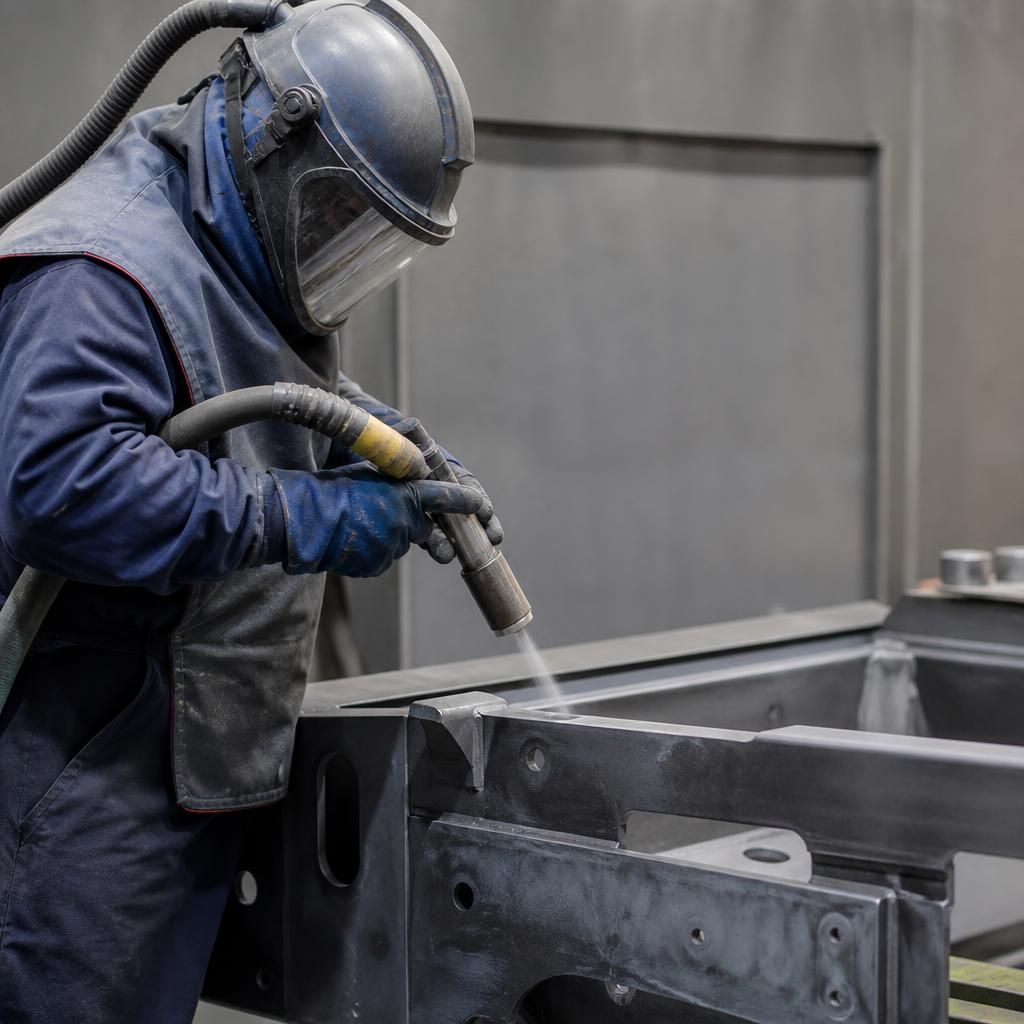
Shotblasting improves corrosion resistance only when the blasting process is controlled. An unsuitable abrasive, excessive impact or contaminated blast media can leave residues or embed particles in the metal, creating weak points beneath the powder coating. The abrasive must therefore be appropriate for the substrate and maintained in a condition that does not introduce further contamination.
This is particularly important where components have close tolerances, thin sections or visible finished surfaces. Excessive blasting can alter edges or dimensions, while insufficient blasting may leave isolated areas that are more vulnerable to corrosion. Checking the prepared component for uniformity before powder application helps confirm that the surface is suitable for a continuous protective finish.