

How does the powder colour paint application process impact the quality and consistency of the finish?
The powder colour paint application process directly affects finish quality because surface preparation, powder coverage and oven curing determine adhesion, colour uniformity, gloss and resistance to defects. Consistent pre-treatment, controlled application and a verified curing cycle help produce an even finish across individual components and larger batches.
The application process affects powder-coated finish quality by controlling how evenly the powder is deposited, how consistently the coating is built up and how reliably each part experiences the required thermal cycle. Small differences in equipment settings, component geometry, powder condition or handling can produce visible variation in colour, texture, gloss and film thickness.
Component design and positioning influence how the powder reaches the surface. Recesses, internal corners, boxed sections, sharp edges and closely spaced features can receive a different charge from broad, exposed faces. The Faraday cage effect may reduce powder deposition in recessed areas, while edges can attract more powder or become thinner during handling. Correctly positioning parts on the rack and allowing suitable spacing helps the operator reach difficult surfaces and reduces shadowing between components.
Hanging arrangements also affect the finished appearance. Contact points must provide a reliable electrical earth without unnecessarily marking a visible face. If parts move, touch one another or are suspended at inconsistent angles, the powder cloud may not reach them evenly. Consistent racking is therefore important when a batch contains repeated components, particularly where parts will be compared side by side.
Spray equipment settings determine how the powder behaves as it travels towards the component. Factors such as gun-to-part distance, powder delivery rate, air volume, electrostatic charge and spray pattern need to suit the part rather than being treated as fixed settings for every job. Excessive charge can make recessed areas more difficult to coat, whereas unsuitable air settings can disturb previously deposited powder. A controlled spray technique helps maintain a stable coating build across different faces and geometries.
The operator also needs to manage overlap between spray passes. Inconsistent movement or excessive overlap can create heavier areas, patchy texture or variation in gloss after curing. Automated application can improve repeatability for suitable high-volume work, while manual application remains useful for complex shapes and areas requiring selective control. In either case, repeatable settings and a defined method are more important than applying powder by visual judgement alone.
Powder condition and handling can change the way the material flows and deposits. Powder should be stored and handled in conditions appropriate to the product, kept free from contamination and managed carefully during colour or product changes. Moisture, foreign particles or unsuitable reclaimed material can contribute to roughness, specks, poor flow or shade variation. Equipment and powder delivery paths also need suitable cleaning between jobs to reduce contamination and unintended colour carry-over.
Film thickness control is another important quality factor. A coating that is too thin may provide inadequate coverage or an uneven appearance, while excessive build can affect texture, edge definition and the way the colour develops during curing. Thickness should be checked using an appropriate gauge at representative points, including faces, edges and areas that are more difficult to coat. Measurements are more useful when they are linked to the component drawing, specification or agreed acceptance criteria rather than considered in isolation.
Curing must be assessed by the metal temperature, not simply the oven display or the time that a part has spent inside the oven. Components of different mass and thickness heat at different rates, so two parts entering the same oven setting may not follow the same thermal history. Insufficient heat can leave the coating with inadequate performance, while excessive heat or prolonged exposure may affect colour, gloss or the final appearance. For repeat work, confirming the relationship between oven settings, part temperature and coating requirements supports more consistent results.
Batch consistency depends on controlling variables between runs as well as within a single run. Useful checks include:
- confirming that the correct powder and colour are being used;
- checking that racking and component orientation match the approved method;
- monitoring application settings and film build at suitable inspection points;
- verifying that the curing cycle remains appropriate for the part mass and coating specification; and
- comparing finished components under consistent lighting and viewing conditions.
Inspection should cover more than colour alone. Operators may assess surface smoothness, gloss, coverage, edge condition, visible contamination, runs, pinholes, impact damage and the security of the finish. Where a customer specification applies, documented inspection points make it easier to distinguish an isolated handling defect from a process-wide variation.
Colour matching is particularly sensitive to process consistency. The same powder can appear different if film build, texture, gloss or curing conditions vary. For that reason, a reference panel or retained approved sample can provide a more reliable comparison than memory or an isolated visual check. Parts should also be assessed in comparable lighting, as surrounding light and viewing angle can alter the perceived shade and texture.
When a defect is found, the likely process stage should be identified before reworking the component. For example, contamination, poor electrical contact, unsuitable spray technique and an incorrect thermal cycle require different corrective actions. Simply applying another coat may hide the symptom without resolving the cause and can create excessive film build. A controlled process, supported by inspection records and clear acceptance criteria, gives manufacturers and fabricators a better basis for achieving a consistent finish across individual components and repeat batches.
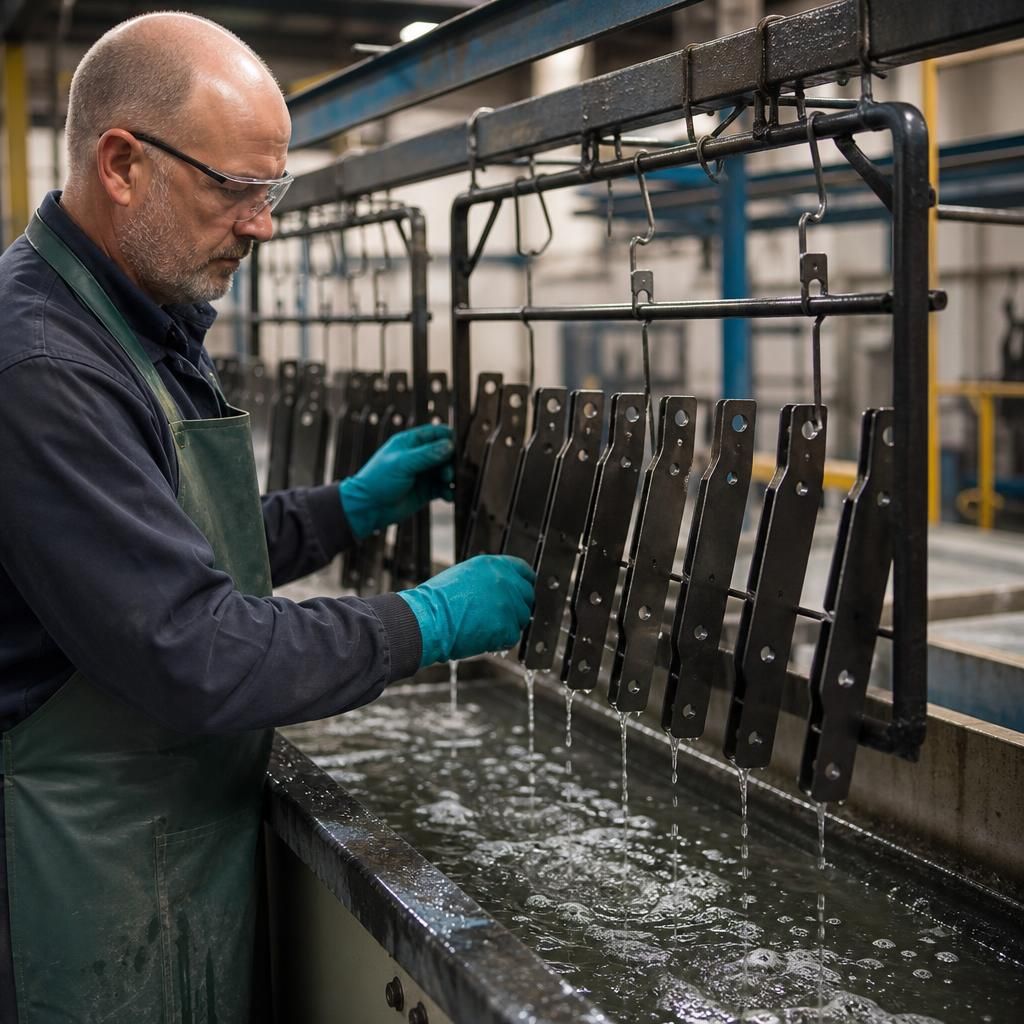
Surface preparation establishes the foundation for a consistent powder-coated finish. Oil, grease, rust, mill scale, moisture and other residues can prevent the coating from bonding evenly, even when spraying and curing are carefully controlled.
The preparation method should suit the substrate and the conditions the component will face. Cleaning removes contaminants, while suitable chemical or mechanical treatment can improve adhesion and support corrosion protection. Rinsing and drying are equally important: residues, salts or trapped moisture may cause blistering, peeling, staining or localised defects beneath the powder film.
Inspection before coating should confirm that the metal is clean, dry and free from visible contamination, with particular attention to welds, joints, recesses and edges where residues can remain. Treating preparation as a defined process rather than a quick preliminary step gives the powder a more uniform surface to bond to and reduces variation between parts in the same batch.
Discuss your powder colour paint application requirements
Discuss your powder colour paint application requirements with the team, providing details of the metal substrate, component design, colour, finish and batch requirements. This allows the coating process and inspection approach to be considered against your specification.