

How does powder coating impact the maintenance requirements of powder-coated chassis and frames?
Powder coating reduces the maintenance demands of chassis and frames by providing a hard, continuous finish that helps protect the metal from corrosion, abrasion and everyday contamination. Maintenance generally focuses on periodic cleaning and inspection, with prompt treatment of chips, scratches or exposed metal to prevent local damage from spreading.
Powder coating changes chassis and frame maintenance from frequent repainting to a controlled care programme focused on preserving the coating, managing interfaces and dealing with local damage before it affects the underlying metal. The finish can reduce the need for major remedial work, but it does not make a chassis maintenance-free. The required regime still depends on exposure, loading, impact risk, chemicals and the quality of the original preparation and application.
Maintenance is usually more predictable. A correctly applied coating provides a consistent surface that does not normally require repeated primer and topcoat applications as part of routine care. This can simplify planned maintenance because attention can be directed towards the areas most likely to deteriorate, such as exposed edges, mounting points, underside sections, weld zones and locations where components contact the frame.
Maintenance inspections should assess more than the visible colour or gloss. Check for:
- lifting, blistering, cracking or loss of adhesion;
- impact marks and damage around loading, lifting and securing points;
- wear at brackets, hinges, clamps and other areas subject to movement;
- coating build-up around mating surfaces, threads and close-fitting components;
- water or debris retention around joints, recesses and drainage points; and
- changes that could indicate movement, distortion or a separate mechanical fault beneath the coating.
Powder coating should not be treated as a substitute for mechanical inspection. It does not correct fatigue, distortion, poor welds, loose fasteners or inadequate drainage. Where the coating has covered a repaired or fabricated area, the frame should still be assessed in line with the manufacturer’s or operator’s engineering procedures.
Cleaning requirements are generally straightforward, but the method matters. Use a suitable detergent and a soft or non-abrasive washing method, then rinse away residues that could attack the finish or retain moisture. Avoid aggressive solvents, highly abrasive tools and unsuitable alkaline or acidic cleaners unless their compatibility with the particular powder system has been confirmed. Equipment used for cleaning should not drive grit into the surface, particularly on textured or matt finishes where contamination can be harder to remove.
Chassis used in environments exposed to road salt, fertiliser, oils, fuels, hydraulic fluid, chemicals or industrial dust may need a more carefully specified cleaning routine. The important consideration is not simply how often the frame is washed, but whether contaminants are allowed to remain in joints, folds and concealed areas. A coating supplier or powder manufacturer can advise on chemical compatibility where the service environment is unusual.
Local damage should be managed according to its extent. A small chip can usually be isolated, cleaned and repaired with a compatible touch-up system selected for the service conditions. The damaged area needs to be prepared so that loose coating and contamination are removed, while the surrounding sound coating is left intact. Touch-up products may not reproduce the original powder-coated appearance exactly, particularly where the finish is textured, metallic or matt, so the repair should be judged for both protection and appearance.
Touch-up work is a local repair rather than a complete replacement for factory-applied powder coating. If damage is widespread, if corrosion has developed beneath the coating, or if adhesion has failed over a larger area, the appropriate response may involve stripping, preparing and recoating the affected component. Recoating decisions should also consider dimensional tolerances, masked areas and the effect of additional coating thickness on assembly.
Interfaces require particular attention. Powder coating can affect electrical continuity, earthing points, threaded connections and close-tolerance fits if these areas are not correctly masked or cleared during assembly. When a coated chassis is dismantled and rebuilt, contact faces, fasteners and protective treatments should be restored in accordance with the equipment design. Avoid damaging the surrounding finish when tightening, levering or replacing components.
Record keeping can make the maintenance programme more effective. A useful record identifies the coating system, colour or finish, preparation requirements, areas that were masked, known chemical exposures and any repairs carried out. This helps maintenance teams select compatible products and distinguish normal surface wear from a developing adhesion or corrosion problem.
In practical terms, powder coating usually lowers the frequency and extent of cosmetic refurbishment, while shifting attention towards good handling, compatible cleaning, interface control and early repair. Chassis and frames that operate in severe or high-impact conditions may still need more frequent attention than protected indoor equipment. The coating’s maintenance benefit is therefore maximised when it is combined with sound design, appropriate use, effective drainage and a documented inspection and repair process.
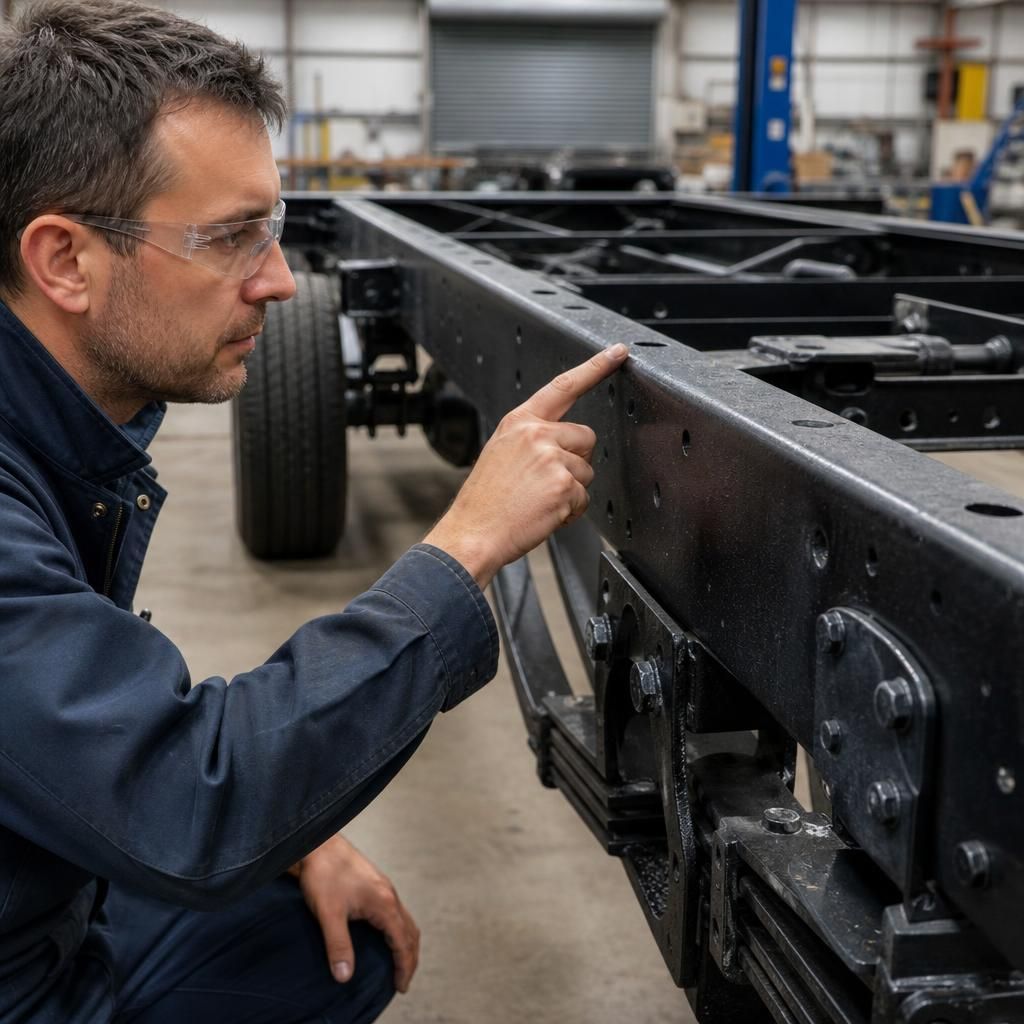
Changes in colour or gloss do not necessarily mean that a powder-coated chassis or frame has lost its protective function. Ultraviolet exposure and weathering can gradually affect the appearance of some finishes, while the coating may still be sound and firmly bonded to the metal.
Maintenance decisions should therefore distinguish cosmetic weathering from functional coating failure. Recoating is more likely to be justified where there is exposed substrate, corrosion, blistering, cracking or loss of adhesion than where the only change is a degree of fading or surface dullness. This assessment helps maintenance teams plan remedial work according to actual coating condition rather than appearance alone.