

What are the capacity limits for large-scale powder coating projects?
Large-scale powder coating capacity is determined by the dimensions and weight of the components, the curing oven and handling equipment, batch size, and the coating specification. Projects exceeding available oven or loading limits may need to be divided into controlled batches, with production planning also accounting for preparation, masking, curing and collection or delivery across the Midlands.
There is no single capacity limit for a large-scale powder coating project. The workable limit is established by whether each component can be safely loaded, moved, coated and cured while meeting the required finish standard. A project may therefore be suitable for large-scale processing even when individual items must be scheduled in separate production runs.
Component envelope and geometry
The usable coating envelope is not determined by length, width and height alone. Irregular shapes, projecting sections, deep recesses and assemblies with limited access can require additional clearance around the component. Parts must also be positioned so that the powder can reach the required surfaces and so that they do not touch one another during handling or curing.
Long or awkward components can create a practical limit even when their overall dimensions appear manageable. The available racking arrangement, lifting points and route into the curing equipment all affect whether a part can be processed safely. Components that exceed the practical envelope may need to be redesigned for coating, separated into subcomponents or processed using a different production arrangement.
Weight and handling capacity
Weight affects more than whether a part can be lifted. It influences the choice of rack, the number of suspension points and the stability of the component while it is being sprayed and cured. A heavy part may also require additional support to prevent distortion or movement, while thin sections may need careful handling to avoid damage before the coating has cured.
For assemblies, the combined weight of the component, racking and any handling fixtures must be considered. The coating plan should identify how the item will be loaded, transferred between stages and unloaded without marking newly finished surfaces.
How batch volume affects capacity
Large-scale work is not defined solely by the number of parts. A high quantity of small, uniform components may be easier to process than a smaller quantity of large, varied items. Repeated components can often be organised into consistent loads, whereas mixed batches may require changes to racking, masking, colour, coating material or curing arrangements.
Batch planning should account for:
- the number of components required for each production run;
- whether parts can be grouped by size, material, colour and coating specification;
- the amount of rack space needed between components;
- the time required for loading, unloading, masking and inspection; and
- whether different parts require separate preparation or curing controls.
Dividing a project into planned batches is normally more useful than attempting to maximise the number of parts in every load. Overloading can obstruct powder application, restrict airflow and make it harder to maintain consistent curing conditions.
Thermal mass and curing considerations
The curing process depends on the component reaching the specified metal temperature for the required period. Parts with substantial thermal mass take longer to heat through than thin sections. A load containing components with very different thicknesses may therefore need careful arrangement and process control to prevent some areas from being under-cured while others receive unnecessary heat exposure.
Large assemblies can also create cooler areas within sheltered sections. Geometry, rack position and the distribution of metal in the load should be reviewed before production begins. The coating specification may place further limits on how components of different types can be combined in one run.
Surface preparation and masking can become the bottleneck
Preparation capacity may limit a project before coating capacity does. Large parts need suitable access for cleaning, preparation and inspection, while enclosed sections may require particular attention to drainage, trapped contamination and masking. Threads, machined faces, electrical contact points and areas intended for assembly may need protection from powder.
Masking requirements become especially significant when a project contains many parts with precise exclusion zones. The time and fixtures required for this work should be included in the capacity assessment rather than treating coating application as the only production stage.
Coating specification and changeovers
A project requiring one consistent coating system is generally simpler to schedule than work involving several colours, textures, film builds or performance requirements. Changes between specifications can require cleaning, equipment preparation and separate handling arrangements. These changeovers reduce the useful production capacity available for the main batch, particularly where small quantities of several specifications are mixed together.
Specialist protective or nylon coatings may also require different preparation, application or curing controls from standard architectural or industrial finishes. The specification should therefore be confirmed before capacity is calculated, rather than selecting a production method based only on component size.
Information needed for an accurate assessment
A coating provider will normally need more than an estimated quantity. Useful information includes component drawings or photographs, maximum dimensions, individual weights, material type, surface condition, required finish, areas to remain uncoated, expected batch quantities and any inspection requirements. Samples can help identify handling, masking and preparation issues that are not obvious from a drawing.
The assessment should then establish whether the work can be processed as one repeatable batch, several controlled batches or a combination of both. This approach gives a more realistic capacity estimate than quoting a maximum part size or a maximum number of items in isolation.
What happens when a project exceeds a practical limit?
Exceeding a single-load limit does not automatically make a project unsuitable for powder coating. Options may include separating an assembly, changing the rack arrangement, grouping similar parts, revising the batch sequence or using an alternative approved coating process for specific components. Any change must still preserve the required appearance, adhesion, corrosion protection and dimensional tolerances.
For this reason, capacity should be treated as a project-planning issue rather than a simple maximum number. The most reliable assessment considers the complete route from preparation through handling, application, curing, inspection and final packing.
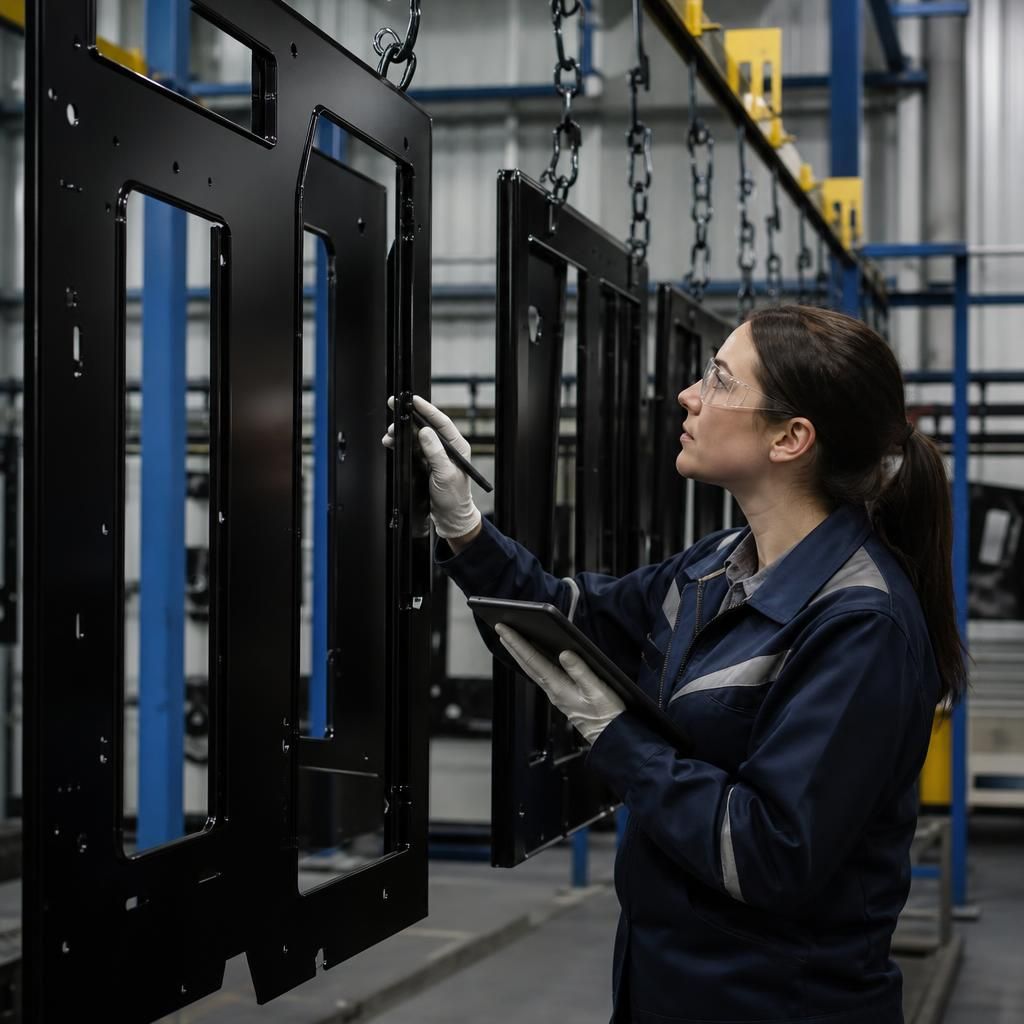
Quality-control requirements can reduce the usable capacity of a large-scale powder coating project, particularly where every component must be inspected before the next batch is released. The production plan may need space for identification, inspection, quarantine and any approved rework, rather than assuming that every coated part moves directly to packing.
This is especially relevant for projects with strict appearance, adhesion or film-build requirements. Inspection points should be agreed before production so that any issue can be isolated to the affected components without disrupting the remaining batches. Capacity is therefore influenced not only by how much metal can enter the process, but also by how much work can be controlled and verified at each stage.