

How does curing affect the final quality and performance of powder-coated stainless steel?
Curing melts and chemically cross-links the powder coating on stainless steel, creating the continuous film that provides adhesion, hardness and protection. Correct control of the curing temperature and time is essential for an even appearance, strong corrosion resistance and the intended long-term performance; insufficient or excessive curing can reduce these properties.
The final quality of powder-coated stainless steel depends on achieving the powder manufacturer’s specified cure at the temperature of the metal itself. The oven display alone is not sufficient: a heavy stainless component, a thin panel and a complex assembly can reach the required metal temperature at different rates. This affects the coating’s appearance, mechanical properties and resistance to service conditions.
What happens during curing
Once the applied powder reaches its activation temperature, the particles flow together and form a continuous film. The resin then cross-links, changing the coating from a meltable layer into a stable finish. The cure schedule must provide enough heat for this reaction to progress throughout the coating thickness and across every part of the component.
Curing is therefore a combination of temperature and time. A short period at a high temperature may produce a different result from a longer period at a lower temperature, even where the total heat exposure appears similar. The correct schedule depends on the powder formulation and should be taken from its technical data rather than estimated from the oven setting.
Effects of insufficient curing
Under-cured powder may look acceptable immediately after coating but remain chemically incomplete. Typical consequences can include:
- reduced resistance to scratching, impact, abrasion and handling damage;
- a softer or less chemically resistant surface;
- poor resistance to moisture and contaminants reaching the substrate;
- inconsistent gloss, colour or texture between different areas of the same component; and
- premature loss of coating performance in demanding industrial service.
Under-curing can be local rather than uniform. Areas shielded by brackets, dense assemblies or recessed geometry may receive less effective heat, while a thick section may still be below the required metal temperature when the oven cycle ends.
Effects of excessive curing
Over-curing can also affect the final result. Excessive heat exposure may cause colour shift, gloss change, yellowing or degradation of the coating system, particularly where appearance is tightly specified. Some powder finishes are more sensitive to prolonged heating than others. An unnecessarily severe cycle can also make it harder to reproduce the same appearance across separate production batches.
Excessive curing is not a reliable way to compensate for poor temperature control or an unsuitable process. The coating must be matched to the intended cure schedule, and the schedule must be applied consistently.
Why stainless steel component design matters
Stainless steel’s thickness, shape and mass influence how quickly it heats through. Large fabrications, folded sections, tubes, welded areas and assemblies with enclosed or shadowed surfaces can have significant temperature differences during one oven cycle. The outside surface may appear fully flowed before colder sections have received the necessary cure.
Parts should be loaded so that air can circulate around coated surfaces and so that components do not contact one another in a way that creates cold spots, marks or areas of restricted heat transfer. The hanging arrangement, spacing and orientation can be as important to consistency as the nominal oven temperature.
Controlling and verifying the process
Reliable curing requires more than setting a thermostat. A controlled process normally includes:
- identifying the powder system and its specified metal-temperature cure schedule;
- considering the thickest, heaviest and most thermally demanding parts in the batch;
- checking the actual metal temperature at representative locations, rather than relying only on oven-air temperature;
- allowing for the time needed for the component to reach the required temperature; and
- recording process conditions so that consistent results can be investigated and reproduced.
Temperature profiling equipment can show how a component heats and cools as it passes through the oven. This helps identify slow-heating areas, excessive exposure and variations caused by changes in loading or part geometry. Visual inspection should be supported by appropriate checks for the specified finish and performance, especially where the coated stainless steel will face abrasion, chemicals, moisture or repeated handling.
Relationship between curing and service performance
A correctly cured coating provides a more stable basis for the properties specified for the finished component. These may include adhesion, surface hardness, flexibility, colour and gloss retention, and resistance to corrosion-related attack. Curing cannot correct contamination, inadequate preparation, incorrect film thickness or poor powder application, so it must be treated as one stage of the complete coating process rather than a standalone remedy.
For industrial batches, the most dependable approach is to confirm the powder specification, assess the thermal characteristics of the stainless steel parts, profile representative loads and maintain the same loading and oven conditions wherever practical. This links the final finish to measurable process controls rather than appearance alone.
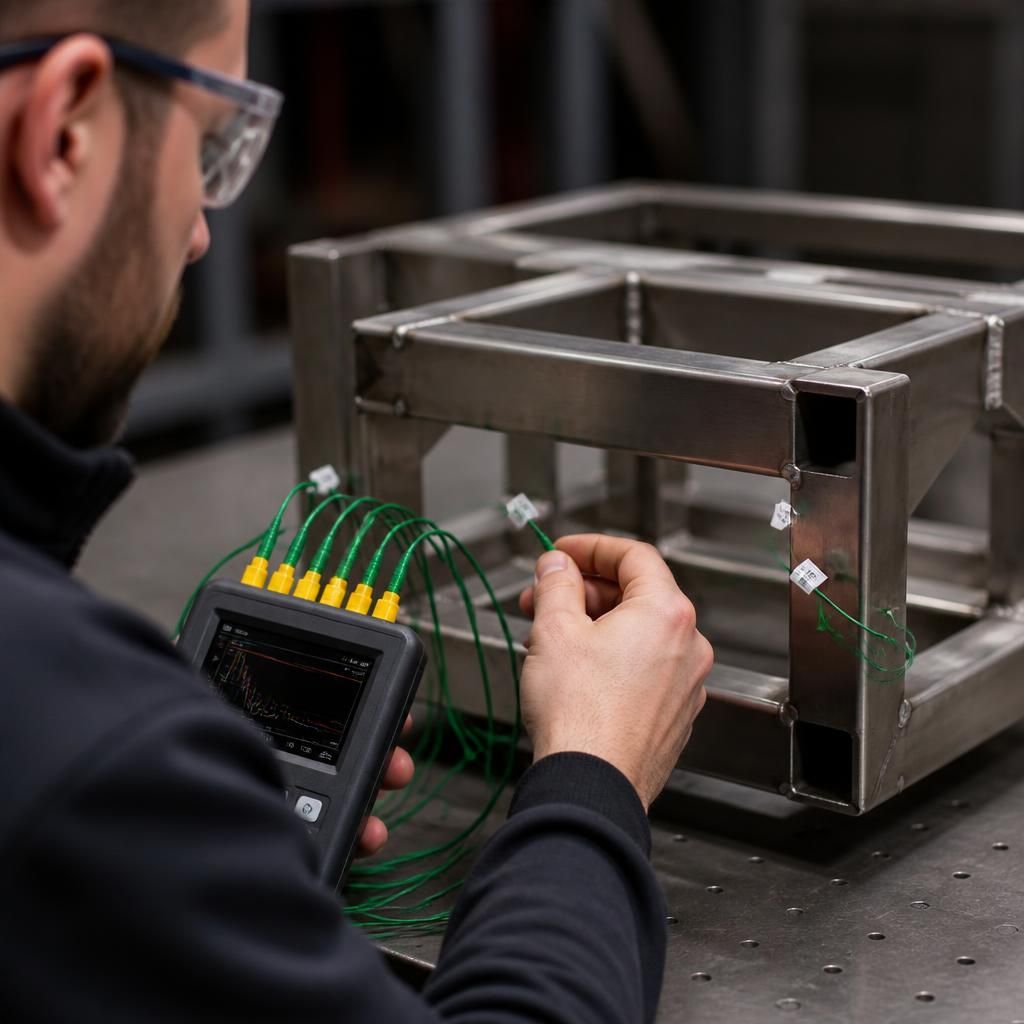
Cure validation should be carried out on a representative stainless steel component, not solely on a flat test panel. A panel can confirm that the powder flows and cross-links under a selected schedule, but it cannot reproduce the heat-up behaviour of thick sections, welded joints, folds or enclosed areas. Profiling a production-representative part therefore gives a more reliable indication that the specified cure has been achieved throughout the finished component.
This is particularly important when the batch includes different component sizes or when the racking arrangement changes. The part that heats most slowly should guide the process assessment, because a satisfactory surface appearance on faster-heating areas does not establish that the whole component has received the required cure.