

What are the stages involved in preparing metal surfaces for powder coating?
Preparing metal surfaces for powder coating typically involves inspecting the component, removing oil, grease, rust and previous coatings, then using mechanical or chemical treatment to create a clean, suitable profile. The surface is rinsed and dried where required, checked for contamination or defects, and masked before powder application.
Metal surface preparation for powder coating is a controlled sequence that makes the substrate chemically clean, physically suitable and stable enough for the coating system. The precise stages depend on the base metal, its condition, the required finish, the operating environment and whether the component has welds, recesses, sharp edges or mixed materials.
1. Establish the preparation specification
Before work begins, the component should be assessed against the intended coating system and service conditions. This includes identifying whether it is mild steel, galvanised steel, aluminium or another compatible metal, as each substrate can require a different treatment route. The specification should also account for exposure to moisture, chemicals, abrasion, heat and outdoor conditions. These factors influence whether straightforward preparation is sufficient or whether enhanced pre-treatment and corrosion protection are needed.
The condition of the component is equally important. Weld spatter, sharp projections, burrs, laminations, casting marks and poorly finished joints can remain visible through the powder film or create weak points. Any fabrication defects that could affect the appearance or performance of the finished coating should be corrected before chemical treatment or coating begins.
2. Prepare welds, edges and difficult features
Welded areas often need particular attention because they may contain heat-affected metal, residues, spatter or uneven surfaces. Crevices and partially enclosed sections can retain preparation chemicals or moisture, while sharp edges can receive a thinner powder film than adjacent flat areas. Grinding, dressing or smoothing may therefore be used where appropriate, while drainage and access should be considered for hollow or folded components.
Components should also be checked for trapped water, enclosed cavities and incompatible inserts. If liquids or residues cannot drain during processing, they may later cause staining, blistering, corrosion or contamination of the coating.
3. Select the mechanical preparation method
Mechanical preparation is selected according to the substrate and the material that must be removed. Abrasive blasting can provide a consistent surface texture and is useful where corrosion, mill scale or an existing coating has to be taken back to a sound substrate. The abrasive, air pressure, nozzle technique and stand-off distance all affect the resulting profile. Excessive blasting can distort thin sections or create an unnecessarily rough surface, whereas insufficient preparation may leave weakly bonded material behind.
Alternative methods, such as controlled abrasion or localised mechanical treatment, may be more suitable for delicate areas or components that must retain close dimensional tolerances. The objective is not simply to make the surface look clean; it is to produce a uniform, suitably keyed substrate without embedding abrasive or damaging the part.
4. Apply chemical pre-treatment where specified
After the main preparation route, a chemical pre-treatment may be used to improve corrosion resistance and provide a more receptive surface for the powder film. The treatment must be compatible with both the substrate and the specified coating system. Process control includes the concentration and condition of the treatment, contact time, solution temperature and the quality of any subsequent rinsing stages.
Steel, galvanised surfaces and aluminium do not respond identically to chemical treatment. A process suitable for one metal may be ineffective or damaging on another, so mixed-metal assemblies require particular care. Where phosphate treatment is used, it should form an even, adherent conversion layer rather than a loose or excessive deposit.
5. Control rinsing, drying and handling
Following wet preparation, the component must be dried thoroughly, including joints, folds, recesses and internal areas that are not immediately visible. Residual water or treatment solution can interfere with powder fusion and may contribute to corrosion beneath the coating. Drying conditions should be appropriate for the substrate and should not introduce new contamination.
Once prepared, the metal should be handled in a way that preserves the treated condition. Clean gloves, suitable racks and protected contact points help prevent fingerprints, oil transfer, dust and metallic debris from reaching the surface. Contact marks from hooks or supports should be planned so that they occur in an acceptable location and do not compromise functional or visible areas.
6. Carry out final quality checks
Before powder is applied, the prepared component should be checked for remaining residues, flash rust, dust, moisture, damaged areas and inconsistent texture. Inspection may involve visual examination, close attention to welds and edges, and process checks appropriate to the preparation system. The acceptance criteria should reflect the final use of the component rather than appearance alone.
At this point, any issue should be corrected before coating. Applying powder over a contaminated or unstable area can conceal the problem temporarily but will not remove the cause of poor adhesion, corrosion or an uneven finish.
7. Protect areas that must remain uncoated
Threads, bearing seats, electrical contact points, machined faces, drainage holes and other functional surfaces may need protection during preparation and coating. Masking materials must withstand the selected process without leaving adhesive residue or affecting the coating edge. Masking is normally planned before the final handling stage so that protected areas remain clean and accurately defined.
The completed preparation stage should leave a component that is suitable for immediate powder application, with the substrate condition, surface profile, pre-treatment and handling method all consistent with the coating specification. Good preparation is therefore a combination of correct sequencing and process control, not a single cleaning operation.
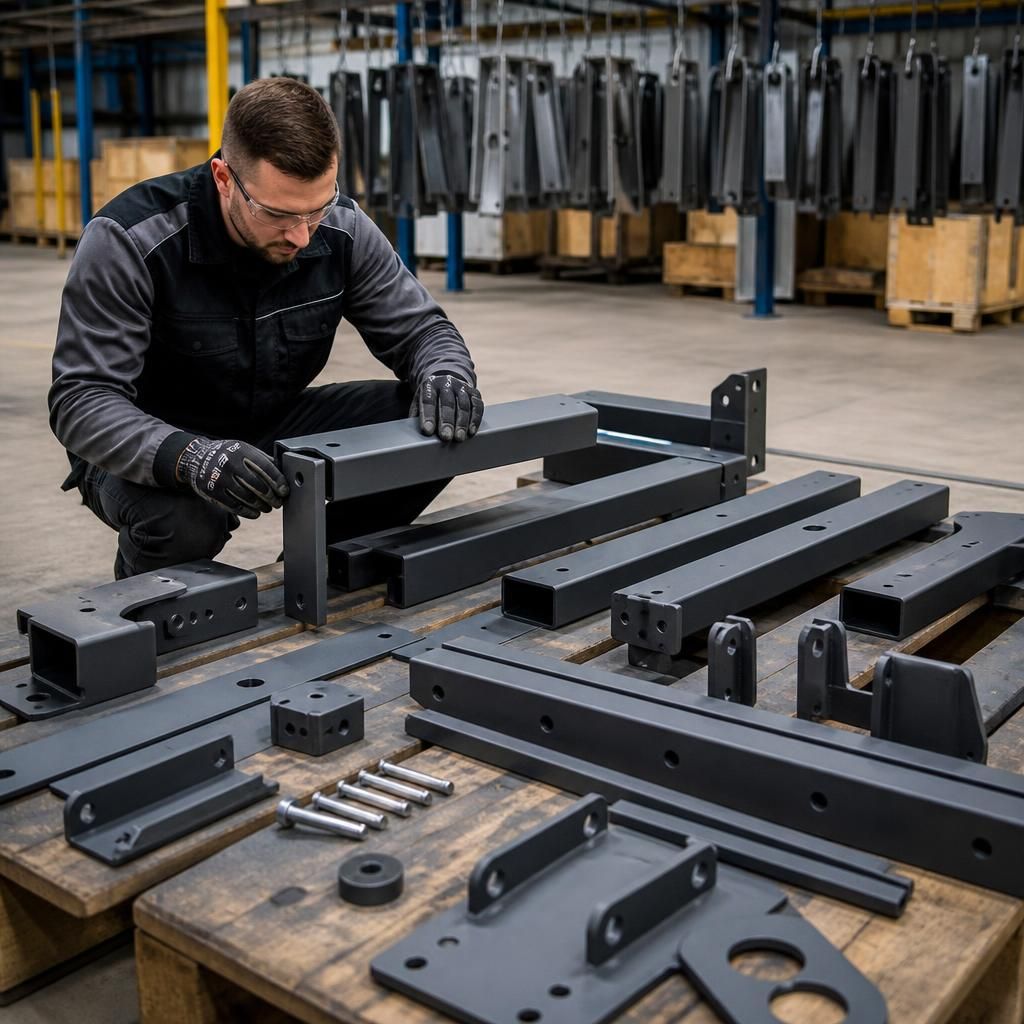
One often-overlooked stage in preparing metal surfaces for powder coating is deciding whether a component should be processed as a complete assembly or as separate parts. Preparation and coating cannot be fully effective where joined surfaces, concealed interfaces or non-metallic inserts prevent proper access.
- Separate components where overlapping faces, fasteners or folded sections would prevent cleaning and treatment from reaching the substrate.
- Remove seals, plastics, rubber parts and other heat-sensitive or incompatible materials before processing, unless the coating specification allows them to remain in place.
- Confirm that each part can be securely supported without obscuring important surfaces during preparation and powder application.
- Plan the final assembly sequence so that coated faces are not damaged by drilling, welding, grinding or forced fitting afterwards.
This decision should be made before preparation begins because assembly state affects access, masking, coating coverage and the condition of the finished component. For fabricated parts with concealed areas, processing individual components may produce a more consistent result than coating the assembly as a single unit.
Discuss your metal surface preparation requirements
If you are unsure which preparation route suits your components, discuss the substrate, dimensions, existing finish and intended coating specification with the powder-coating.co.uk team. They can help clarify the information needed before your parts are prepared for powder coating.