

Can Interpon D2015 and D2525 finishes be applied to aluminium components with intricate designs or complex shapes?
Yes, Interpon D2015 and D2525 finishes can be applied to aluminium components with intricate designs or complex shapes, provided the part is suitably prepared and the coating process is adapted to its geometry. Recesses, edges, narrow sections and areas that could retain contaminants require careful design review, pretreatment and powder application to achieve consistent coverage and protection.
Interpon D2015 and D2525 finishes are generally suitable for aluminium components with intricate profiles, provided the component has been designed and specified for powder coating. The coating system must be selected with the intended environment and performance requirement in mind, while the part’s geometry determines how it should be prepared, mounted, sprayed and cured.
Complex aluminium shapes present different coating challenges from flat panels or straightforward extrusions. Deep recesses, internal corners, perforations and closely spaced features can restrict the movement of powder particles. Electrostatic powder may be attracted more strongly to exposed outer surfaces than to recessed areas, creating uneven film build. This effect, commonly associated with the Faraday cage effect, needs to be considered when assessing the design and planning the spray sequence.
A pre-production review should examine the following features:
- Recesses and cavities: narrow or deep areas may need a revised spray angle, additional manual application or a design change to make the surface accessible.
- Sharp edges: very acute edges can receive less consistent coverage than radiused edges and may require attention during design review and inspection.
- Overlapping sections: close-fitting folds, louvres and nested profiles can restrict both powder access and air movement during processing.
- Drainage and ventilation: hollow or enclosed sections should be assessed for suitable drain and vent arrangements where required by the component design and pretreatment process.
- Racking points: the part must be supported securely without obscuring important surfaces or leaving contact marks in visible areas.
- Dimensional tolerances: the specified coating thickness and any masking requirements should be checked against holes, threads, mating faces and other close-tolerance features.
Surface preparation is particularly important on aluminium because the coating needs a clean, chemically suitable surface to adhere consistently. The preparation sequence should be appropriate for the aluminium alloy, the condition of the component and the chosen Interpon system. Fabrication residues, oils, handling contamination, oxide layers and residues from cutting or welding can all affect the finished result if they are not dealt with correctly. Welded areas, joints and heat-affected zones should be included in the review rather than treated as identical to the original sheet or extrusion.
Masking is normally used where powder must not be applied. Typical examples include threaded holes, bearing seats, electrical contact points, precision-machined faces and assembly interfaces. On intricate components, masking can be more extensive and may influence both preparation and racking. Masking materials and methods also need to tolerate the curing process without leaving residue or damaging the finish.
The application method should be planned around the shape rather than treating the component as a simple flat surface. Gun distance, spray direction and the order in which areas are coated can affect coverage in corners and recesses. A skilled applicator may use several orientations to reach less accessible faces while controlling excess powder on exposed edges. Parts may also need careful repositioning between stages, provided this can be done without contaminating the prepared surface.
Curing requires the same level of control. The relevant requirement is the metal temperature and cure schedule specified for the selected coating system, not simply the temperature displayed by the oven. Aluminium’s section thickness, mass and shape affect how quickly it reaches the required temperature. Thin projecting features may heat differently from heavier sections, so the production process should be assessed against the actual component rather than assumed from a simpler reference part.
Inspection should cover more than the most visible faces. A suitable quality check can include visual examination of recesses, edges, corners and masked areas, together with checks that the finish is continuous and free from obvious defects. Where the project specification requires it, coating thickness, adhesion, cure and colour consistency can be assessed using appropriate methods. The acceptance criteria should be agreed before production, especially where some internal faces are difficult to inspect or where the component has close assembly tolerances.
Interpon D2015 and D2525 should therefore be compared against the project’s exposure conditions, appearance requirements, durability specification and maintenance expectations, rather than chosen solely because a component is complex. A complicated profile does not automatically rule out either finish, but it may require design-for-coating changes, a trial component or a documented process review before batch production. Providing accurate drawings, alloy information, surface requirements, masking details and the intended use of the part allows the coating process to be assessed realistically before work begins.
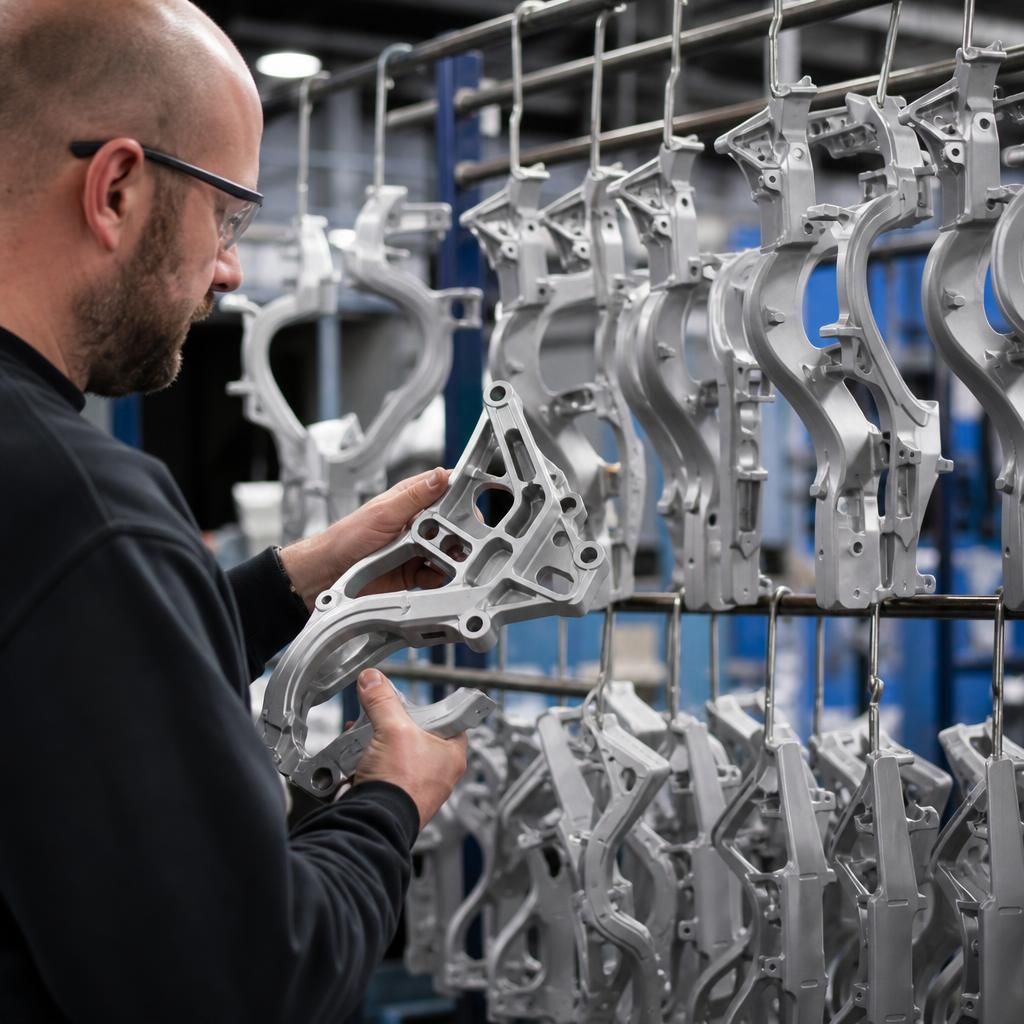
Intricate aluminium details can usually retain their intended form after Interpon D2015 or D2525 application, but the coating’s film build must be allowed for in the design. Very fine grooves, narrow slots and close-fitting interfaces may lose definition or become tighter once coated, particularly where several coated parts assemble together.
For components with demanding visual or dimensional features, the drawing should identify critical clearances and areas where coating must be limited. This helps determine whether masking, additional tolerance or a representative sample is needed before the full production run.