

What role does curing time play in the effectiveness of filler primers in powder coating?
Curing time determines whether a filler primer develops the correct adhesion, hardness and stability before the powder topcoat is applied. Under-curing can leave the primer soft or poorly bonded, while over-curing may reduce intercoat adhesion or contribute to surface defects, so the specified time and temperature must be matched to the primer, metal substrate and coating thickness.
Curing time controls when a filler primer is ready to receive the powder topcoat and determines whether its designed performance is achieved. The primer must be exposed to the specified combination of part temperature and time so that its binder develops the required film structure, allowing it to support the subsequent coating layers without distortion, contamination or loss of bond.
In powder coating, the stated cure schedule normally relates to the temperature reached by the metal part, rather than simply the time that the component spends inside the oven. A small bracket may reach the target temperature quickly, whereas a heavy fabricated section or a densely loaded batch may take considerably longer. The oven dwell period therefore needs to account for the thermal mass, shape and loading of the work. Applying the same clock time to every component can result in inconsistent primer performance.
The curing process affects several aspects of a filler primer:
- Film development: the primer’s resin and additives form a continuous, stable film as the coating reacts and consolidates. Insufficient development can leave the layer vulnerable during handling or during application of the topcoat.
- Surface condition: correct curing gives the primer a predictable surface for the next powder layer. An abnormal surface may cause poor wetting, pinholing, cratering or uneven appearance in the finished coating.
- Dimensional stability: the filler layer must retain its shape and thickness as it passes through the oven. Excessive thermal exposure can affect the coating or reveal imperfections that were not apparent immediately after application.
- Intercoat performance: the primer and topcoat need to function as a coating system. The permitted recoat condition and any preparation required between coats should be confirmed from the technical data for the selected products.
The correct schedule is influenced by more than the nominal oven setting. Primer formulation, applied film thickness, metal type, component geometry and the topcoat chemistry can all affect the result. A thick primer film may require different treatment from a light, uniform layer. Complex parts can also create shaded or poorly exposed areas where heat transfer is slower. If the primer is applied over welds, sharp edges, repairs or areas with different substrate thicknesses, these locations should be included when assessing cure uniformity.
Oven control is particularly important. Air temperature and actual metal temperature are not interchangeable, so a coating operation should establish how the parts heat throughout the oven. Temperature profiling equipment can identify cold spots, excessive heat, slow ramp-up and differences between component locations. This is more reliable than relying only on the oven display or a fixed stopwatch. Profiling is especially useful when changing batch size, part thickness, rack arrangement or production loading.
A practical curing assessment should follow a controlled sequence:
- Confirm the primer’s specified cure schedule, recommended film thickness and recoat instructions from the current technical documentation.
- Check that the substrate has been correctly prepared and that the applied primer film is within the intended thickness range.
- Measure the temperature profile of representative parts, including the heaviest or most thermally demanding components.
- Allow the primer to cool or condition as required before applying the topcoat, while protecting the surface from dust, moisture and handling damage.
- Apply the topcoat using the specified process and complete its own cure cycle rather than assuming that the primer’s schedule is sufficient for the entire system.
- Inspect the finished coating and investigate any variation by comparing part position, film thickness and recorded thermal history.
Curing time should not be adjusted in isolation when a problem appears. A soft or easily marked primer may indicate inadequate metal temperature, excessive film build, poor oven circulation or an unsuitable preparation condition rather than simply a need for a longer dwell. Conversely, extending the cycle without checking the product specification can increase thermal exposure and alter the surface available for the topcoat. Changes to line speed, oven temperature, component loading or part presentation should therefore be validated rather than assumed to be equivalent.
For batch production, recording the relevant process conditions helps separate curing faults from application or preparation faults. Useful records include the primer product specification, batch identity, measured film thickness, oven profile, component configuration and any inspection findings. Where the coating is safety-critical, corrosion-sensitive or subject to a customer specification, verification may include solvent resistance, adhesion assessment, film-thickness checks and visual examination. The appropriate test method should be agreed with the coating supplier or project specification, as no single test confirms every aspect of cure.
In short, curing time is part of a wider thermal process. A filler primer is effective only when the correct product, film thickness, metal temperature, oven conditions and recoat procedure work together. Controlling these variables gives the powder topcoat a consistent base and reduces defects caused by a primer that has been processed outside its intended cure window.
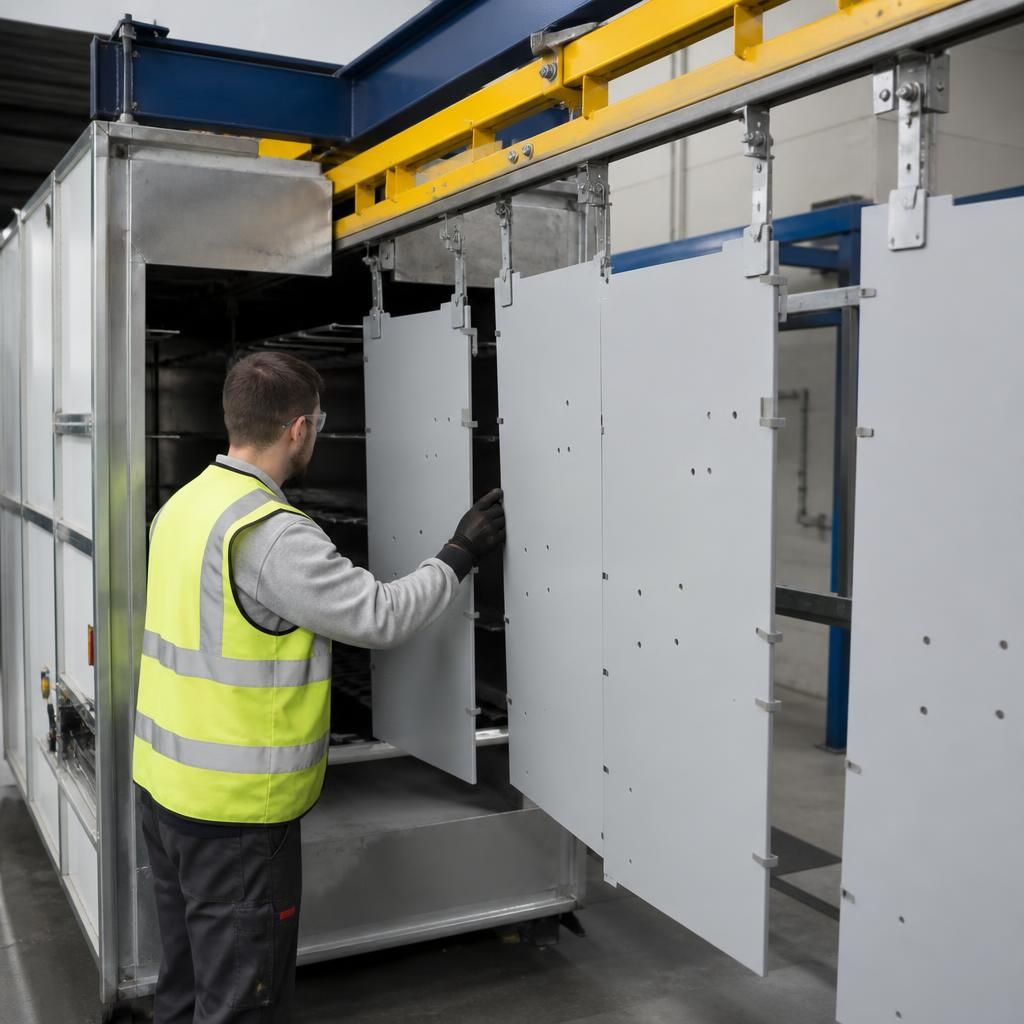
The specified cure state is important when a filler primer forms part of a two-coat powder system. Some products are intended to receive the topcoat after an intermediate cure, while others require the primer to be fully cured before recoating. These stages are not interchangeable: applying the second layer at the wrong point in the primer’s cure cycle can affect how the coats bond and may change the final surface appearance.
For this reason, the primer’s technical data should state whether the coating is to be gelled, partially cured or fully cured before the topcoat is applied. The required interval between coats, any permitted cooling period and any surface preparation should also be followed. A process that is suitable for one filler primer may be unsuitable for another, even when the same metal component and powder topcoat are used.
Discuss Your Filler Primer Curing Requirements
Discuss your filler primer curing requirements with our powder coating specialists, providing the primer and topcoat specifications, component details and required finish. We can help identify the process information needed to assess the coating system for your application.