

What factors should be considered when selecting the right epoxy primer coat for specific metal applications?
Select an epoxy primer coat by matching its formulation to the metal substrate, the required corrosion resistance, the service environment and the intended topcoat. Also consider surface preparation, application method, curing requirements, film thickness and compatibility with the powder coating system to ensure dependable adhesion and long-term performance.
The right epoxy primer coat is selected by assessing the metal component’s duty, geometry, substrate condition, exposure and production requirements together. The best choice is not necessarily the thickest or most highly corrosion-resistant product; it must provide the required protection without creating problems with dimensions, flexibility, appearance, processing or the finished coating system.
Consider the metal and its condition. Steel, galvanised steel, aluminium, cast metal and previously coated components can present different adhesion and corrosion challenges. Galvanised surfaces may contain residues or passivation treatments, while aluminium can have a tenacious oxide layer. Castings may also contain pores, moulding residues or trapped contaminants. The selected primer should be technically suitable for the actual substrate rather than being treated as a universal coating.
Mixed-metal assemblies require particular care. If dissimilar metals are in contact and moisture can reach the joint, the coating system should help limit access to the interface and avoid creating a route for galvanic corrosion. Masking, joint design and the treatment of crevices may be as important as the primer specification itself.
Match the coating to the component’s mechanical duty. A rigid epoxy film may be appropriate for a stable structural part, but a component that is bent, flexed, bolted, vibrated or exposed to repeated impact may require a coating with suitable flexibility and toughness. Consider movement at seams, sharp edges, threaded areas and formed sections. Excessively brittle coverage can crack when the metal deforms, allowing corrosion to develop beneath the coating.
Dimensional tolerances also matter. Primer adds film build to mating faces, holes, threads and close-fitting components. If the part has tight tolerances, the specification should identify areas requiring masking or controlled coverage. This is particularly relevant for precision-fabricated parts, sliding interfaces and assemblies where a small increase in thickness could affect fit.
Assess the actual exposure rather than relying on a general environment description. Identify the substances that may contact the coating, such as oils, fuels, detergents, salts, solvents, process chemicals or alkaline and acidic materials. Temperature cycling, immersion, condensation and abrasion can affect a primer differently from occasional outdoor exposure. Where contact is continuous or severe, the manufacturer’s chemical-resistance information should be checked for the specific concentration, temperature and duration involved.
Ultraviolet exposure should also be considered. Epoxy primers are generally selected for their adhesion and protective properties beneath a suitable finishing layer, not for long-term appearance when left exposed. If the primer may remain visible, the specification should address colour stability, chalking and the visual standard required. Areas hidden inside an assembly may have different requirements from visible faces.
Check how the part is designed and manufactured. Welds, overlaps, drain holes, folded edges, recesses and enclosed sections can retain moisture or make uniform coverage difficult. Sharp corners can receive less effective protection than broad faces, while recesses may collect coating or remain inaccessible. The primer choice should be considered alongside the component’s geometry and the level of edge and recess protection needed.
For hollow fabrications, confirm that the design allows air, moisture and process residues to escape. Sealed sections can create pressure or outgassing problems during heating, and trapped contamination can undermine the coating from beneath. Castings and porous materials may need additional assessment because heating can release gases through the coating and cause pinholes or blistering.
Review the complete specification and quality requirements. Important selection criteria can include:
- the required visual finish, including acceptable colour, gloss and surface uniformity;
- whether the part will be visible, enclosed, handled frequently or exposed to abrasion;
- the inspection method used to verify coverage, adhesion and coating continuity;
- the permitted film-build range and any restricted areas;
- the required repair procedure if the coating is damaged during transport or assembly;
- traceability requirements for batches, materials and inspection records; and
- any sector-specific documentation, testing or environmental restrictions.
These points prevent a technically sound primer from being rejected because it does not meet the project’s appearance, documentation or dimensional requirements.
Use technical data for the specific system. Product literature should be checked for substrate recommendations, recoat limits, chemical resistance, storage conditions, film-build guidance and permitted curing parameters. A primer that performs well in isolation may not be suitable if its recoat window, surface characteristics or curing behaviour conflicts with the subsequent coating process. Where the combination is not already established, a representative trial or compatibility test is more reliable than selecting by product name alone.
Finally, weigh the consequences of failure. A decorative enclosure, an external fabricated frame and a component exposed to chemicals may justify different levels of testing and specification control. For critical parts, selection should be based on documented technical requirements and, where appropriate, a sample evaluation using the same metal, geometry and coating sequence as production. This approach identifies incompatibility, excessive build, adhesion weaknesses and appearance issues before the full batch is processed.
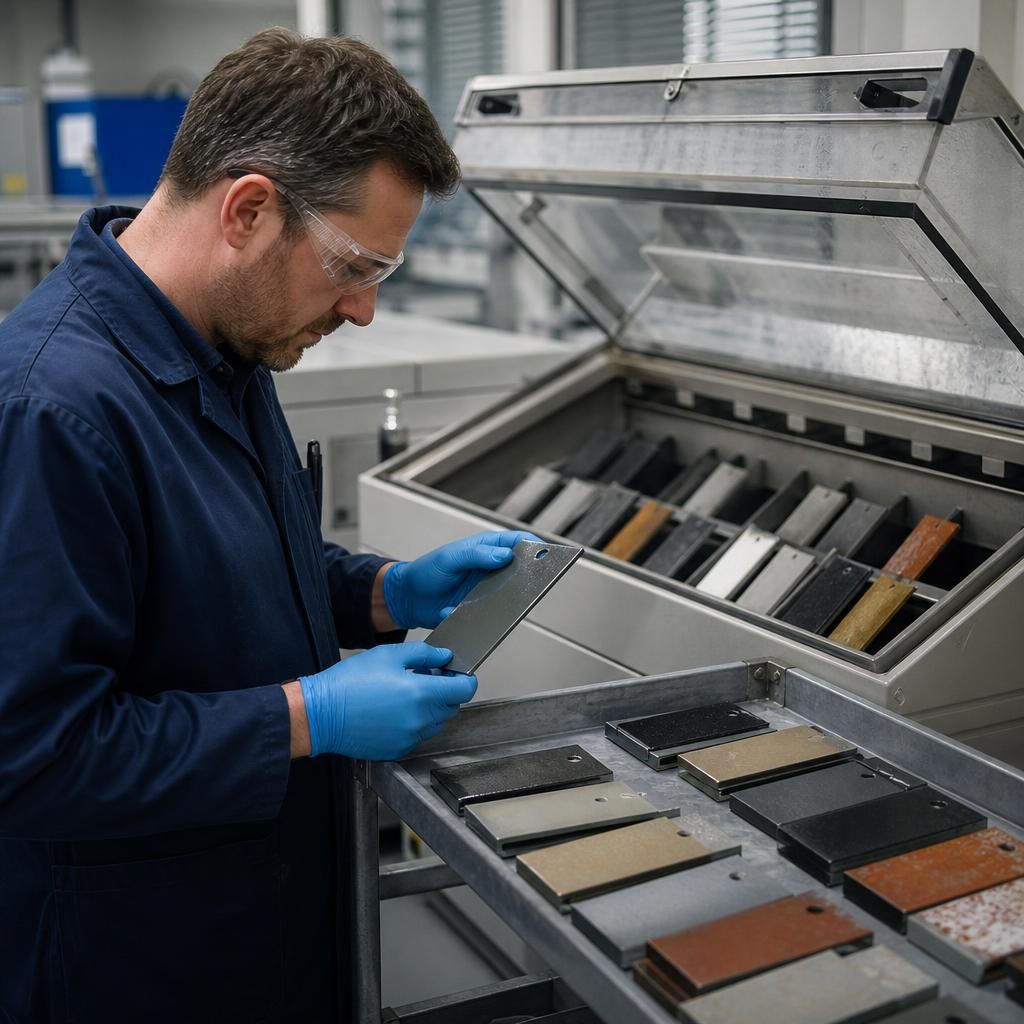
Corrosion protection should be selected using relevant test evidence rather than a product’s general resistance claim. Check that the data relates to the intended substrate, pretreatment, primer thickness, topcoat and exposure conditions. Results from accelerated testing are only useful for comparison when the test method and assessment criteria are understood; they do not automatically predict performance in every service environment.
For components where corrosion failure would be costly or difficult to rectify, request evidence from representative coated panels or trial parts. The evaluation should reflect the proposed preparation and complete coating system, including edges, joints and any areas likely to be damaged during handling. This gives a more reliable basis for choosing between primers than relying on nominal specifications alone.
Discuss the right epoxy primer coat for your metal application
Discuss your proposed metal application with a powder-coating specialist, providing details of the substrate, service environment, component design and intended finishing system. This allows the epoxy primer specification to be reviewed against the complete coating process before production.