

How does powder coating ensure adherence to industry standards for electrical insulation?
Powder coating supports electrical insulation standards through a specified coating system, controlled surface preparation, consistent application and correct curing. The finished coating can then be assessed against the relevant requirements for properties such as dielectric strength, insulation resistance, adhesion and environmental durability.
Powder coating supports adherence to electrical insulation standards when the coating is treated as one controlled part of the component’s compliance specification, rather than as an automatic guarantee of insulation performance. The required standard, electrical duty, substrate, coating system and service environment must be defined first, then verified through documented production controls and suitable testing.
Electrical standards generally assess the complete component or assembly. Depending on the application, relevant requirements may include:
- Dielectric withstand, which confirms that the insulation resists breakdown when a specified voltage is applied.
- Insulation resistance, measuring how effectively the coating and component restrict unwanted current flow.
- Creepage and clearance distances, particularly where the coating forms part of the separation between conductive areas.
- Thermal performance, including the ability to retain insulating properties at the temperatures encountered in service.
- Resistance to moisture, chemicals, corrosion and mechanical damage where these could reduce insulation performance.
- Flammability or fire-related requirements where the coated part is used within electrical equipment subject to those controls.
The applicable requirements may come from product-specific BS, EN or IEC standards, customer specifications or an internal engineering standard. The correct reference depends on the finished component, its voltage, operating environment and position within the assembly. A coating supplier can support the process, but responsibility for demonstrating that the complete product meets its applicable standard remains with the product designer or manufacturer.
Compliance starts with a defined coating specification. This should identify the powder type, intended electrical function, substrate, colour where relevant, target film build, approved preparation method, curing conditions and acceptance criteria. It should also identify areas that must remain uncoated, such as earth connections, threads, mating faces or dimensional interfaces. Clear boundaries prevent a coating that is electrically suitable in general from creating a problem elsewhere in the assembly.
Surface condition is important because contamination, oxidation, sharp burrs or incompatible pretreatment can create weak points beneath the film. Preparation must therefore be appropriate to the base metal and the service environment. The coating specification should also account for edges, recesses, apertures and joints, where achieving continuous coverage can be more difficult than on a flat surface.
Application controls help produce a repeatable insulating layer. Powder must be applied evenly enough to avoid thin areas, uncovered sections, heavy runs or inclusions. Film thickness is not simply a case of applying as much material as possible: excessive build can affect fit, curing, edge coverage and the operation of associated parts. Masking and racking arrangements also need to prevent contact points or specified conductive areas from being unintentionally coated.
Curing is another compliance consideration. The powder must reach the specified metal temperature for the required time so that the resin system develops its intended physical and electrical properties. Oven settings alone do not necessarily demonstrate that every component has received the required cure. Part size, metal thickness, loading and component position can affect heat transfer, so production checks should relate the cure schedule to the actual workpiece.
Inspection provides evidence that the finished coating remains within the agreed specification. Depending on the component and standard, checks may include:
- Visual inspection for pinholes, bare areas, blisters, cracks, inclusions and other discontinuities.
- Film-thickness measurement at representative locations, including areas where coverage is difficult.
- Adhesion assessment to identify poor bonding that could allow moisture or contamination to reach the substrate.
- Dimensional checks on coated interfaces, holes, threads and mating surfaces.
- Electrical tests selected for the component’s intended use, such as insulation resistance or dielectric withstand testing.
Electrical test results must be interpreted in context. A coating may show suitable insulation resistance on a test panel while the finished part still fails because of an exposed edge, an uncoated fixing point, inadequate separation distance or damage introduced during assembly. For that reason, representative parts and the completed design are more informative than a generic statement that a particular powder is electrically insulating.
Environmental validation may also be necessary. Heat cycling, humidity, salt exposure, chemical contact, abrasion or vibration can affect adhesion and create paths for leakage current. The selected tests should reflect the conditions the component is expected to experience, with inspection and electrical measurements repeated where the applicable product standard requires it.
Traceable records connect the finished part to the compliance decision. Useful documentation can include the coating specification, powder identification, batch information, preparation details, curing records, inspection results, electrical test results, non-conformance reports and any approved changes. Retaining this information helps the manufacturer demonstrate that production parts were made using the same controlled system that was assessed during development.
Changes should be managed rather than treated as interchangeable substitutions. A different powder chemistry, pretreatment, substrate, film thickness, cure schedule or masking arrangement can alter electrical and environmental performance. Revalidation may therefore be required when a change affects the properties on which the original assessment was based.
For a B2B coating project, the most useful starting point is the component drawing, electrical specification and applicable product standard. These documents allow the coating requirements to be separated from the requirements of the wider assembly and make it clear which characteristics need to be tested, recorded and approved before production.
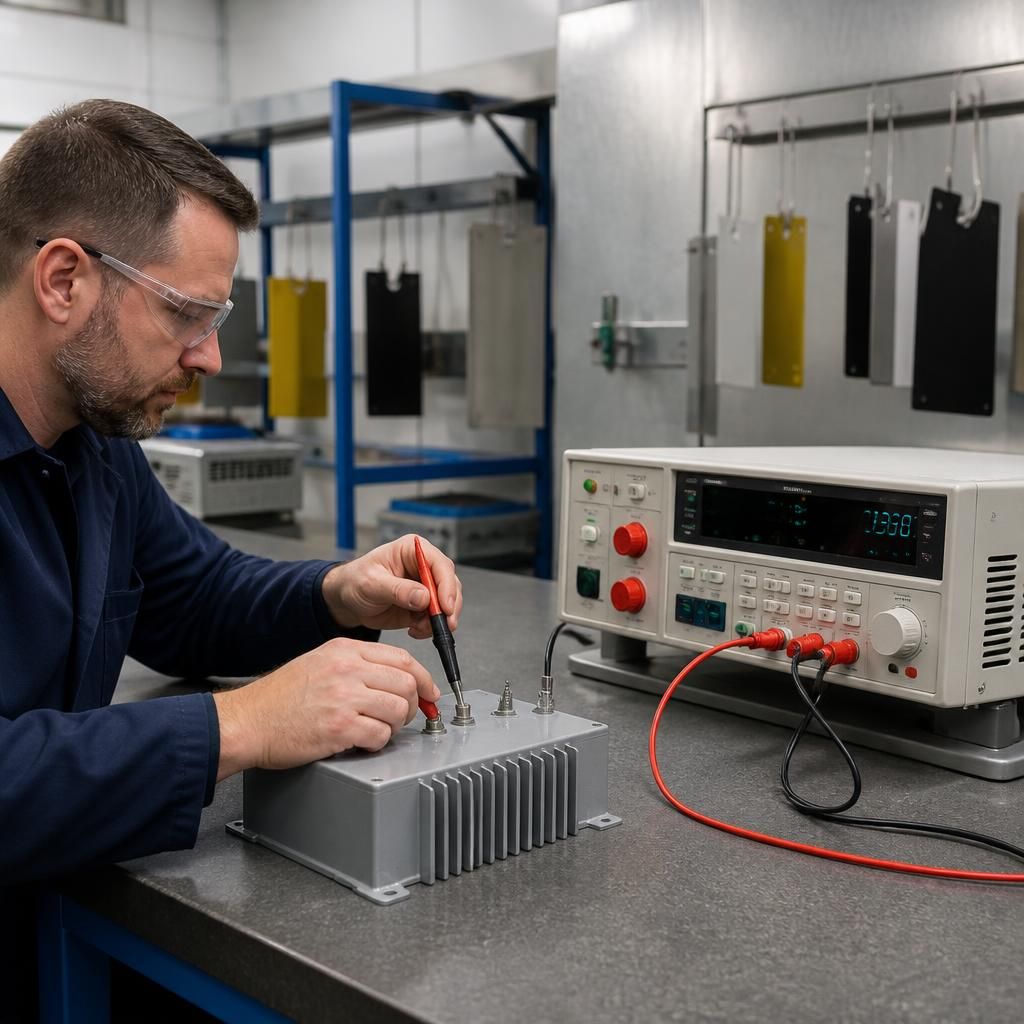
Reliable evidence of electrical insulation performance depends not only on the coating itself, but also on how measurements are made. Inspection and electrical test equipment should be suitable for the required range, maintained in a controlled condition and calibrated against recognised references. Test methods should define the applied voltage, conditioning, contact points and acceptance limits so that results are consistent and meaningful.
This approach helps distinguish a genuine coating or component issue from variation caused by the test arrangement. It also gives the manufacturer an auditable basis for reviewing results against the applicable industry requirement, particularly where electrical performance forms part of a wider product approval process.