

What role does rinsing play in the aluminium powder coat pretreatment process?
Rinsing removes cleaning chemicals, loosened contaminants and pretreatment residues from aluminium before powder coating. Effective rinsing prevents surface contamination and helps the conversion coating form a clean, consistent base for strong adhesion and a durable finish.
Rinsing is a controlled process step that stabilises the aluminium surface between pretreatment stages. Its role is not simply to wash the component; it separates incompatible chemicals, controls carry-over from one tank to the next and helps ensure that each subsequent treatment acts under the intended conditions.
Aluminium components normally pass through more than one rinse stage during pretreatment. A rinse after alkaline cleaning limits the amount of cleaner entering the etching or conditioning stage. A further rinse after etching removes the products generated during that reaction before the component receives its conversion treatment. The final rinse is particularly important because anything left on the surface at this point can remain beneath the powder coating.
- Inter-stage rinsing: reduces chemical carry-over and protects the formulation of the next treatment bath.
- Rinsing after conversion treatment: removes soluble residues without damaging the newly formed conversion layer.
- Final rinsing: prepares the component for drying and powder application, where water quality and drainage have a direct effect on finish quality.
The effectiveness of a rinse depends on more than immersion time. Spray pressure, nozzle coverage, water flow, tank condition, component orientation and the time allowed for drainage all influence the result. Recesses, folded edges, drilled holes and overlapping sections can retain process liquid, so components should be positioned to allow liquid to escape. Racks and handling fixtures must also avoid shielding areas from the rinse spray.
Water quality is another important consideration. As a rinse tank becomes loaded with chemicals and dissolved material, its ability to dilute carry-over falls. Conductivity, pH and other site-specific checks can be used to assess whether rinse water remains suitable for its position in the process. Fresh or treated water is generally reserved for the later stages where surface cleanliness is most critical, while earlier rinses may be managed differently according to the pretreatment system.
Rinsing should be matched to the chemistry being used. An aluminium surface may require thorough dilution of an alkaline cleaner, but a conversion coating can be more sensitive to aggressive handling or unsuitable water conditions. Excessive rinsing, poor water selection or incorrect flow can affect the treatment just as inadequate rinsing can. The objective is a controlled transition between stages, not the greatest possible volume of water.
After the final rinse, parts should drain properly and be dried without allowing dirty equipment, bare hands or contaminated surfaces to reintroduce residues. Operators commonly inspect for water break, staining, runs, trapped liquid and uneven wetting. Persistent droplets or patches may indicate poor cleaning, inadequate spray coverage, contaminated rinse water or a component design that prevents drainage. These signs should be investigated before powder is applied rather than concealed by the coating.
Inadequate rinsing can produce several recognisable problems, including discolouration, blistering, loss of adhesion, staining around joints and inconsistent appearance between batches. It may also shorten the useful life of the pretreatment system by allowing excessive chemical transfer between tanks. Correct rinsing therefore supports both surface performance and process repeatability, while reducing the need to rework components that fail inspection.
For batch work, rinse conditions should be recorded as part of the pretreatment process rather than treated as an informal wash stage. Relevant controls may include rinse sequence, water replacement or replenishment, measured water condition, spray coverage, drainage time and drying arrangements. The precise limits depend on the chemicals, equipment and specification involved, so they should be set by the pretreatment system supplier or the coating process engineer.
Professional powder coating preparation applies these controls to the component geometry and the required finish, checking that rinsing is sufficient at difficult areas as well as on exposed faces. This is especially relevant for fabricated aluminium assemblies and parts with channels or joints, where retained liquid can undermine an otherwise well-controlled pretreatment process.
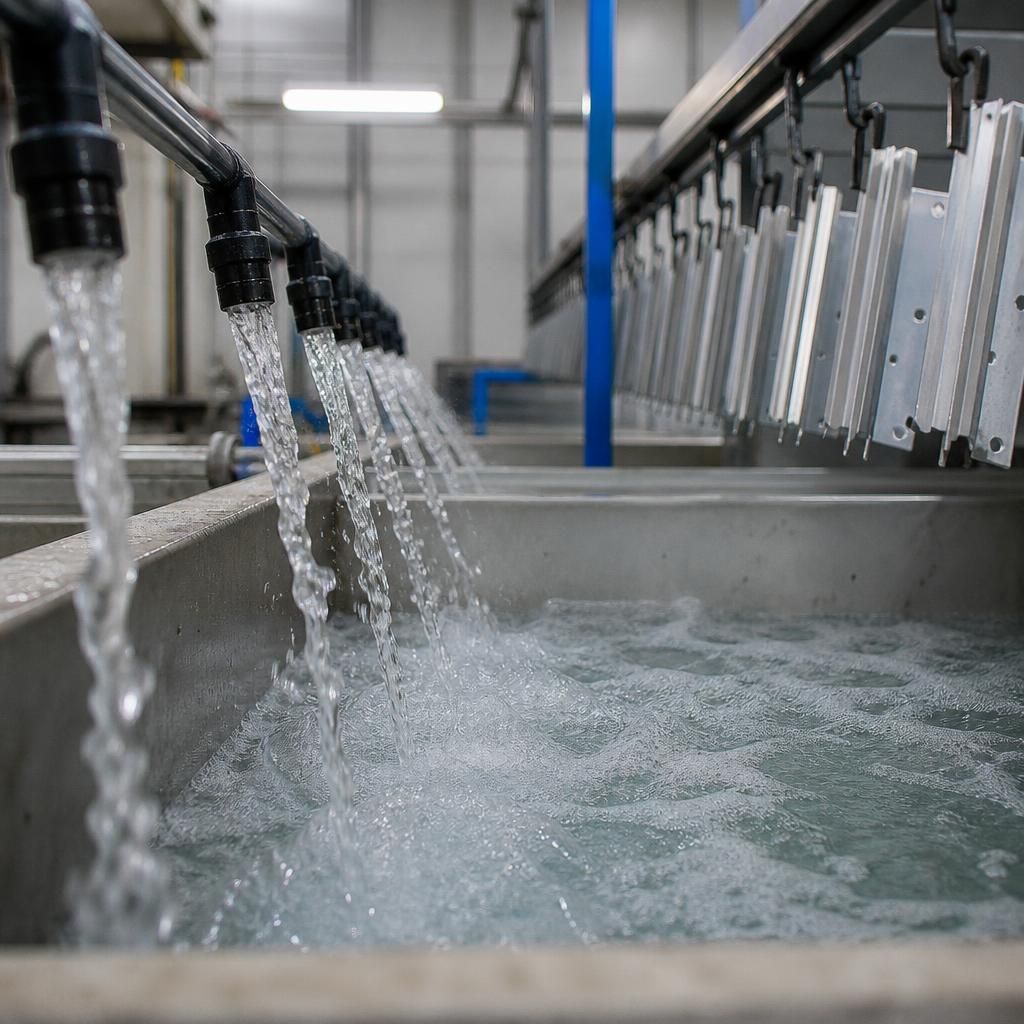
Rinsing also helps control water use without compromising surface preparation when the stages are arranged in a suitable cascade or counter-current system. In this arrangement, the cleanest water is used at the later rinse stage, while water from that stage can be directed towards an earlier stage where the contamination load is higher. This maintains a cleaner surface before conversion coating while avoiding the need to use the same water quality throughout the entire pretreatment line.
The sequence must be designed around the chemical load carried by each stage. If rinse water is allowed to move in the wrong direction, contaminants can be transferred back towards the cleaner aluminium surface and undermine the purpose of the process. Monitoring each stage separately helps identify when a rinse is no longer providing adequate dilution and supports consistent pretreatment across batches.