

What are the applications of powder coated perforated aluminium across different industries?
Powder coated perforated aluminium is used across construction, manufacturing, automotive and architectural design for lightweight panels, ventilation screens, protective guards, façades, partitions and enclosures. Its perforated structure provides airflow, screening or visual interest, while the powder-coated finish adds a durable, colour-consistent surface for indoor and outdoor metalwork.
Powder coated perforated aluminium is used where a project needs a formed metal surface that allows air, light or sound to pass through while providing a consistent, coloured finish. Its applications vary by industry: building projects commonly use it for external screening and architectural detailing, manufacturers use it for protective and ventilated components, and transport, automotive and interiors projects use it where low weight and controlled perforation are important.
In construction, one of the most established uses is external screening. Perforated aluminium can be specified for plant-room screens, service-yard enclosures, balcony infill panels, roofline features and façade detailing. The open area can be selected to balance visibility, airflow and screening requirements, while the powder-coated surface provides a defined finish that can align with the wider building design. It may also be used for soffits, suspended ceiling features and internal partitions where the perforation pattern forms part of the visual scheme.
Building services contractors may use the material around ventilation and mechanical equipment where an enclosure needs to conceal plant without fully restricting air movement. It can also be incorporated into access panels, equipment surrounds and removable service screens. For these applications, the design must consider the required free area, panel stiffness, fixing method and access for inspection or maintenance. Powder coating can be applied after the aluminium has been prepared, but the component design should allow the coater to reach the relevant faces and edges consistently.
Manufacturing uses include machine guards, equipment covers, protective screens and ventilated enclosures. Perforated aluminium can separate operators from moving or heated equipment while allowing observation and air circulation. It is also suitable for guards around motors, compressors and processing equipment when the perforation size and panel construction are appropriate for the hazard being controlled. The coating provides a defined surface for the finished component, but it should not be treated as a substitute for a formal guarding assessment or the correct mechanical design.
In factory and warehouse environments, powder coated perforated aluminium may be used for racking infills, work-area dividers, tool-storage panels and protective surrounds. These components can be designed in repeatable sizes for batch production, making it easier to maintain a consistent appearance across multiple units. Where panels will be handled, cleaned or exposed to abrasion, the specification should address edge treatment, coating suitability and the likelihood of impact rather than relying on colour or appearance alone.
Automotive applications can include airflow covers, protective guards, service-area screens and trim elements for vehicles, workshops or specialist equipment. Perforation can support ventilation around components while reducing the visual bulk of a solid cover. In this sector, the design also needs to account for vibration, contact with oils or cleaning products, heat exposure and the way the part will be fixed. Small holes, folded returns and accurately positioned apertures may require particular attention during fabrication and coating to prevent distortion or make assembly difficult.
Architectural and interior designers use powder coated perforated aluminium for feature walls, room dividers, balustrade infill, reception details, retail fittings and display structures. Here, the pattern, orientation and colour are often as important as the engineering function. A regular round-hole pattern may provide a restrained appearance, while slots or bespoke arrangements can create directional lines, logos or visual screens. The final effect depends on the viewing distance, the position of lighting and the contrast between the panel and whatever is behind it.
Transport, public-realm and commercial developments may specify perforated aluminium for station, terminal or service-area screening, pedestrian barriers, sign backing and protective architectural elements. These applications can involve repeated panels, exposed edges and frequent contact, so the specification should include suitable thickness, support spacing and secure fixings. Where components are installed outdoors, the coating system, pretreatment and colour choice should be selected with the surrounding environment and expected cleaning regime in mind.
Electrical and equipment manufacturers can use perforated aluminium for ventilation covers, cabinet doors, control-panel surrounds and electronic equipment enclosures. The perforations help provide an open route for airflow, although the final arrangement must be checked against the equipment’s thermal, ingress and safety requirements. A powder-coated finish can help distinguish equipment zones or match an established product range, but apertures, hinges, latches and earthing points must remain compatible with the complete assembly.
Across these industries, the most suitable application is determined by more than the chosen colour. Important decisions include:
- Perforation pattern: hole diameter, slot shape, pitch and open area affect airflow, visibility, strength and appearance.
- Aluminium thickness and form: flat sheet, folded panels and framed sections behave differently under load and during installation.
- Edge and fixing details: folded returns, hems, brackets and access points influence rigidity and the quality of the finished installation.
- Exposure: indoor, outdoor, industrial and coastal conditions may require different preparation and coating considerations.
- Handling and assembly: parts should be designed to reduce damage during transport, fitting and later removal for servicing.
For a batch of perforated aluminium parts, the coating specification should be agreed alongside the fabrication drawings. That allows the intended visible faces, masking requirements, fixing points and tolerances to be considered before production. A specialist powder coater can then advise on preparation and the practical treatment of the component, while the designer or manufacturer retains responsibility for the application’s structural, safety and performance requirements.
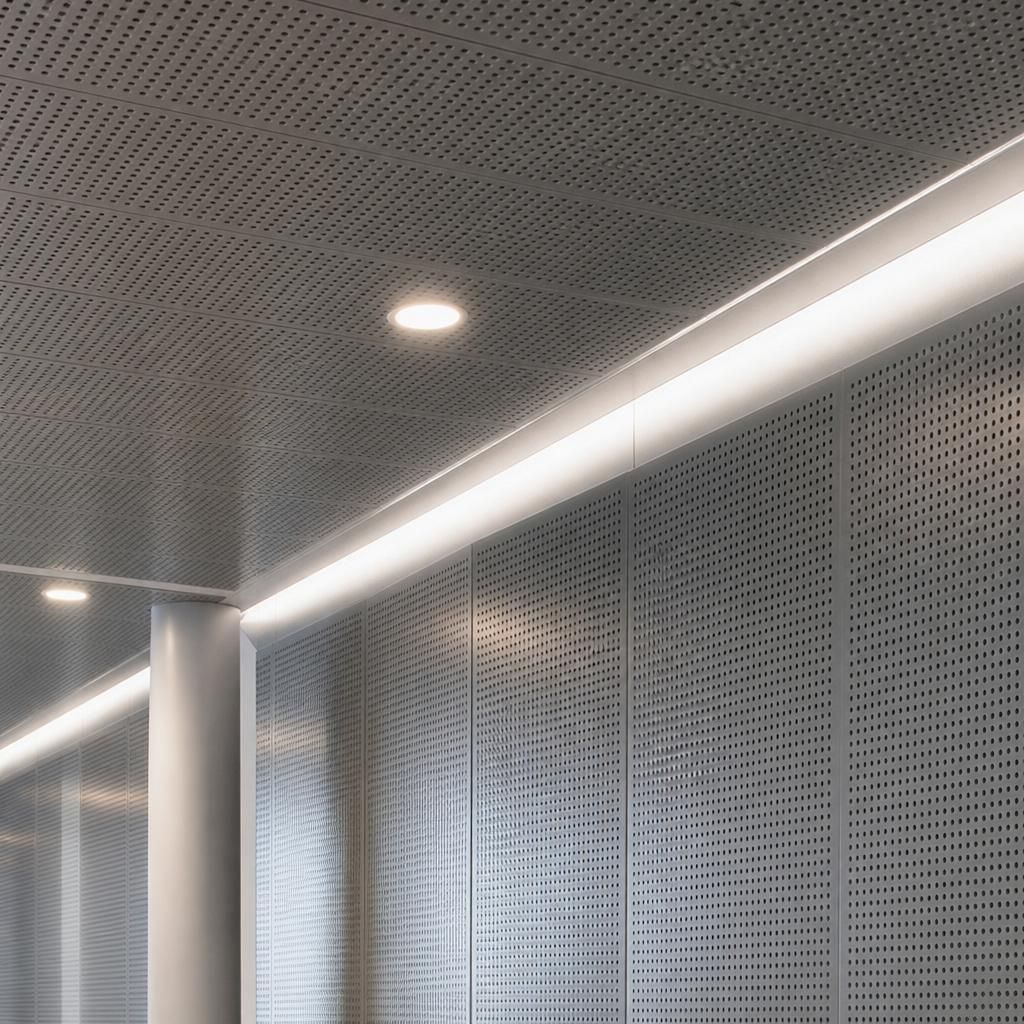
In commercial and public interiors, powder coated perforated aluminium can be used as a visible face layer over acoustic backing, lighting equipment or building services. The perforations allow the underlying system to remain effective or accessible while the panel provides a consistent architectural finish. This makes it suitable for ceiling features, wall panels and service screens where a solid sheet would conceal too much or restrict airflow.
These applications require coordination between the perforation pattern, the backing material and the lighting or acoustic design. Designers should also allow for panel removal, concealed fixings and cleaning access. The powder-coated surface can help maintain a uniform appearance across repeated panels, but the selected colour and gloss level should be assessed with the intended lighting, viewing distance and surrounding materials.