

What materials are used for sandblasting metal surfaces in powder coating repair?
Common materials for blasting metal surfaces before powder coating repair include aluminium oxide, steel grit, garnet, crushed glass and glass bead. The choice depends on the metal substrate, existing coating, contamination and desired surface profile, with harder abrasives generally used for removing stubborn powder coating and corrosion.
The materials used for blasting metal during powder coating repair are selected according to how aggressively the surface must be cleaned and how much texture the replacement coating needs. In addition to commonly used angular and spherical media, professional preparation may involve silicon carbide, mineral abrasives, steel shot, ceramic media, plastic media, walnut shell, sodium bicarbonate or dry ice. Each has a different effect on the substrate and the remaining coating.
Silicon carbide is an extremely hard, sharp abrasive. It is suitable for difficult residues, heavy oxidation and hard coatings where a strong cutting action is required. Because it removes material quickly, blasting pressure and dwell time need careful control on thin sections, soft alloys and edges.
Steel shot consists of rounded particles that clean by impact and peening rather than by cutting deep angular grooves. It can be useful on robust steel components where removal of scale or old coating is required without creating a highly pronounced profile. Ferrous media must be selected carefully for aluminium, stainless steel and other substrates where iron contamination could affect the subsequent finish.
Mineral abrasives, including certain forms of slag and olivine, provide an angular cutting action for removing corrosion, mill scale and firmly attached coating. Their suitability depends on particle size, cleanliness and the surface profile required. Any abrasive residue must be removed thoroughly because dust trapped in recesses can interfere with powder coating application.
Ceramic media can provide a consistent finish on suitable components and is often considered where controlled impact is more important than maximum cutting power. Plastic media and softer organic materials such as walnut shell are less aggressive. They may be appropriate for removing a defective coating from thin metal or delicate features while reducing the risk of excessive substrate erosion. They are not normally the first choice for heavy corrosion or thick, strongly bonded powder coating.
Sodium bicarbonate is a relatively gentle cleaning medium that can remove some contamination and coatings while producing little surface profile. This makes it less suitable where the replacement powder coating depends on a pronounced mechanical key. It is also water-soluble, so the component must be cleaned and dried properly after treatment to prevent residue affecting adhesion.
Dry ice is a specialist alternative for removing contamination or certain coatings without leaving conventional abrasive particles behind. It does not create the same anchor profile as an abrasive blast, so it may need to be combined with another preparation method before powder coating repair.
Ordinary silica sand should not be treated as a default choice. Respirable crystalline silica presents a serious health risk, and abrasive blasting requires suitable controls, extraction, respiratory protection and waste handling. For this reason, engineered media with known composition and particle size is generally preferred for controlled metal preparation.
The chosen material should be matched with the metal type, component thickness, coating thickness, corrosion level, required surface profile and the areas that must remain untouched. Masking may be needed around threads, machined faces, bearings, holes and identification marks. After blasting, the surface should be inspected for residual coating, embedded media, dust and flash rust before the powder coating repair proceeds.
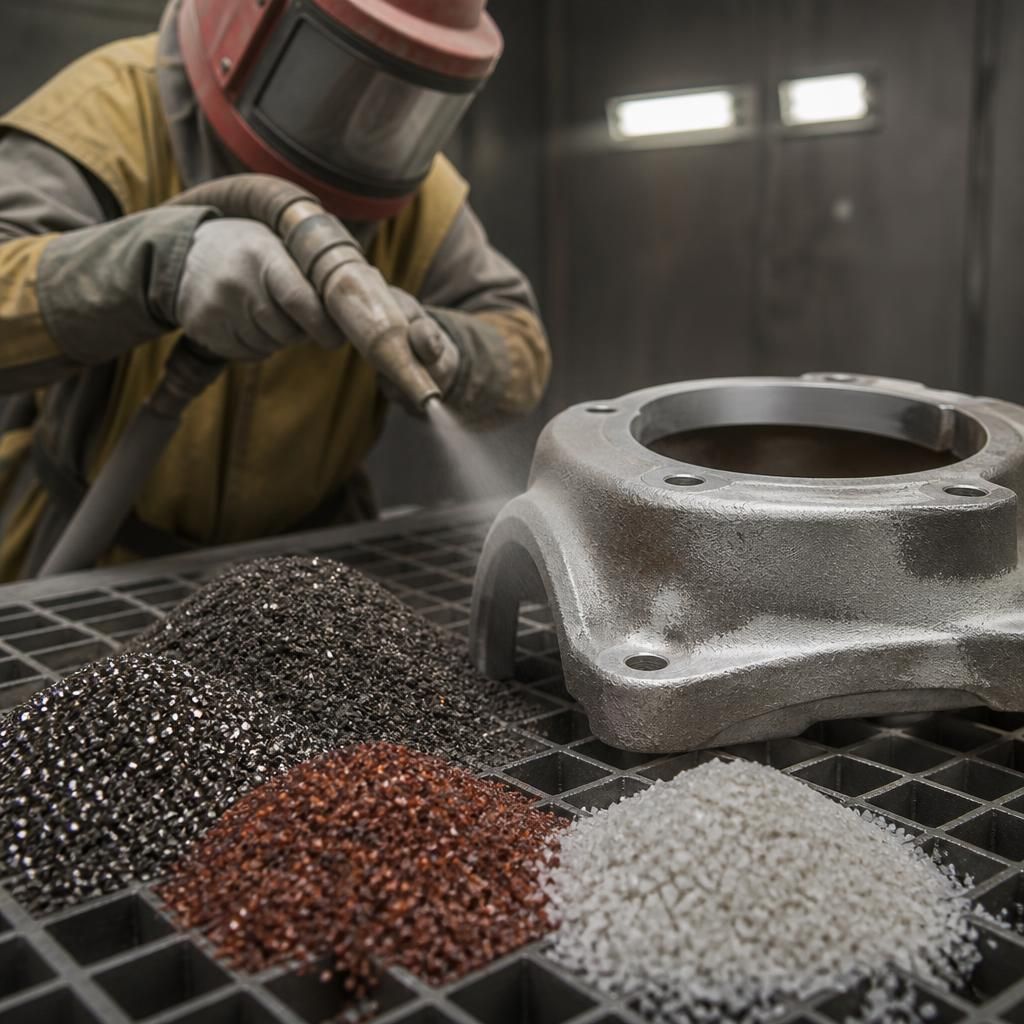
Sandblasting material selection also depends on how consistently the abrasive can produce the required surface. Where equipment allows recovery, reusable media such as steel grit can be monitored and replenished as particles wear down. Worn abrasive may produce more dust and a less predictable finish, so its condition matters as much as its original specification.
For expendable media, clean storage and careful separation from previously used abrasive help prevent unwanted contamination. Mixing materials or reusing media that has picked up oil, coating particles or corrosion debris can transfer those contaminants back onto the metal. A controlled blasting process therefore considers the abrasive’s condition, not simply whether it is hard or soft.