

What are the notable advantages of using high temp powder coating over traditional liquid coatings?
High temperature powder coating can provide stronger resistance to heat, wear and chemical exposure than many traditional liquid coatings, while producing a consistent, hard-wearing finish. Its dry application also reduces solvent use and can improve material efficiency, although the correct powder must be selected for the component’s operating temperature and substrate.
High temperature powder coating can offer several practical advantages over traditional liquid coatings, particularly where coated components must withstand elevated operating temperatures and repeated industrial use. The main benefits relate to film build, application control, handling, emissions and process consistency. However, the powder must be matched to the component’s service conditions; a coating designed for ordinary industrial use should not automatically be treated as a high temperature system.
Higher film build in a single application is one of the key differences. Powder can often produce a substantial protective layer without the multiple wet coats, flash-off periods and intermediate drying stages associated with many liquid systems. This can simplify the coating sequence and reduce the number of handling stages. A suitably selected powder may also help cover minor surface irregularities more effectively than a very thin liquid film, although it will not replace proper cleaning, preparation or repair of defective metal.
Electrostatic application can improve transfer to suitable components. Powder particles are electrically charged and attracted to an earthed metal workpiece, allowing the coating to reach broad faces and many recessed areas with controlled application. Operators can adjust gun settings, grounding and powder flow to suit the part. Liquid paint relies more heavily on spray technique, viscosity, atomisation and solvent evaporation, so its application can be more sensitive to environmental and process conditions.
Powder application can also reduce some common wet-paint defects, including runs, sags and solvent-related surface problems. This is not automatic: poor grounding, incorrect powder flow, contamination, unsuitable curing or inadequate pretreatment can still produce defects. The advantage is that the process does not depend on a liquid coating remaining stable while solvents evaporate from the wet film.
Parts can generally move through production with less wet-film handling. Once the powder has been correctly cured and cooled, the finish is dry rather than tacky or solvent-laden. That can make it easier to rack, package or assemble components without the risks associated with marking a partially dried liquid coating. The actual handling point depends on the powder specification, component temperature and curing process, so it should be established as part of the production method rather than assumed.
Powder systems may also support more predictable repeat production. The coating material is supplied in a defined formulation, while application and curing parameters can be recorded and controlled for successive batches. This helps reduce variation caused by changes in liquid viscosity, solvent balance or wet-film drying. Quality still depends on consistent substrate preparation, correct film thickness, oven performance and checks on the finished coating.
Material recovery is another potential advantage. In suitable spray-booth arrangements, overspray can be collected and, where the system and powder specification allow, reclaimed or managed separately from the coated component. Liquid overspray generally becomes waste mixed with solvent or other contaminants. Whether powder recovery is worthwhile depends on the colour, coating type, equipment and quality requirements; reclaimed material should not be used where it could compromise the finish.
High temperature powder coating can be particularly useful for metal components exposed to heat from ovens, exhaust systems, industrial equipment or other thermal processes. The relevant performance measure is the coating’s continuous operating temperature, together with any short-term peak temperature, exposure cycle and surrounding chemicals. A coating that performs well at a specified temperature may fail if the part experiences repeated thermal cycling, localised hot spots or temperatures above its design range.
There are also practical advantages in avoiding some liquid-coating constraints. Liquid systems may require controlled solvent evaporation, ventilation and careful management of wet coats before the next production stage. Powder does not use the same solvent-based drying mechanism, which can simplify certain process controls. This does not eliminate the need for extraction, safe powder handling or suitable curing equipment, and powder application remains an industrial process requiring appropriate controls.
Despite these benefits, powder is not the best choice for every component. The metal must normally tolerate the heat required to cure the coating, and the part must fit the application and oven process. Liquid coatings may be preferable where the substrate cannot withstand powder-curing temperatures, where an exceptionally thin film is required, or where coating must be applied in place rather than in a controlled coating facility. Liquid paint can also be more practical for small repairs or components with requirements that are difficult to reproduce through a powder process.
The comparison should therefore be based on the complete specification rather than heat resistance alone. Consider the metal substrate, operating and peak temperatures, thermal cycling, required film thickness, geometry, appearance, chemical exposure, production volume and curing capability. High temperature powder coating is most advantageous when its formulation and process are matched to those conditions and when the part benefits from a dry, robust finish applied under controlled conditions.
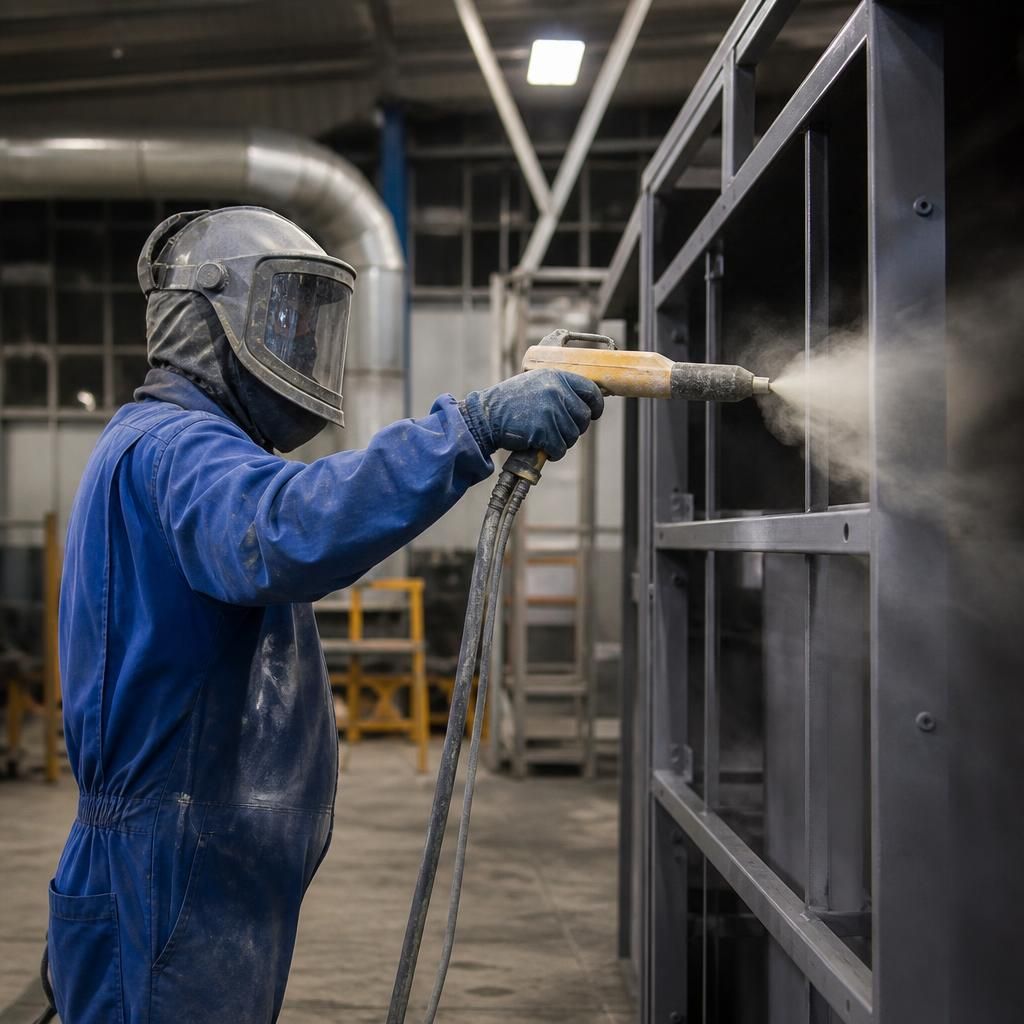
A less obvious advantage of high temperature powder coating is the absence of solvent entrapment within the cured film. If a thick liquid coating is not adequately dried, retained solvent can escape when the component is later heated, potentially causing blistering, pinholes or loss of adhesion. Powder is applied as a dry material and fused during curing, so this particular failure mechanism is avoided.
This does not remove the need for correct preparation. Oil, moisture, trapped air in hollow sections and contaminants on the metal can still create defects during heating. Components should therefore be cleaned, pretreated and assessed for outgassing before coating. Where the substrate and curing process are suitable, avoiding solvent release can provide a more stable finish during subsequent thermal service.
Discuss Your High Temperature Powder Coating Requirements
Share your component details and operating conditions with our powder coating team to assess whether a high temperature powder system is suitable. We can then discuss the coating specification and collection or delivery requirements for your project.