

What are the safety considerations when operating a high temp powder coating oven?
Safe operation of a high temp powder coating oven requires effective heat protection, ventilation, fire prevention, and controlled handling of coated parts and powder. Operators should follow the oven manufacturer’s instructions and site risk assessments, use suitable personal protective equipment, keep combustible materials away from heat sources, and isolate the equipment before cleaning, inspection or maintenance.
Operating a high-temperature powder coating oven safely depends on controlling the equipment, the process and the surrounding work area as one system. The main considerations are competent operation, reliable safety interlocks, safe loading and unloading, control of gas or electrical hazards, suitable powder information, emergency procedures and documented inspections. The oven should only be used within its designed temperature, loading and ventilation limits.
Restrict operation to trained personnel. Operators should understand the control panel, temperature controls, alarms, emergency stop, conveyor or trolley movement and the hazards associated with the particular coating process. Training should cover abnormal conditions, including a failed temperature controller, an oven that does not shut down, a stalled conveyor, an unexpected alarm or a component becoming trapped. Instructions should be available at the equipment, and changes to the oven, coating material or production method should trigger a review of the risk assessment.
Check safety controls before starting. A pre-use inspection should confirm that doors, access panels, guards and viewing points are secure, and that emergency stops, door switches, over-temperature cut-outs and other interlocks function as intended. An interlock must not be bypassed to keep production moving. If an alarm, cut-out or control device has operated unexpectedly, the cause should be investigated by an appropriately authorised person before the oven is returned to service.
The control system should prevent the oven from continuing to heat when a critical fault occurs. Temperature displays and independent high-limit devices should be checked in accordance with the site’s inspection schedule. Where the oven uses gas, the burner, ignition system, flame supervision, fuel pipework and shut-off arrangements require competent inspection. Electrically heated ovens require suitable electrical protection, intact wiring and access restricted to people qualified to work on the equipment. These checks are particularly important because a control failure can allow heat to rise beyond the intended process conditions.
Keep loading arrangements predictable. Parts, racks and hooks should be positioned so they cannot touch heating elements, burners, sensors, walls or the oven roof. The load must not obstruct the designed air circulation, create an unstable stack or exceed the equipment’s rated capacity. Long or heavy components may need support to prevent them shifting as they heat. Operators should also account for thermal expansion, since a part or rack that fits when cold may interfere with doors, guides or moving equipment at operating temperature.
For conveyorised systems, the movement path should be kept clear and protected against entanglement or crushing hazards. Access to moving sections should be controlled, and a stopped conveyor should not be restarted until the reason for the stoppage and the position of personnel have been established. Trolleys, racks and lifting equipment should be suitable for the load and inspected for distortion, damaged wheels, loose hooks or coating build-up that could affect stability.
Control the powder and coating-specific hazards. The safety data sheet for each powder should be available and followed, particularly for storage, spill response, waste disposal and any hazards associated with decomposition or curing emissions. Different formulations should not be mixed unless the process and material supplier’s information supports this. Powder deposits on ledges, floors, ducting or equipment can create housekeeping and fire-load concerns, so the cleaning method should be suitable for the material and equipment. Avoid actions that disperse settled powder into the air, and do not use improvised cleaning methods that could create an ignition source or damage electrical components.
Powder storage should be separated from hot surfaces, ignition sources and incompatible materials, with containers kept closed when not in use. Waste powder, contaminated wipes and packaging should be placed in designated containers and removed in line with the site’s waste procedure. The coating process should also be reviewed under the Control of Substances Hazardous to Health requirements where workers may be exposed to powder or curing products.
Provide a clear emergency response. Everyone working near the oven should know how to raise an alarm, stop the process, summon assistance and report a fault. Emergency stop controls should be accessible without requiring someone to approach the hazard. In the event of smoke, unusual odour, uncontrolled temperature, burner failure or suspected fire, the process should be stopped using the established procedure and the area evacuated if required by the site plan. Staff should not open an oven or attempt intervention that exposes them to heat, flames or accumulated vapours unless they are specifically trained and authorised to do so.
Emergency arrangements should identify isolation points, escape routes, suitable firefighting equipment and the circumstances in which the fire and rescue service must be called. Fire equipment should be selected for the hazards present and maintained as part of the workplace’s fire-safety arrangements; it should not be treated as a substitute for prevention and properly functioning oven controls.
Inspect the installation and workplace routinely. Records should cover safety-device tests, defects, servicing, calibration checks and corrective actions. The area around the oven should provide safe access, adequate lighting and unobstructed escape routes. Floors should be kept free from powder, oil, packaging and other contamination that could cause slips or interfere with loading equipment. Noise, manual handling, work at height and interaction with forklifts or other vehicles should also be included in the site assessment rather than treating the oven as an isolated item of plant.
For a UK business, the precise controls will depend on the oven design, fuel, powder formulation, building and production method. A competent person should review the installation against relevant workplace equipment, fire, electrical, gas and hazardous-substance requirements. Safe operation is achieved when the documented assessment, operator training, equipment safeguards and maintenance arrangements all match the actual process being carried out.
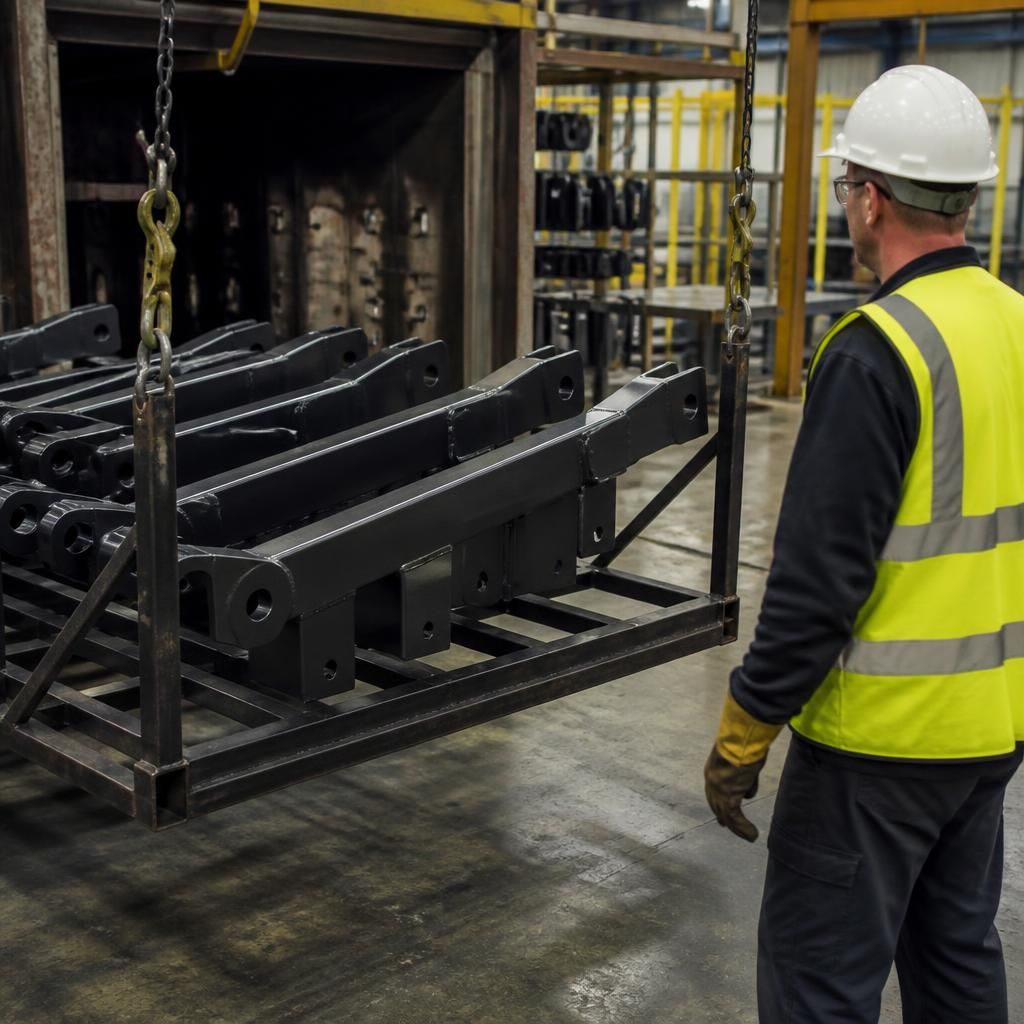
A coated component can remain hot after it leaves the oven, even when its surface no longer appears visibly heated. Heat may also be retained in thick sections, enclosed areas, racks, hooks and lifting points, creating burn and handling hazards away from the oven itself.
Establish a designated cooling area separated from walkways and vehicle routes. Mark hot loads clearly, prevent unauthorised handling, and allow parts to reach a verified safe handling condition before inspection, packing or transfer. Where temperature checks are used, the measuring device should be suitable for the surface and used according to its instructions; an instrument reading should support, not replace, the site’s handling procedure. Heat-resistant tools or mechanical handling equipment may be necessary for components that cannot be safely moved by hand.