

How does the choice of protective coatings influence the curing process in powder coating ovens?
The protective coating’s chemistry, film thickness and curing requirements determine the oven temperature, time and heating profile needed to achieve complete fusion without defects. Coatings with different formulations may require separate process settings, so curing should be based on the powder manufacturer’s technical data and verified by measuring the part temperature.
The choice of protective coating determines how the part must be heated, how long it must remain at temperature and what checks are needed before it can be handled. Thermosetting powders require sufficient heat to melt, flow and chemically cross-link, while thermoplastic coatings such as nylon are heated to melt and fuse rather than undergo the same chemical curing reaction. Selecting the correct oven cycle therefore depends on the coating system as well as the component being coated.
Coating chemistry and oven response
Different powder formulations respond differently to heat. Epoxy-based systems, polyester-based systems and hybrid powders each have their own cross-linking behaviour, flow characteristics and resistance to overbaking. A coating may reach a visually acceptable finish before it has developed its full mechanical and chemical properties, so appearance alone is not proof of a completed cure.
Some protective systems are designed primarily for corrosion resistance, while others must withstand impact, abrasion, chemicals or outdoor exposure. The formulation used to achieve those properties affects the permissible heating range and the length of time the component must remain hot. A coating intended for a demanding service environment may require particularly careful control of the cure cycle because under-cured film can have reduced adhesion and durability.
Thermoset and thermoplastic coatings
- Thermoset powders: These melt and flow before cross-linking into a permanent film. The oven must deliver enough heat to the metal for the reaction to complete, but excessive heat or dwell can cause discolouration, loss of gloss, brittleness or other changes in the finish.
- Thermoplastic powders: These coatings are heated until they soften or melt and bond to the substrate. They do not normally form a permanent cross-linked network in the same way as thermoset powders, so the process is assessed through melt, flow, coverage, adhesion and final film performance.
- Specialist protective systems: Nylon and other specialist powders can have different melt behaviour, film-building requirements and substrate preparation needs. They may require an oven arrangement and handling method suited to the thickness and flow of the coating rather than a standard thin-film thermoset cycle.
Part temperature matters more than air temperature
Oven air temperature is only an indirect control variable. The coating reacts according to the temperature reached by the metal and the time it remains at that temperature. A light bracket may heat rapidly, whereas a heavy casting, folded section or densely loaded rack may take much longer. If both are processed using the same air setting without checking the actual part temperature, one component may be under-cured while another is over-cured.
Part geometry also affects the result. Box sections, recesses and areas shielded by adjacent components can receive heat differently from exposed surfaces. Racks and hanging points can create thermal shadows or reduce the effective airflow around a component. The selected coating may tolerate some variation, but the process should still be established around the slowest-heating areas that require the specified finish.
Film thickness changes the heating and finishing behaviour
Protective coatings are not all applied at the same film thickness. A thicker film contains more material to melt and flow, which can alter the time needed to achieve a smooth, fully developed finish. It can also increase the risk of runs, sagging, pinholes, solvent or moisture release, and trapped gases if the substrate or previous layer has not been prepared correctly.
Thin films present a different challenge. They can expose surface defects more readily and may provide inadequate coverage at edges, corners or difficult-to-reach areas. The oven cycle cannot compensate for insufficient deposited powder, poor grounding or unsuitable preparation. Curing must therefore be considered alongside application control and the performance requirement for the finished component.
Substrate and coating combinations
The substrate influences how quickly heat reaches the coating and whether the coating can tolerate the required process. Steel, aluminium and other metals have different thermal characteristics, while welded assemblies may contain areas with significantly different mass. Galvanised or previously treated surfaces can also release gases or behave differently during heating. If gas escapes after the powder begins to flow, it may produce pinholes, craters or bubbles in the film.
For components with a high risk of outgassing, suitable preparation, preheating, degassing or a compatible powder system may be needed. These measures should be determined before production rather than attempting to correct defects by extending the cure cycle. More oven time does not remove every source of porosity and can damage a coating that has already reached its intended cure.
How the coating affects process settings
When changing from one protective powder to another, the process review should consider:
- the coating’s specified metal-temperature range and required dwell time;
- whether the system is thermosetting or thermoplastic;
- the target film thickness and expected flow behaviour;
- the mass, shape and material of the components;
- the risk of outgassing from the substrate or an earlier coating;
- the maximum temperature tolerated by inserts, seals, masking materials or assembled parts;
- the finish requirements, including gloss, colour consistency, coverage and texture; and
- the method used to confirm that the coating has reached the required condition.
The powder supplier’s technical documentation should be treated as the starting point for the cycle. It should then be validated on representative parts, particularly when the production load, component thickness, hanging arrangement or coating thickness differs from previous work.
Common effects of an unsuitable cycle
An under-cured thermoset film may show poor adhesion, reduced hardness, weak chemical resistance or premature loss of protective performance. It may also remain more sensitive to marking during handling. Over-curing can lead to yellowing, colour shift, reduced gloss, embrittlement or a change in texture. Uneven heating can produce variation across one component or from one batch to the next.
Some defects that appear to be curing problems originate earlier in the process. Contamination, inadequate cleaning, moisture, poor powder application, incorrect grounding and unsuitable storage can all affect the final finish. A sound investigation separates application and preparation faults from genuine oven-cycle faults instead of increasing temperature or dwell time without evidence.
Validating the selected coating and cycle
Validation should use the actual coating, substrate, component geometry and loading pattern intended for production. Record the oven conditions and measure the temperature reached by representative parts, including heavy or shielded sections where relevant. The finished coating can then be assessed for appearance, adhesion, film thickness and other performance characteristics required for its service environment.
Where a job includes several coating types, avoid assuming that one setting is suitable for all of them. Grouping compatible products can make the process more consistent, while a changeover may require cleaning, a revised cycle or separate verification. The objective is not simply to make the powder look fused; it is to establish a repeatable thermal process that gives the selected protective coating the properties for which it was specified.
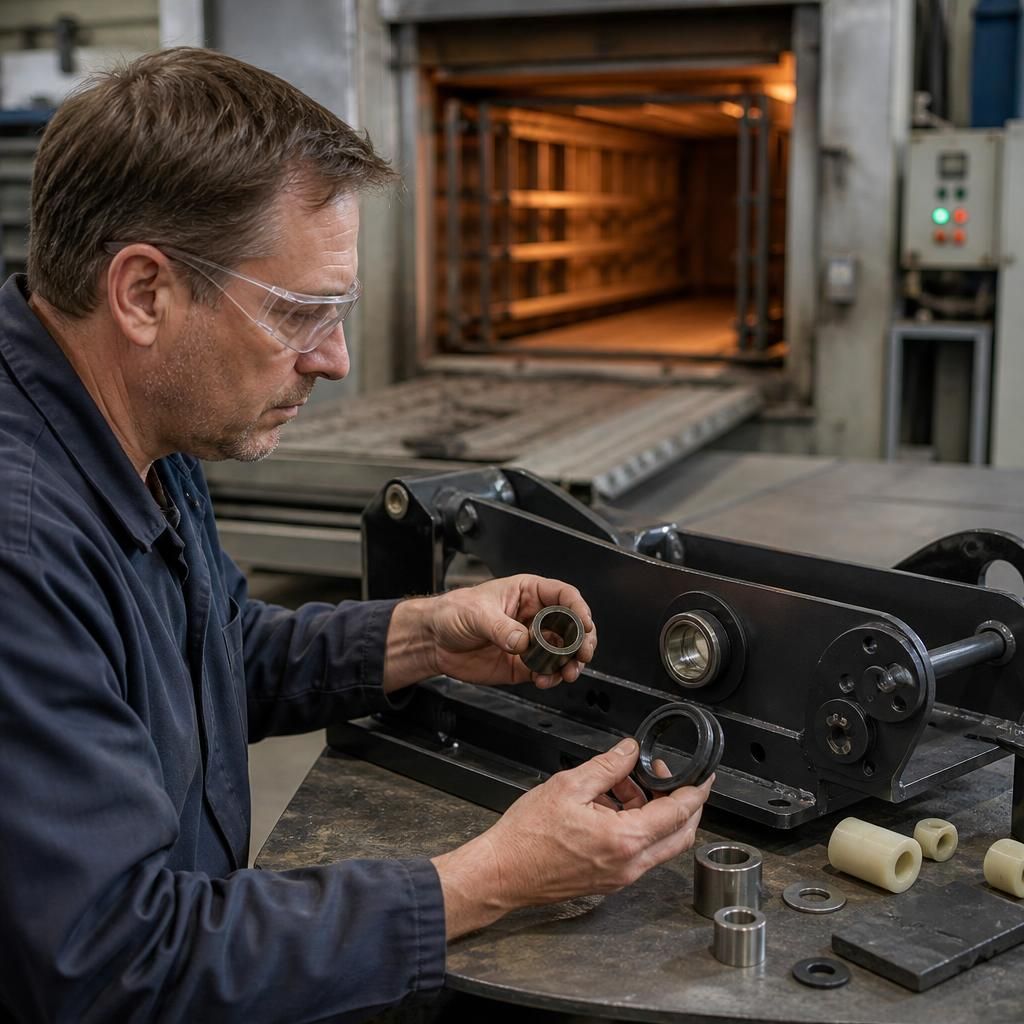
The selected protective coating must also be compatible with every part of the component that enters the oven. Inserts, seals, adhesives, bearings, masking materials and other heat-sensitive items may tolerate a narrower temperature range than the powder itself. This can determine whether the component should be disassembled, masked, coated before assembly or finished using a different coating system.
Lowering the oven temperature to protect an adjacent component is not a reliable solution if it prevents the powder from reaching its specified cure condition. Likewise, extending the dwell time may expose heat-sensitive materials to unnecessary thermal stress. The coating specification should therefore be reviewed alongside the assembly materials, with the curing cycle established around the component’s complete thermal limits rather than the powder alone.
Discuss your powder coating oven curing requirements
Contact Powder-coatings.co.uk to discuss your coating specification, component requirements and proposed oven curing process. Sharing details of the powder, substrate, film thickness and production load will help establish the appropriate next steps.