

What options are available for custom colour matching in powder coating?
Custom colour matching in powder coating can use RAL or BS references, an existing coated sample, or a bespoke colour specification. The selected colour is matched to a powder formulation and confirmed against the required finish, substrate and application conditions before production.
Custom colour matching for powder coating can be approached through a recognised colour standard, a physical reference sample, or a newly specified bespoke shade. The most suitable option depends on how closely the finished component must relate to an existing colour, whether a recognised standard is acceptable, and how the coating will be viewed and used.
RAL and BS reference colours are usually the simplest starting point where a standard shade is suitable. A reference code gives the coater and powder supplier a defined target rather than relying on a verbal description such as “dark grey” or “warm white”. This is useful for repeat orders, product ranges and components that need to coordinate with other manufactured items. The relevant colour reference, edition and finish should be recorded because the same colour can appear different with changes in gloss, texture or surface effect.
Standard references are not automatically identical across every coating type. A RAL or BS shade may need to be produced in a particular powder chemistry, gloss level or texture, and the available formulation can affect the final appearance. Where the precise standard cannot be reproduced in the required coating system, the practical target may be the closest approved match rather than an exact visual copy.
An existing coated sample is useful when the required colour is already present on a panel, machine, enclosure, vehicle component or previous production part. The sample should be clean, representative and large enough to show the colour consistently. It is important to identify whether it has faded, weathered, become contaminated or changed through polishing, as matching an aged surface may produce a different result from matching its original coating.
Visual comparison should take place under suitable, consistent lighting. A colour can look different under daylight, fluorescent lighting and warm artificial light, a phenomenon commonly known as metamerism. The angle of viewing also affects metallic, mica and textured finishes. For this reason, a small laboratory or production sample is more reliable than judging colour from a screen, photograph or printed image.
Bespoke colour development is appropriate where a corporate shade, product identity or design requirement does not correspond closely enough with an existing RAL or BS option. The target may be defined using a physical object, a colour specification or an approved sample. The formulation is then selected or developed to achieve the required appearance within the chosen powder coating system. Bespoke matching is particularly useful when colour consistency across a product family matters, but the target should still be agreed against a physical coated sample before full production.
The finish must be specified alongside the colour. Options can include:
- different gloss levels, from low-sheen to high-gloss appearances;
- smooth, fine-textured or more heavily textured surfaces;
- solid colours, metallic effects or other visual finishes;
- coating systems selected for interior use, exterior exposure or particular chemical and mechanical demands.
These choices are not merely cosmetic. Gloss and texture alter how much light the surface reflects, so two parts using the same nominal colour can appear different if their finishes are not the same. Metallic and special-effect powders can also show directional variation or differences caused by application and curing conditions, making sample approval especially important.
Substrate and preparation also influence the result. Steel, aluminium and other metal substrates can produce different visual effects, particularly with translucent or lightly pigmented powders. Surface contamination, pretreatment, edge coverage and the condition of the underlying metal may affect uniformity. The specified coating thickness and curing cycle must be compatible with the powder, because under-curing, over-curing or uneven application can change the apparent shade and gloss.
A sensible approval process normally records the colour reference or source sample, powder type, gloss, texture, substrate, preparation requirements and curing conditions. A coated test panel or representative component can then be assessed before the production run. Approval should consider the intended viewing distance, lighting, adjacent materials and acceptable variation, rather than colour alone.
For repeat manufacture, retaining the approved reference and matching future batches against the same standard helps reduce avoidable variation. It is also useful to clarify whether the requirement is for an exact visual match, a recognised colour reference or a consistent appearance within an agreed tolerance. That distinction determines how the colour is assessed and how much importance is placed on the powder formulation, application method and final finish.
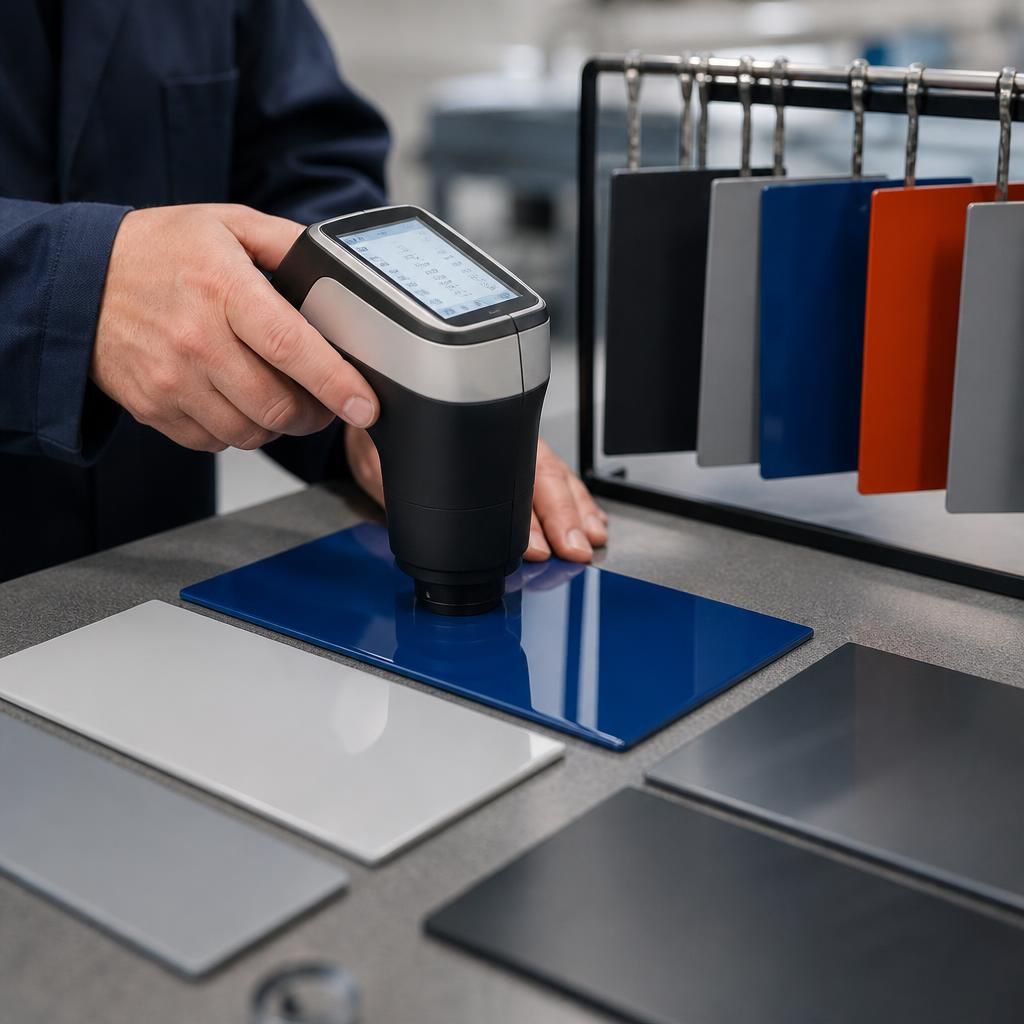
Instrumental colour measurement can provide a more precise starting point when a custom shade must be reproduced. A spectrophotometer records the colour of an approved surface as measurable values, giving the powder supplier objective data instead of relying solely on visual descriptions or digital images.
This approach is particularly useful for repeat production, where the same target needs to be communicated between different teams or retained for future orders. The measurement should identify the surface and finish from which it was taken, because gloss, texture and metallic effects influence the recorded result. Instrumental data supports the matching process, but the final powder should still be assessed on a coated panel or representative component before manufacture is approved.