

What are the typical curing times and temperatures for epoxy and polyester powder coatings?
Epoxy and polyester powder coatings typically cure during a controlled oven cycle in which the metal reaches the powder manufacturer’s specified temperature and remains there for the required dwell time. Exact curing temperatures and times vary by formulation, coating thickness, component size and oven performance, so the product technical data sheet and the part’s actual metal temperature should determine the schedule.
Typical epoxy and polyester powder-coating schedules involve heating the metal to the temperature specified for that powder and holding it there until the coating has fully cross-linked. Epoxy and polyester products can use broadly comparable oven conditions, but the correct cycle is set by the individual formulation rather than by the resin family alone. The powder’s technical data sheet should therefore take priority over any general rule.
Temperature refers to the metal, not simply the oven display. An oven set to the target temperature does not mean that every part has reached that temperature. The coating begins its effective dwell period only when the relevant areas of the component have reached the required metal temperature. Large, thick or densely loaded parts take longer to heat than thin sheet or small brackets, even when they are processed in the same oven.
This distinction is particularly important for fabricated assemblies, castings, heavy sections and components with enclosed areas. The outer surface may appear cured while cooler areas remain under-cured. Conversely, a small part can reach temperature quickly and receive more heat than intended if it is left in the oven for the same overall cycle as a much heavier component.
Epoxy powder coatings are commonly selected for interior components and applications requiring chemical resistance, adhesion and hardness. Their curing schedule depends on the grade, colour, film build and substrate. Under-curing can leave the finish softer than intended and reduce its resistance to chemicals, abrasion or handling. Over-curing may affect colour, gloss or other appearance properties, particularly where the component remains at elevated temperature beyond the recommended cycle.
Polyester powder coatings are formulated for a range of uses, including components exposed to weather and sunlight. Their required oven cycle also varies between products. A polyester designed for exterior durability should not be assumed to follow the same schedule as an interior-grade product, even if both are applied to similar metalwork. The product specification determines the required combination of metal temperature and dwell time.
Several practical factors influence the cycle:
- Part thickness and mass: heavy sections and heat-sink areas need more time to reach the required temperature than thin sections.
- Component geometry: boxed sections, overlapping parts and recessed areas can heat unevenly and may need particular attention during process validation.
- Load arrangement: tightly packed batches can restrict airflow and slow heating, while widely spaced parts usually expose more surface to the circulating air.
- Powder film thickness: excessive build can affect appearance and performance, while insufficient coverage may leave the substrate inadequately protected.
- Substrate and pre-treatment: steel, galvanised metal and aluminium transfer heat differently, and the preparation system must be compatible with the powder and intended environment.
- Oven performance: temperature uniformity, airflow, recovery after loading and the accuracy of controls all affect whether the required cycle is achieved consistently.
Validation should use the coldest or slowest-heating area of the part. For critical work, a temperature logger or suitable profiling equipment can record the metal temperature at several points. This helps establish when the component reaches the specified curing condition and identifies hot or cold zones in the oven. Checking only the oven air temperature can give a misleading result.
A coating that has not received enough heat may show poor adhesion, reduced hardness, incomplete chemical resistance or premature failure in service. Visual appearance alone is not a reliable test: a finish can look acceptable while its cross-linking remains incomplete. Excessive heat can cause discolouration, gloss variation, loss of surface quality or embrittlement, depending on the powder and substrate.
For repeat production, the approved schedule should be recorded alongside the powder batch, part type, loading arrangement and film-build requirements. If the powder is changed, the component design is altered or the batch size changes substantially, the curing process may need to be checked again. This is especially relevant where epoxy and polyester powders are used on different components within the same project, because each product may have its own specified cycle.
A specialist powder-coating processor can review the technical data sheet, assess the component’s mass and geometry, and establish a practical oven profile rather than relying solely on a nominal set-point. The final curing conditions should always be agreed against the powder manufacturer’s instructions and the performance requirements of the finished metal component.
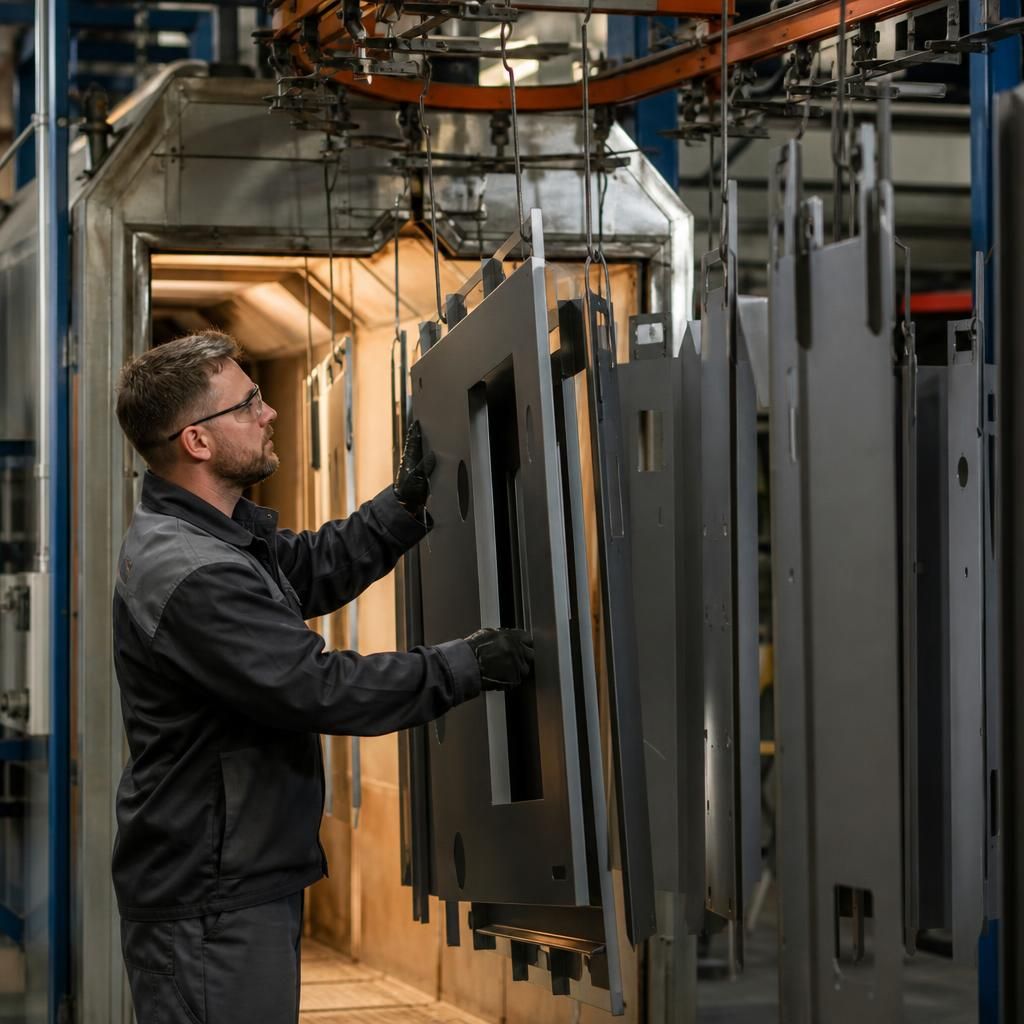
Curing is a chemical cross-linking process, not simply the drying of a wet paint. A powder-coated component may feel dry to the touch while the resin is still under-cured, so handling or packing it at this stage can mark the finish or compromise its performance.
After leaving the oven, components should be allowed to cool sufficiently before they are stacked, wrapped or put into service. Cooling conditions matter particularly for large or closely packed parts, which can retain heat for longer. The finished coating should be assessed against the powder manufacturer’s requirements rather than judged by touch or surface appearance alone.
Discuss your powder coating curing requirements
If you need to confirm a suitable curing schedule for a particular component, discuss its material, dimensions, batch arrangement and coating specification with our powder-coating team. This allows the requirements to be reviewed against the relevant technical data sheet before processing.