

How does powder coating provide electrical insulation in industrial applications?
Powder coating provides electrical insulation by forming a continuous, non-conductive polymer layer over a conductive metal component. This coating separates the metal from surrounding parts, helping to limit current flow and electrical leakage where the formulation, coverage and film thickness are suitable for the application.
In industrial applications, the insulating performance of a powder-coated component is determined by the coating’s electrical properties, the continuity of the cured film and its suitability for the voltage, temperature and environment involved. The coating acts as a dielectric barrier, reducing the opportunity for current to pass between the metal substrate and adjacent conductive parts.
How the insulation works
Metal is electrically conductive, whereas most powder coating films are polymer-based and have high electrical resistance. Once cured, the film separates the conductive substrate from contact with other components, fasteners, tools, moisture and contaminated surfaces. This separation helps control leakage paths and reduces the risk of unintended contact between electrically different parts.
The coating’s insulating behaviour depends on its dielectric strength, volume resistance and surface resistance. Dielectric strength describes how much electric field the material can withstand before electrical breakdown occurs. Surface and volume resistance indicate how strongly the cured film resists current travelling across its surface or through its body. These properties are influenced by the resin system, pigments, additives, film thickness, cure quality and operating conditions.
Where insulated powder-coated parts are used
- Electrical enclosures and cabinets, where the coating helps isolate the metal enclosure from internal components or mounting points.
- Brackets, covers, guards and support components used near live equipment.
- Switchgear and control equipment, where a consistent coating can help limit surface leakage.
- Metal components in motors, generators and industrial machinery, where electrical separation is required alongside mechanical protection.
- Busbar supports and other fabricated parts, provided the selected coating system is technically suitable for the voltage and service conditions.
Powder coating is not automatically a substitute for dedicated insulating components. Clearances, creepage distances, insulating washers, barriers, earthing arrangements and enclosure design remain important. A coated surface may reduce the risk of accidental contact, but it does not remove the need to design the complete assembly to the relevant electrical requirements.
Why film continuity matters
Pinholes, bare edges, impact damage and poorly coated recesses can create localised conductive paths. The same applies where the coating has been removed for earthing, bolted connections or assembly tolerances. For this reason, the coating specification should identify which faces require insulation and which areas must remain electrically bonded.
Component geometry also affects coverage. Sharp corners, deep recesses, threaded holes and internal faces can be more difficult to coat evenly than broad, accessible surfaces. Suitable racking, application settings and part orientation help achieve consistent coverage, while masking protects earth points, mating faces and threaded features that must remain functional.
The importance of preparation and curing
Preparation supports insulation as well as adhesion and corrosion resistance. Oil, grease, oxides, moisture and fabrication residues can interfere with film formation or leave weak points in the finished surface. The appropriate cleaning and pretreatment process depends on the substrate and its condition.
After application, the powder must be cured according to the requirements of the selected formulation. Insufficient or uneven curing can affect the film’s hardness, adhesion and electrical performance. Excessive heat may also be unsuitable for temperature-sensitive assemblies or components containing materials that cannot tolerate the curing cycle. The relevant requirement is the temperature reached by the part itself, not simply the oven air temperature.
Environmental factors affecting insulation
A dry, clean powder coating film generally provides stronger insulation than the same surface when it is wet or contaminated. Condensation, salt deposits, industrial dust, oils and chemical residues can create a conductive film across the surface. Outdoor or harsh industrial equipment may therefore require a coating system selected for its resistance to moisture, chemicals, ultraviolet exposure and temperature variation as well as its electrical properties.
Thermal conditions also matter. Electrical resistance and dielectric behaviour can change as polymer films are heated, and repeated heating and cooling can place stress on the coating and substrate. The specification should consider the component’s normal operating temperature, short-term temperature excursions and exposure to heat from nearby equipment.
Verification before use
Electrical insulation should be verified against the requirements of the finished component rather than assumed from the fact that it has been powder coated. Depending on the application, assessment may include visual inspection, dry-film thickness measurement, adhesion checks, continuity or resistance testing and dielectric withstand testing. Test methods, acceptance criteria and sampling should be agreed with the electrical designer or relevant compliance specialist.
Testing may need to take place after assembly, because fasteners, edges, drilled holes and handling damage can alter the final insulation path. If a part is safety-critical or forms part of certified equipment, the powder coating should be treated as one element of the wider design validation process.
For B2B projects involving insulated metal components, the coating specification should state the substrate, areas to be coated, required finish thickness, masking points, cure requirements, operating environment and electrical tests. Sharing drawings and service conditions before production allows the coating process to be matched to the component’s functional requirements rather than relying on a decorative finish alone.
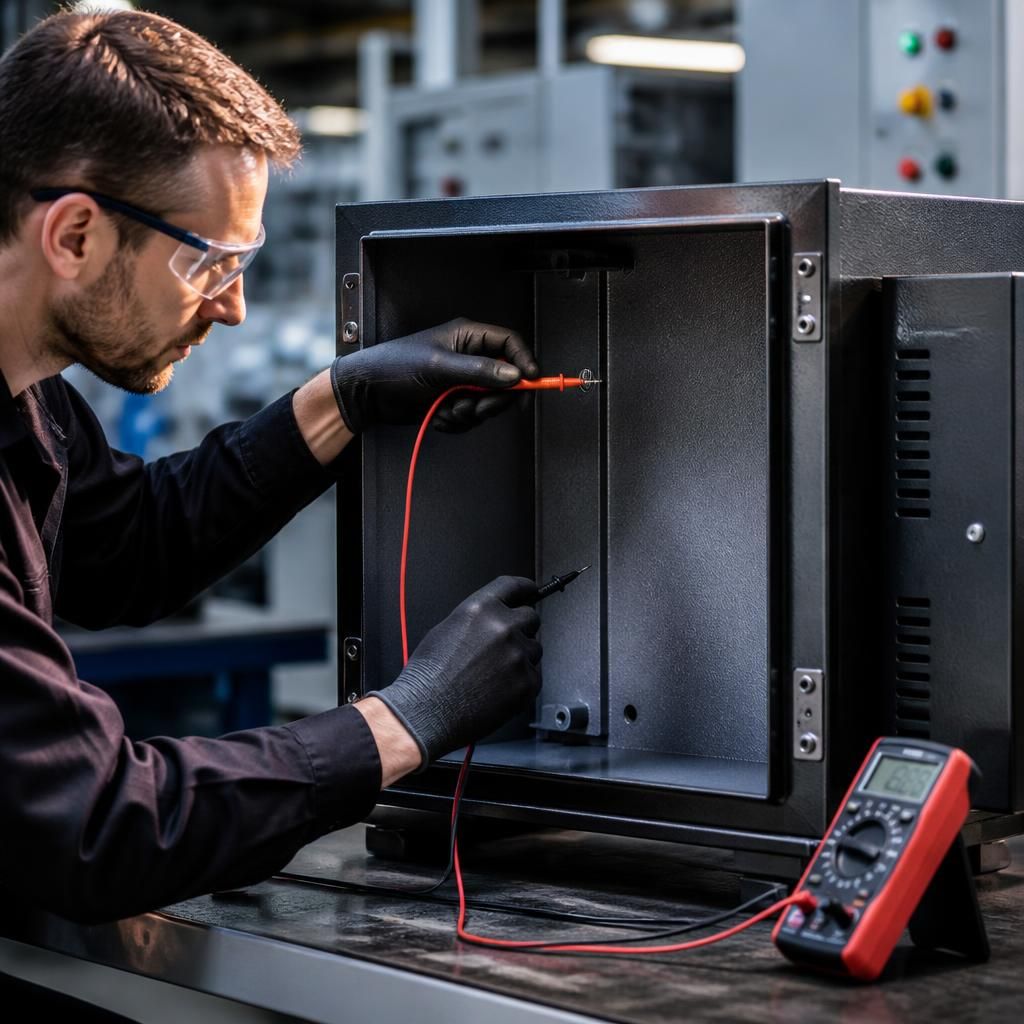
Electrical insulation cannot be judged from a powder coating’s colour, gloss or texture. These are visual characteristics, while insulation depends on the cured formulation and its resistance to electrical breakdown. Two coatings with a similar appearance may therefore have different suitability for an electrical application.
For this reason, the coating should be specified by its required electrical performance rather than by finish alone. The assessment should consider the resin system, any pigments or functional additives, the intended film build and the voltage involved. Where the component forms part of electrical equipment, the coating’s performance should be confirmed as part of the complete product evaluation, using representative coated parts rather than relying solely on a decorative sample.
Discuss your electrical insulation requirements
Discuss your electrical insulation requirements with Powder-coatings.co.uk and share the component drawings, substrate and service conditions for review. This helps establish the required coating specification, masking details and verification approach before production.