

Are there any specific environmental or safety regulations to consider in powder coating projects?
Yes. UK powder coating projects must consider environmental permitting and waste requirements, alongside workplace safety controls for airborne powder, curing ovens, compressed air, electrical equipment, fire and explosion risks; relevant frameworks can include COSHH, DSEAR and PUWER, depending on the process and premises.
Powder coating projects in the UK must be planned around three areas of compliance: environmental controls, protection of employees and contractors, and evidence that the process is being managed responsibly. The exact requirements depend on the coating materials, preparation methods, curing equipment, premises, scale of operation and whether the work is carried out in-house or by a specialist contractor.
Confirm whether environmental permission is required. The Environmental Permitting (England and Wales) Regulations, with equivalent arrangements in Scotland and Northern Ireland, may apply to certain industrial coating and surface-treatment activities. Powder coating often produces fewer solvent emissions than liquid painting, but that does not automatically remove the need to assess permitting. The relevant regulator may consider the type of process, emission points, fuel-burning equipment, production scale and associated preparation activities. A business should establish whether it needs an environmental permit, a local authority permit, an exemption or no specific permit before commencing or expanding the operation.
Where an installation is permitted, conditions can cover emissions, operating procedures, monitoring, maintenance, complaints, record keeping and abnormal events. Planning permission, building control requirements or restrictions relating to noise, odour, traffic and neighbouring premises may also be relevant. These matters should be checked before installing a booth, curing oven, extraction system or additional production equipment.
Manage powder and other waste correctly. Unused powder, contaminated filters, booth residues, masking materials, blasting media, chemical containers and preparation residues should be assessed and handled under the applicable waste rules. Waste producers have a duty of care to store waste securely, use an authorised carrier and ensure that it is transferred to an appropriately authorised destination. Waste should be classified correctly rather than assumed to be non-hazardous simply because the coating is a powder.
Good controls include keeping waste streams separate, preventing powder from entering drains or soil, retaining transfer documentation and checking the relevant safety data sheets. If stripping chemicals, degreasers, contaminated abrasives or other hazardous substances are used, they may require different storage, labelling and disposal arrangements. The waste hierarchy should also be considered: reduce unnecessary waste first, then look at reuse or recycling where technically and legally suitable before disposal.
Control exposure during preparation and application. A suitable risk assessment should cover each stage of the work, including loading, masking, blasting, cleaning, spraying, booth cleaning, filter changes and maintenance. Controls may include enclosed equipment, local exhaust ventilation, suitable housekeeping methods, restricted access, written procedures and health surveillance where a risk assessment identifies a need for it. Dry sweeping or using compressed air to disperse settled powder can increase airborne contamination and should not be treated as routine housekeeping.
Personal protective equipment is the last line of control rather than a substitute for effective engineering measures. Its selection should reflect the task and the substances involved. This may include protective clothing, gloves, eye protection, respiratory protective equipment and hearing protection. Respiratory equipment must be suitable for the contaminant and properly selected, maintained and fit-tested where tight-fitting masks are used. Workers should understand the correct method of use, cleaning, storage and disposal.
Assess fire and explosion hazards in detail. Powder suspended in air can create a combustible dust hazard, particularly inside application equipment, extraction ducting and collection systems. The Dangerous Substances and Explosive Atmospheres Regulations require employers to assess the likelihood of explosive atmospheres and put appropriate controls in place. Depending on the assessment, this can involve zoning, ignition-source control, suitable equipment, bonding and earthing, ventilation, housekeeping, inspection and emergency procedures.
Particular attention is needed for spray guns, booth interiors, filters, ductwork, powder recovery equipment and areas where deposits can accumulate. Smoking, hot work, unsuitable electrical equipment and static discharge can introduce ignition sources. The design and maintenance of the booth and extraction system should be supported by competent advice, and any explosion relief, isolation or suppression measures should be maintained as specified by the equipment designer.
Keep ovens, electrical systems and machinery safe. Curing ovens introduce risks from heat, gas or electrical energy, moving parts and combustion products. Controls should cover burner operation, temperature control, ventilation, interlocks, emergency shutdown, inspection and safe access for cleaning and maintenance. Gas-fired equipment must be installed and serviced by appropriately competent personnel, with combustion and flue arrangements kept in safe condition.
The Provision and Use of Work Equipment Regulations apply to relevant machinery and require equipment to be suitable, maintained and used by people with adequate information, instruction and training. This can include booths, extraction systems, conveyors, blasting equipment, compressors, ovens and lifting equipment. Where lifting accessories or lifting equipment are used, the applicable inspection and examination requirements should also be considered. Electrical installations and portable equipment require suitable inspection, maintenance and protection against the conditions in which they are used.
Provide suitable storage and emergency arrangements. Powder, cleaning products, gases and other substances should be labelled and stored so that incompatible materials are separated and containers are protected from damage. Safety data sheets should be available to the people who need them, with information reflected in the site risk assessments and emergency procedures. Spill response, fire evacuation, first aid, eyewash, incident reporting and arrangements for contacting emergency services should be documented and tested as appropriate.
Employers also need to consider the general duties imposed by the Health and Safety at Work etc. Act and the Management of Health and Safety at Work Regulations. This includes identifying hazards, appointing competent assistance, providing information and training, coordinating work where more than one business is involved and reviewing controls when the process or equipment changes.
Check the contractor before placing the work. A business outsourcing powder coating remains responsible for selecting a suitable supplier and giving accurate information about the parts, contaminants, previous coatings, intended use and any restrictions on chemicals or waste. It is sensible to ask how the contractor controls powder exposure, manages waste, maintains extraction and ovens, handles non-conforming parts and records the process. Site rules, lifting arrangements, collection and delivery activities, and any hazardous characteristics of the components should be agreed before work starts.
For an in-house project, the compliance review should be completed before equipment is purchased or installed. For outsourced work, the same principles can be checked through the contractor’s risk assessments, method statements, material safety information, waste arrangements and maintenance records. Where the process is unusual, involves specialist coatings or forms part of a larger manufacturing installation, advice from the relevant regulator or a competent health-and-safety professional may be necessary.
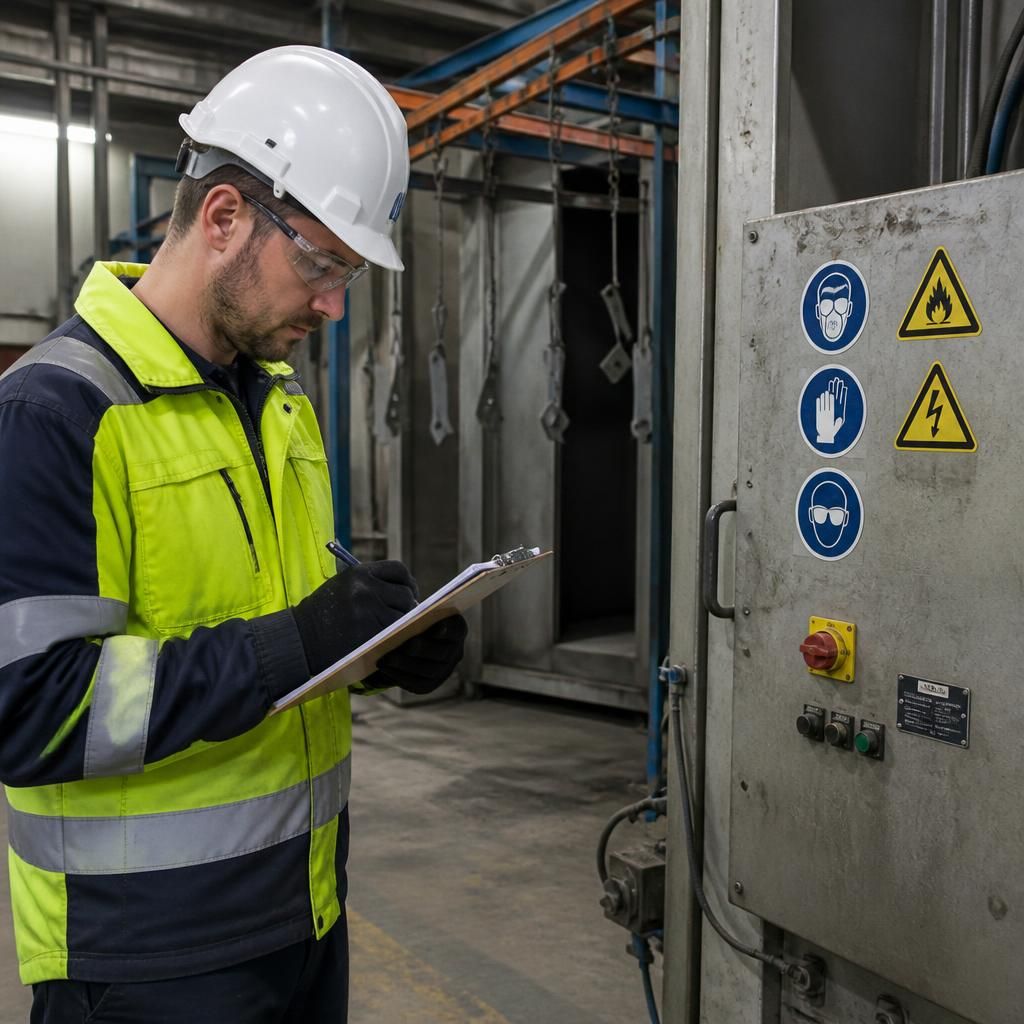
A change to the powder, substrate, preparation method or curing equipment can alter the environmental and safety requirements of a coating process. Treat changes as a formal review point rather than assuming that an existing assessment remains suitable. For example, a new pretreatment chemical may introduce different storage and waste controls, while increased powder use can affect extraction, housekeeping and emissions considerations.
Before implementation, compare the proposed change with the current risk assessments, equipment limits, safety data and waste arrangements. Record the decision, update operating instructions and brief the people affected. This change-control evidence helps demonstrate that compliance has been considered whenever the process, materials or production conditions develop.