

What are the differences between sandblasting and other blast cleaning methods for surface preparation?
Sandblasting uses fine abrasive particles to remove rust, coatings and contaminants, while other blast cleaning methods use media such as steel shot, grit, glass bead, soda or water-assisted abrasive. The main differences are the cleaning speed, surface profile, dust generation and risk of damaging the substrate, so the method should be selected according to the metal, existing finish and powder coating requirements.
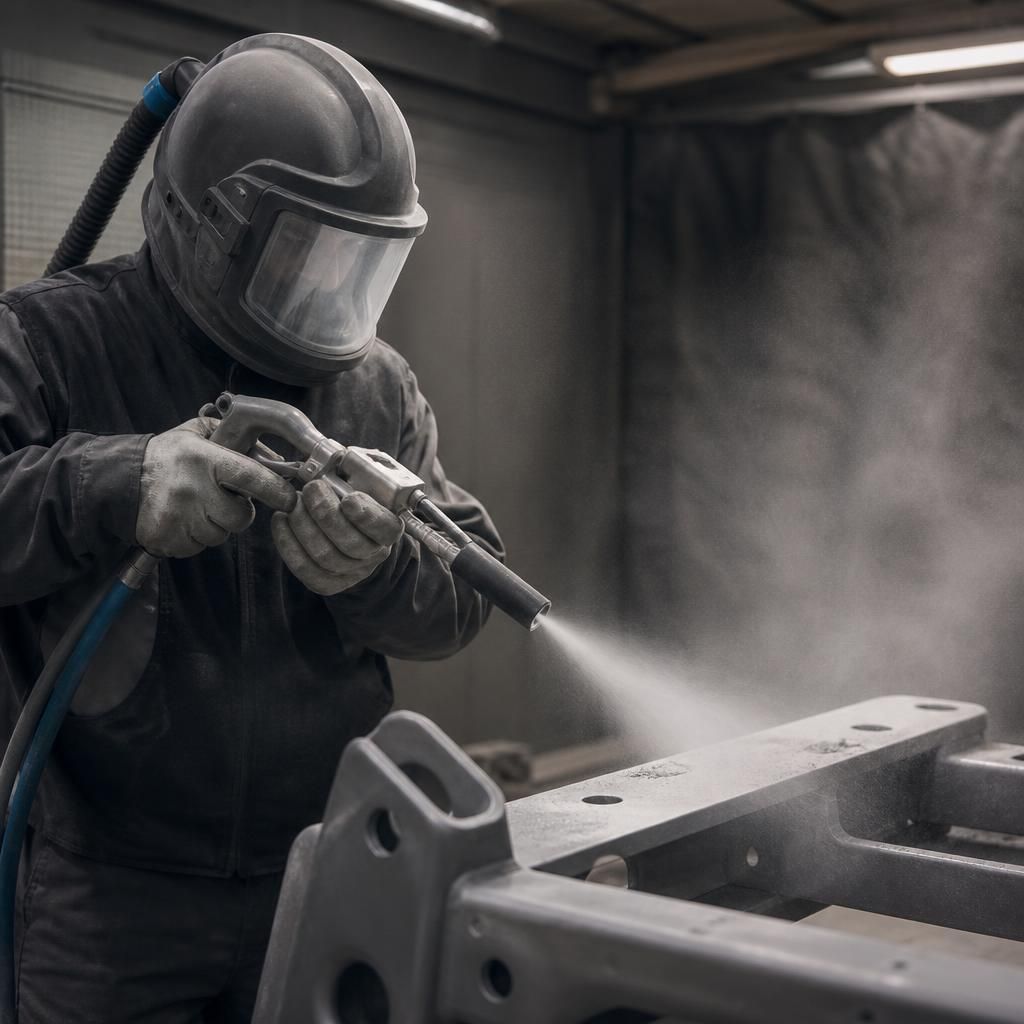
Sandblasting is one form of abrasive blast cleaning, but it is not automatically the best option for every metal surface. The key difference is how each method removes contamination and prepares the substrate for coating: abrasive type, particle shape, application equipment and whether water is introduced all affect the resulting surface and its suitability for powder coating.
Sandblasting traditionally uses silica sand propelled by compressed air. It can cut through corrosion, old paint and mill scale, leaving a mechanically keyed surface. However, airborne respirable silica presents a serious health risk, and the use of silica sand for blasting is heavily restricted in the UK. In modern practice, the term is often used informally for dry abrasive blasting using alternative media, so the actual abrasive should always be confirmed rather than assumed from the description.
Grit blasting is a broader term covering angular abrasives selected for their cutting action. Mineral grit, aluminium oxide and other hard, sharp-edged media are used where a coating or corrosion layer needs to be broken down efficiently. Compared with rounded media, angular grit generally produces a more pronounced key for coating adhesion, although an excessively coarse or aggressive treatment can leave a profile that is unsuitable for a thin powder film or can expose softer areas of the component.
Steel shot blasting uses rounded metallic particles. It is particularly suited to robust steel parts and production work where loose scale, rust and foundry residue must be removed without the sharply cut appearance associated with angular grit. Shot can also compact the outer surface through repeated impact. That makes it useful for some components, but it is not interchangeable with grit: the resulting profile and cleaning action must match the powder specification and the condition of the metal.
Glass bead blasting provides a gentler cleaning action and can produce a more uniform, satin-like appearance. It is often considered for stainless steel, aluminium and other surfaces where preserving the underlying form is important. Glass bead is less suited to severe corrosion or thick, tightly bonded coatings because its rounded particles tend to clean and burnish rather than cut deeply into the surface.
Soda blasting uses sodium bicarbonate, which is relatively soft and breaks down on impact. It can remove paint, grease and other contaminants while causing comparatively little alteration to the base material. This can be useful where dimensional accuracy or a delicate surface matters. Its limitations are equally important: it may provide too little mechanical key for some powder coating systems, and any alkaline residue must be removed thoroughly before pretreatment and coating.
Wet or vapour abrasive blasting combines abrasive media with water. The water suppresses airborne dust and can reduce heat build-up, which helps when treating thin sections or heat-sensitive components. It also changes the cleaning process by introducing moisture that must be controlled. After wet blasting, the part needs suitable rinsing, drying and protection against flash rust before powder coating; otherwise, trapped moisture or renewed corrosion can undermine the finish.
Bead, shot and grit are not interchangeable because particle shape determines the way each one interacts with the substrate:
- Angular particles cut into contamination and create a sharper mechanical key.
- Rounded particles impact and clean with less cutting, often giving a more even or burnished appearance.
- Soft particles can remove contaminants while preserving the surface, but may not remove heavy corrosion or create sufficient profile.
- Metallic media can be efficient on suitable ferrous components but may be inappropriate where embedded particles, cross-contamination or a non-ferrous substrate is a concern.
The substrate is therefore a primary consideration. Steel can usually tolerate more aggressive treatment than aluminium, zinc-coated steel or thin fabricated sections. Softer metals may distort, become roughened excessively or develop an altered appearance if the pressure and media are not controlled. Galvanised or plated parts require particular care because removing the protective layer can create a corrosion problem rather than solve one.
The existing finish also affects the choice. Light oxidation, loose scale and surface dirt may require a different approach from a thick powder coating, baked-on residue or heavily pitted corrosion. A method that removes loose contamination efficiently may leave firmly bonded material behind, while a highly aggressive medium may remove sound substrate unnecessarily. Test blasting or inspection of a representative area can help establish whether the selected process is achieving the required cleanliness and profile.
For powder coating, preparation does not end when visible contamination has disappeared. The surface must be free from abrasive residue, oil, moisture and loose particles, and the resulting profile must be compatible with the powder film thickness and the component’s intended use. After blasting, parts may require vacuuming, air cleaning, washing, chemical pretreatment or another controlled preparation stage. The correct sequence depends on the metal and the powder coating system rather than on the blasting method alone.
Equipment also creates practical differences. Compressed-air blasting is flexible for complex shapes and localised work, whereas wheel blasting projects metallic abrasive mechanically and is better suited to components that can be presented consistently to the equipment. Manual systems can reach awkward features but depend heavily on operator control. Automated systems offer more repeatable coverage when component geometry and loading are consistent. Internal corners, holes, welds and folded sections should be checked because incomplete cleaning in these areas can affect coating performance.
In summary, sandblasting is best understood as one part of a wider group of abrasive preparation methods. The appropriate alternative is selected by considering the metal, the condition and thickness of the existing coating, the required surface profile, the geometry of the part, contamination controls and the powder coating specification. For industrial components, the most reliable choice is the least aggressive method that achieves the required cleanliness and profile without damaging the substrate.
Dry ice blasting differs from abrasive sandblasting because it cleans by propelling solid carbon dioxide pellets rather than cutting media against the metal. The pellets sublimate on impact, helping remove certain oils, dirt, coatings and production residues without leaving abrasive particles behind. This can be useful where media contamination is a concern or where the component contains delicate features.
Its main limitation for powder coating preparation is that it generally produces little or no surface profile. Unlike angular grit, it may clean the surface without creating the mechanical key needed for reliable coating adhesion. Dry ice blasting can therefore be a useful cleaning stage, but the metal may still require a suitable profiling or pretreatment process before powder is applied. The correct choice depends on whether the priority is residue removal, coating removal, surface roughening or a combination of these tasks.