

How does the powder coating process impact metal fatigue resistance?
Powder coating can improve a metal component’s fatigue resistance indirectly by protecting its surface from corrosion, abrasion and environmental damage that could initiate fatigue cracks. It does not increase the inherent fatigue strength of the base metal, so surface preparation, coating adhesion, curing and the component’s design remain important.
Metal fatigue resistance is governed mainly by the substrate, component geometry and cyclic loading. Powder coating influences fatigue behaviour at the surface: it can reduce exposure to conditions that promote crack initiation, but it is not a structural reinforcement and should not be treated as an increase in the metal’s design strength.
Why corrosion matters: Repeated loading can cause very small surface flaws to develop into fatigue cracks. Corrosion pits, oxidation and chemical attack make this process more likely by creating local notches in the metal. A continuous, well-adhered powder coating separates the substrate from moisture, salts and other contaminants, helping to reduce corrosion-fatigue risk. This is particularly relevant for components exposed to outdoor, industrial or chemically aggressive environments.
The benefit depends on the coating remaining intact. A deep scratch, impact mark, pinhole, poorly coated edge or area left uncoated can become a local weakness. If moisture reaches the metal through damaged coating, corrosion may develop beneath the film and remain difficult to identify from a visual inspection alone. Coating specification and application therefore need to account for the component’s operating environment, handling and likely points of impact.
Surface preparation has a direct bearing on fatigue performance. Degreasing removes oils and contaminants that could interfere with adhesion, while suitable mechanical preparation can remove loose scale and provide an appropriate surface profile. Excessively rough preparation, sharp abrasive damage or poorly treated weld areas can introduce stress concentrations rather than remove them. Weld spatter, burrs, sharp corners and fabrication defects should be addressed before coating where they could initiate cracking.
Coverage at transitions is also important. Corners, holes, threads, folded sections and welds are more difficult to coat evenly than broad flat faces. These locations can experience concentrated stress during service and may be more vulnerable to coating thinning, pinholing or edge pull-back. Designers and coaters should identify critical areas in the component drawings and agree which surfaces require full coverage, masking or a specific edge treatment.
Adhesion and curing affect how the coating responds to cyclic movement. Powder must be applied to a suitably prepared substrate and cured according to the powder system’s requirements. Under-cured material may have inadequate mechanical properties, while an unsuitable cure schedule can affect flexibility, adhesion or the substrate itself. Excessive film build can also alter the way a coating flexes or chips under impact. The correct film thickness is therefore a technical requirement, not simply an aesthetic choice.
Flexibility is especially relevant where a component bends repeatedly or experiences vibration. A coating that is too brittle for the application may crack or detach as the metal flexes. Once the film is breached, the exposed area can become a starting point for corrosion. Conversely, a coating selected for suitable flexibility and impact resistance can remain protective during normal movement, provided the underlying metal and joint design are appropriate.
The powder-coating process also introduces heat. Many systems require the component to reach a specified curing temperature, so the applicator should consider the metal grade, prior heat treatment and dimensional requirements. High-strength steels, precipitation-hardened aluminium and other specially treated alloys may be affected by an inappropriate thermal cycle. The coating specification should be checked against the substrate manufacturer’s limitations before processing fatigue-critical parts.
Powder coating does not correct fundamental fatigue problems in the component. An undersized section, abrupt change in geometry, poorly designed weld, misalignment or excessive service load can still cause failure beneath an intact coating. Fatigue assessment should therefore consider:
- the type and amplitude of the repeated load;
- the number and frequency of loading cycles;
- stress concentrations caused by holes, threads, notches, welds and sharp corners;
- the metal grade, heat treatment and surface condition;
- exposure to moisture, salts, chemicals, abrasion and impact; and
- the consequences of coating damage or loss of adhesion.
For critical components, testing may be more informative than relying on coating appearance alone. Fatigue testing can compare uncoated and coated specimens under representative loading and environmental conditions. Inspection should also look for edge damage, impact marks, blistering, underfilm corrosion and cracks around welds or fasteners. Where the coating could hide a surface defect, suitable non-destructive inspection methods may be required before and after coating, depending on the component’s role and applicable specification.
In practical terms, powder coating is most likely to support long-term fatigue performance when the metal is suitable for its duty, the design avoids unnecessary stress raisers, preparation removes harmful surface defects, the coating system matches the environment, and curing and coverage are controlled. For industrial batches, providing drawings, substrate details, heat-treatment information, service conditions and any masking or inspection requirements allows the coating process to be assessed against the component’s fatigue-related risks rather than treated as a purely decorative finish.
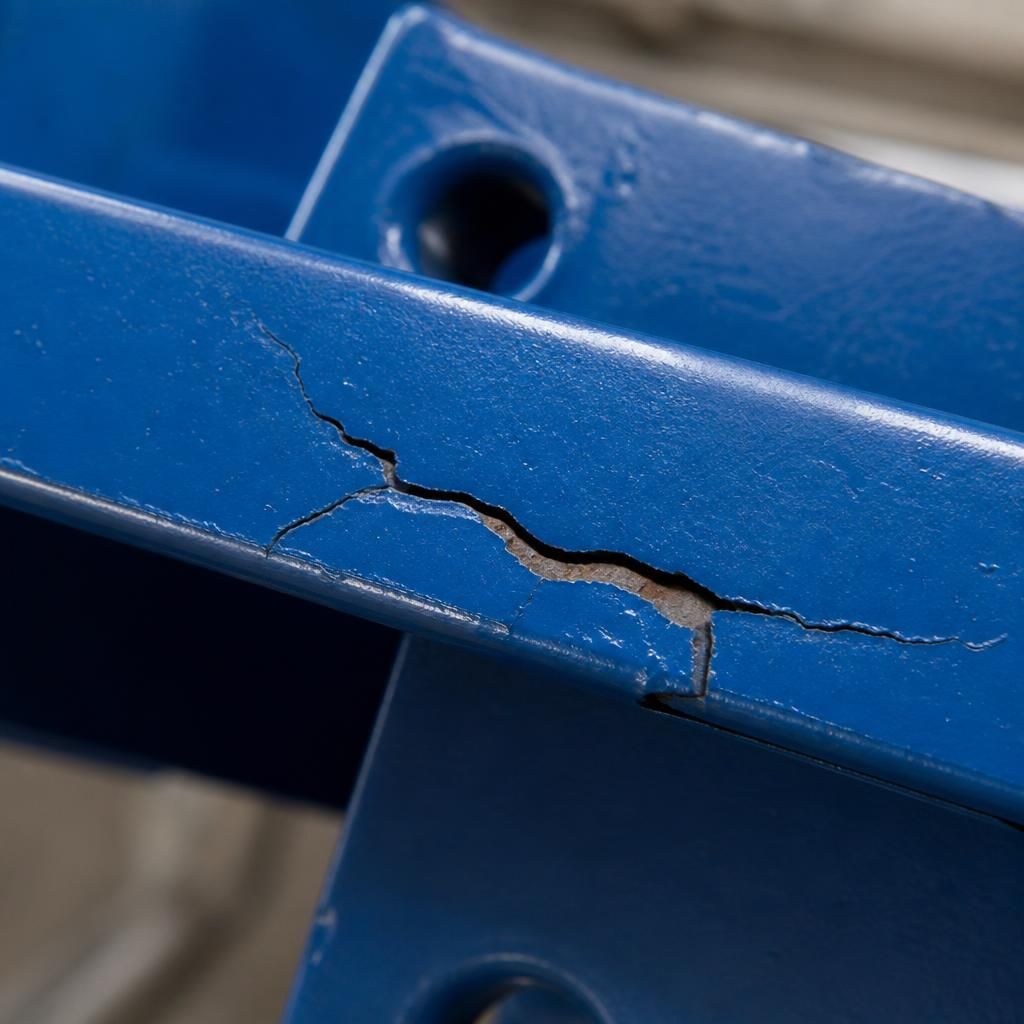
A crack in the powder coating is not automatically a fatigue crack in the underlying metal. Coating films can craze, chip or split because of impact, local movement or differences in flexibility between the coating and substrate. These defects should be assessed to establish whether the metal beneath has also cracked or whether the damage is limited to the finish.
This distinction matters when investigating fatigue-related damage. Remove or examine the affected coating using an appropriate inspection method before drawing conclusions from its appearance alone. A coating defect may expose the substrate to corrosion, while a genuine crack in the metal requires a separate engineering assessment of the component’s loading and continued use.