

What role does environmental condition assessment play in preparing powder coated scaffold tubes?
Environmental condition assessment confirms that scaffold tubes and the surrounding preparation area are suitable for powder coating, with checks for temperature, humidity, moisture and airborne contamination. Identifying unsuitable conditions before coating helps prevent issues such as poor adhesion, trapped moisture and inconsistent curing.
Environmental condition assessment is a decision-making step that determines whether scaffold tubes can move safely through preparation and coating without the surroundings undermining the process. It links the condition of the tubes, the preparation area and the planned workflow, allowing unsuitable batches or risky stages to be identified before powder is applied.
For scaffold tubes, the assessment needs to consider more than a single reading from the coating room. Long, hollow sections may have been stored in different conditions from the main production area, and their surfaces can respond differently during handling. Tubes placed close together, stacked on supports or moved between locations may also experience uneven exposure. These factors can affect whether the entire batch is ready for the next stage at the same time.
A practical assessment commonly covers the following points:
- Previous exposure: establish whether the tubes have been stored outdoors, transported in damp conditions or brought in from an unheated area. This helps identify batches that need additional inspection or conditioning before preparation continues.
- Surface and internal areas: inspect the outside of each tube and consider the open ends, joints, recesses and contact points used during storage or racking. These areas can retain residues or remain less exposed to the preparation environment.
- Temperature transitions: compare the condition of the metal with the surrounding area when tubes move from cooler storage into a warmer preparation or coating space. A surface that is cooler than the surrounding air may reach its moisture threshold even when the room itself appears suitable.
- Air movement and layout: review doors, extraction systems, nearby traffic and the positioning of racks. Strong or poorly directed airflow can carry particles towards prepared metal, while an unsuitable layout can expose completed sections to avoidable handling or disturbance.
- Process interruptions: identify what could happen if a batch is held between cleaning, abrasion, priming and powder application. The longer prepared steel remains exposed, the more important it becomes to reassess its condition before proceeding.
The assessment also helps distinguish an environmental issue from a preparation defect. If a coating problem is later found, records of the conditions and handling sequence can show whether the likely cause was the substrate, the preparation method, the coating material or a change in the surrounding environment. This supports more accurate investigation than relying on visual inspection alone.
Assessment findings should lead to a clear action rather than simply being recorded. Depending on the result, the tubes may be accepted for preparation, held for further conditioning, returned for additional cleaning or abrasion, moved to a more suitable area, or kept separate from material that is ready to coat. Separating batches in this way reduces the risk of mixing tubes with different histories or presenting only part of a batch for coating.
Environmental checks are particularly useful at handover points. The relevant stages include receipt and storage, after preparation, before primer application where specified, before powder application and following any significant pause in the work. A tube that was acceptable at one stage should not automatically be assumed to remain suitable after movement, delay or exposure to a different area.
For batch work, consistent assessment is as important as the individual readings. The same inspection method should be applied across the load, with the location, time, batch identity, observations and resulting action recorded. This creates a traceable basis for deciding whether the tubes can proceed together or whether parts of the load require separate treatment.
Environmental condition assessment therefore supports preparation in three ways: it identifies risks that are not obvious from the metal’s appearance, sets a reasoned point at which work can proceed, and provides evidence for controlling variations during the job. It does not replace cleaning, abrasion or other preparation stages; it confirms that those stages are being carried out under conditions that are suitable for the scaffold tubes and the intended coating system.
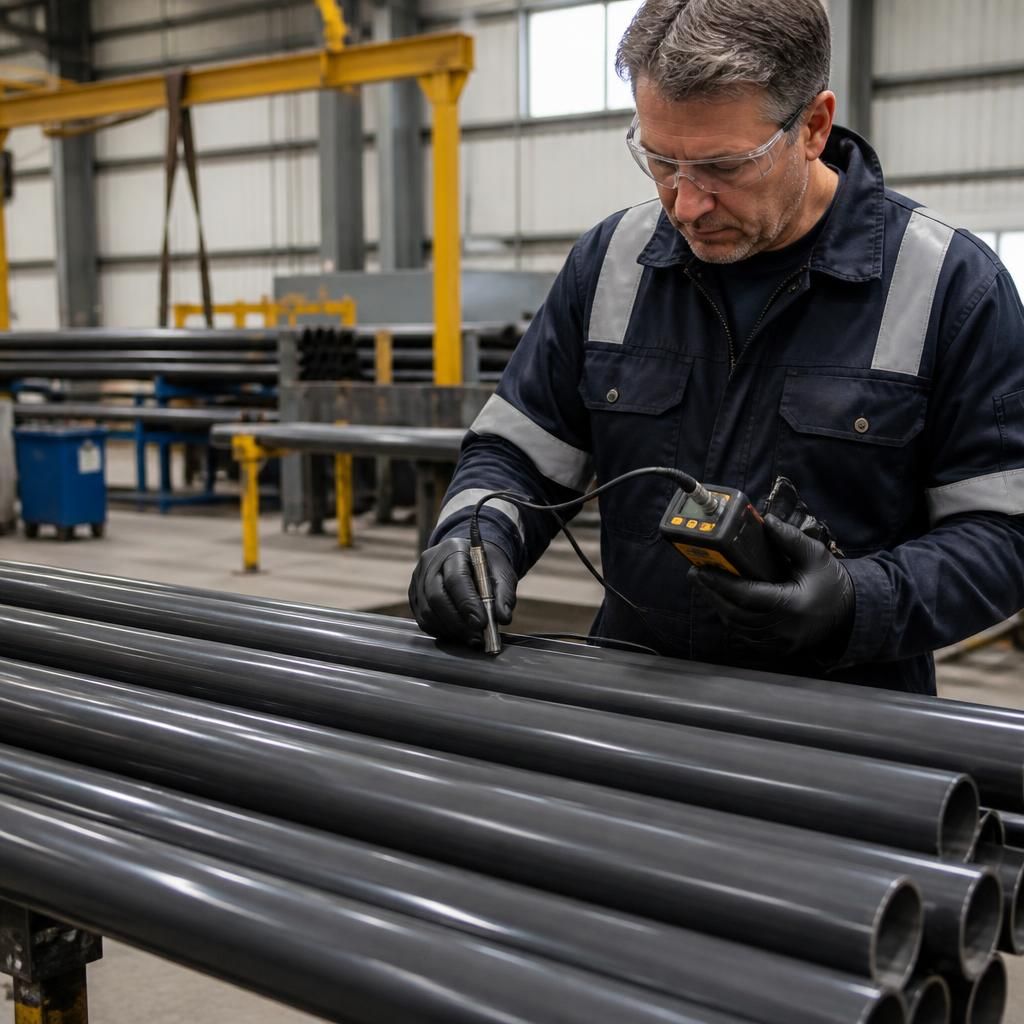
Environmental condition assessment should be judged against the requirements of the selected powder and any primer system, rather than against a universal pass-or-fail reading. Different coating systems can have specific limits for substrate temperature, surrounding conditions and the interval between preparation and application. Checking these requirements before work begins helps the preparer decide whether the planned sequence is suitable for the scaffold tubes.
The assessment also gives quality checks a more reliable foundation. If coating appearance, adhesion or curing is later questioned, the recorded conditions can be compared with the product requirements and the work sequence. This helps separate a problem caused by unsuitable conditions from one caused by surface contamination, abrasion or application. Readings should therefore be taken with appropriate instruments at the tube location and linked to the relevant batch and coating system, rather than relying on a general room reading.
Discuss Environmental Assessment for Your Scaffold Tubes
For a practical next step, provide your scaffold tube batch details, coating requirements and relevant storage or transport history when requesting an assessment from Powder-coatings.co.uk. This gives the coating specialist the information needed to review preparation requirements before the work proceeds.