

Why is uniform temperature crucial during the powder curing process?
Uniform temperature ensures every coated part reaches the required curing temperature consistently, allowing the powder to flow, bond and develop its intended properties. It helps prevent under-cured areas with poor performance and over-cured areas with discolouration, brittleness or other finish defects.
Uniform temperature is crucial because powder curing depends on the metal reaching a controlled thermal condition throughout the complete coating system, not merely on the oven display showing the target setting. Consistent heat exposure allows the coating to develop comparable chemical and physical properties across different parts, positions and sections of the same component.
The oven setting is not the same as the part temperature. A curing schedule is normally specified by the temperature of the coated metal and the time it remains at that temperature. Air temperature can reach the set point before the workpiece does, particularly when components are thick, densely loaded or made from metal with substantial thermal mass. If the process is assessed only by the controller reading, the actual thermal history of the coating may be misunderstood.
Temperature variation can occur in several directions:
- Between different areas of the oven, such as the entrance, centre and exit;
- Between upper and lower rack positions or areas close to the burners and heating elements;
- Between the exposed and sheltered faces of a component;
- Between thin sections, heavy welds, folded edges and solid plate;
- Between lightly loaded and heavily loaded batches.
These differences matter because the powder film responds to the heat received by the metal beneath it. A thin bracket may reach the required condition much sooner than a heavy fabricated frame placed in the same batch. Likewise, a recessed face may receive less effective heat than an exposed surface, while a tightly packed load can restrict air movement and alter the heating pattern.
Uniformity supports repeatable film formation. During curing, the powder softens and forms a continuous film before the resin system reacts and cross-links. Stable, even heating helps the coating progress through these stages in a controlled manner. Uneven heat can create differences in gloss, texture, colour, film appearance and mechanical behaviour between areas that should otherwise match. This is particularly important for assemblies or batch orders where parts need to have a consistent visual and functional finish.
Temperature consistency also affects process control. When the heat profile is stable, the coater can relate the finished result to defined oven settings, loading arrangements and part specifications. If different zones fluctuate or individual parts heat at different rates, it becomes difficult to identify whether a variation has come from the powder, pretreatment, application equipment, loading pattern or curing conditions. A uniform oven therefore reduces one significant source of uncertainty when investigating coating results.
Oven design and loading practice both influence temperature distribution. Correct airflow helps transfer heat around the work, while suitable spacing prevents parts from shielding one another. Parts should be positioned so that the oven can circulate heated air around their surfaces, with consideration given to their size, shape, orientation and thermal mass. A load made up of substantially different components may need a process assessment rather than being treated as equivalent to a batch of similar parts.
Reliable monitoring should examine the conditions experienced by the workpiece rather than relying on a single fixed probe. Temperature profiling equipment can record the thermal history at representative locations, including heavy sections and areas known to heat more slowly. Comparing those results across oven zones, rack positions and load types helps identify cold spots, excessive temperature exposure and repeatability issues. The findings can then inform adjustments to airflow, loading, conveyor speed, oven set points or the arrangement of heating zones.
Uniform temperature is especially important for large or complex metalwork. A single component may combine thin sheet, boxed sections, brackets and welds, each with a different heating response. The oven process must provide sufficient and consistent heat to the slowest-heating areas without exposing already-heated sections to unnecessary thermal stress. This is why curing parameters should be considered alongside component design and batch configuration, rather than applied as a fixed setting without checking the workpiece.
In practice, maintaining uniformity involves keeping the oven in sound working order, checking control and sensing equipment, reviewing airflow, avoiding overloading and validating the process when the product or load changes. These measures help ensure that the coating receives a comparable thermal treatment from one batch to the next and that the finished components meet the required specification.
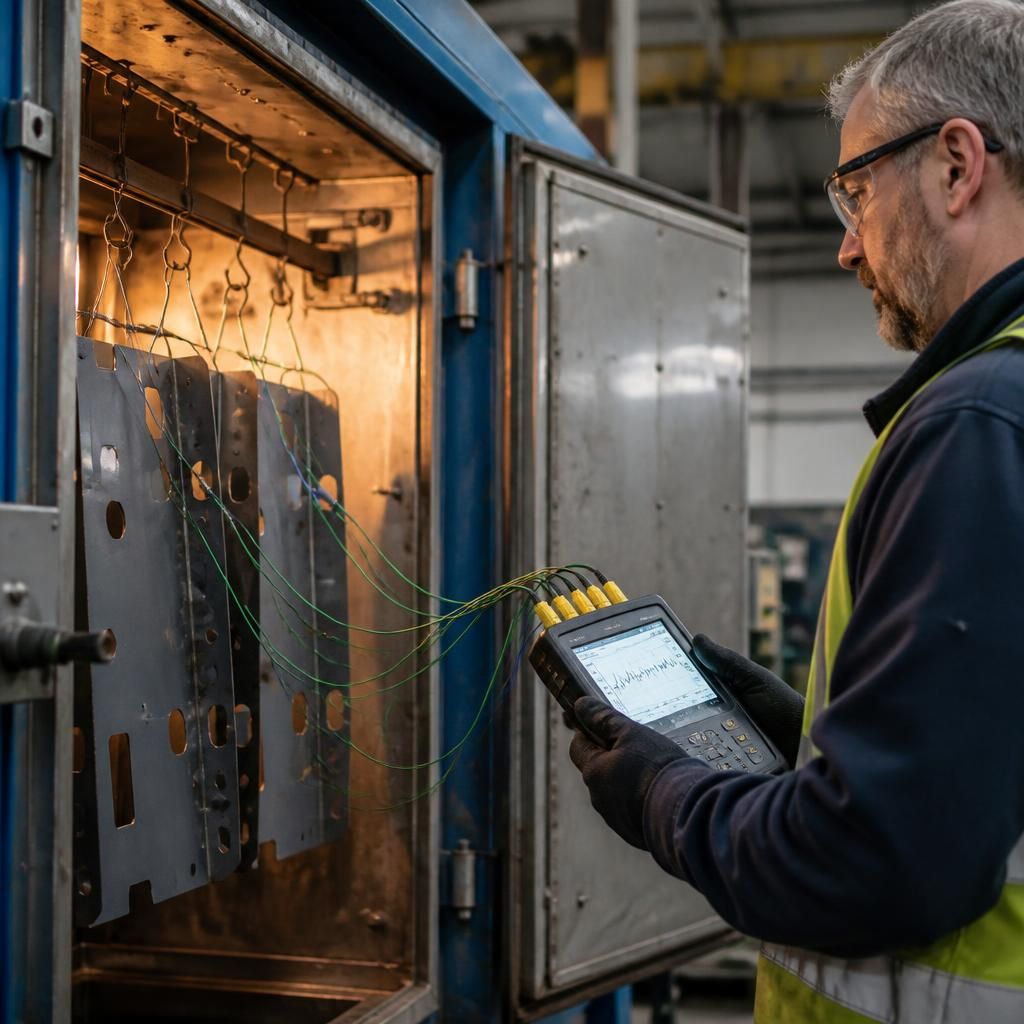
Uniform temperature is essential when validating a powder coating against its specified cure schedule. The coating manufacturer’s recommendations are based on the thermal exposure received by the coated metal, so a result from one convenient test location may not represent every part of a production load. If some areas experience a different temperature history, a coating can appear acceptable at the checked point while other areas have developed different cure characteristics.
For this reason, temperature uniformity should be considered during process approval and whenever the component design, powder system, oven settings or loading arrangement changes. Confirming that representative parts receive comparable thermal exposure makes the approved curing process more meaningful and reduces the risk of relying on a single reading that does not reflect the complete batch.