

What are the most suitable blasting media types for different industrial coating applications?
The most suitable blasting media depends on the substrate, required surface profile and coating system: steel grit or shot suits robust steel components, aluminium oxide or garnet suits controlled preparation, and glass bead is better for lighter cleaning or a smoother finish. Softer media, such as plastic or walnut shell, may be appropriate for delicate substrates where aggressive abrasion could cause distortion or damage.
The correct blasting media is determined by the metal substrate, the contamination being removed, the surface profile required by the coating and the appearance or dimensional tolerance of the finished component. A suitable specification must remove rust, mill scale, old coating, grease or manufacturing residue without distorting the part, embedding unwanted material or creating a profile that the coating cannot properly cover.
Carbon steel and structural steel
Steel grit is commonly selected where the surface has heavy mill scale, corrosion or firmly adhered previous coatings. Its angular particles cut into contamination and create a defined anchor pattern for subsequent coating. Different grit grades can be selected according to the thickness of the contamination and the profile required.
Steel shot is more rounded and is useful for general cleaning, loose scale removal and applications where a less sharply etched surface is preferred. It is also suitable for robust components that can tolerate impact from a reusable metallic medium. Shot is not normally the first choice where a pronounced angular key is essential for a high-build or protective coating.
Stainless steel and other hard-wearing alloys
Aluminium oxide, garnet or silicon carbide can be considered when a hard, angular abrasive is needed without using carbon-steel media. This is important where ferrous contamination could affect corrosion resistance or compromise the appearance of stainless components. The blasting specification should also control pressure and dwell time, as excessive abrasion can alter edges, weld details or machined dimensions.
Glass bead and ceramic bead are better suited to cleaning and producing a consistent satin or matt appearance on sound metal than to removing severe scale. Their rounded form produces less aggressive cutting, which can be useful for visible stainless parts, architectural components and items where retaining the underlying shape is important.
Aluminium and other non-ferrous metals
Aluminium oxide and garnet can prepare aluminium where a definite coating key is needed, but the grade and operating pressure require careful control. Aluminium is relatively soft, so an unnecessarily aggressive medium may roughen thin sections, soften sharp details or leave an unsuitable surface texture.
Glass bead is often appropriate where the main objective is to clean aluminium and provide a uniform cosmetic finish rather than remove deeply bonded corrosion. Plastic media can be preferable for thin or delicate aluminium parts, particularly where limiting heat and substrate erosion is more important than producing a deep profile.
Removing existing paint or powder coating
For thick, tenacious or multi-layer coatings on heavy steelwork, angular mineral or metallic abrasives generally provide the cutting action needed to expose clean metal. On lighter fabrications, castings or components with vulnerable edges, plastic media or crushed glass may offer a better balance between coating removal and substrate protection.
Media should not be selected solely according to how quickly it strips the old finish. The remaining surface must be free from loose residue and have a profile compatible with the next coating. If the old coating contains unknown substances, the preparation method also needs to account for dust control, waste handling and the risk of spreading contamination through reusable media.
Delicate components and precision parts
Plastic media, walnut shell and sodium bicarbonate are lower-aggression options for parts that could be distorted or marked by metallic or highly angular abrasives. Plastic media is used for controlled coating removal, while walnut shell can clean sensitive surfaces without cutting as deeply into the substrate. Sodium bicarbonate is water-soluble and leaves little abrasive residue, although the component must be thoroughly cleaned afterwards and the resulting surface profile may be limited.
These media are not interchangeable. A soft abrasive that protects a delicate component may not remove heavy corrosion or provide sufficient key for a durable protective coating. Conversely, a highly aggressive abrasive can remove sound metal when used on a thin, intricate or dimensionally critical part.
Specialist considerations for coating preparation
- Required profile: The abrasive must create enough surface texture for mechanical adhesion without producing peaks that remain exposed through a thin coating.
- Component geometry: Recesses, holes, welds, folded edges and narrow sections may need a media that reaches the contamination without damaging adjacent surfaces.
- Substrate condition: Light oxidation, heavy rust, mill scale and aged coating require different cutting characteristics and often different abrasive grades.
- Contamination control: Media used on carbon steel may be unsuitable for stainless steel, aluminium or other substrates if ferrous particles could be transferred.
- Surface cleanliness: After blasting, dust, loose abrasive and residues must be removed before coating. Handling should also be controlled so that prepared metal is not recontaminated.
- Finish requirements: A visible architectural component may require a consistent cosmetic texture, whereas a concealed structural part may prioritise coating adhesion and corrosion protection.
For powder coating, the final preparation should be assessed alongside the powder specification, film thickness and service environment. A coating intended for indoor use may have different preparation requirements from one exposed to moisture, chemicals, road contaminants or abrasion. Nylon and other specialist coating systems likewise need a clean, suitably keyed substrate rather than an automatically aggressive blast.
The most reliable approach is to identify the substrate and existing contamination first, then define the required profile and appearance before choosing the abrasive. Where the material or previous coating is uncertain, a controlled test area can confirm whether the selected medium cleans effectively, preserves the component and leaves a surface that the specified coating can consistently wet and adhere to.
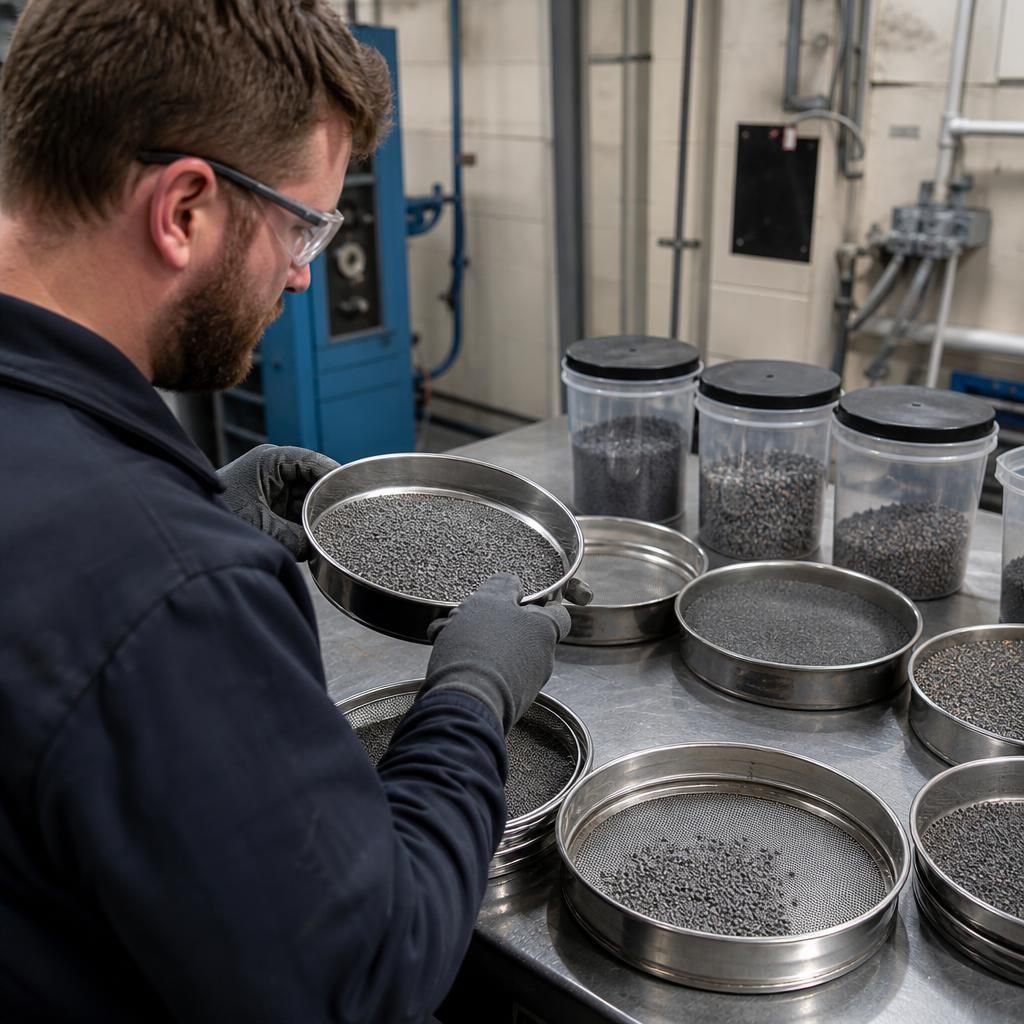
Blasting media must be assessed by condition as well as by type. Reusable metallic abrasives gradually become smaller and less angular as they circulate, changing the surface profile and increasing dust. If the abrasive is not screened and replenished correctly, two batches of identical components can receive different preparation. Media should therefore be kept clean, separated from other abrasive types and checked for breakdown or contamination before use. This is particularly important when a consistent profile is required across a production batch or before applying a specialist coating.