

What equipment is used in the shotblasting process for metal coating?
Shotblasting for metal coating uses a blast cabinet or room, abrasive media delivery system, compressed-air equipment or blast wheels, dust extraction, and media recovery equipment. Work-handling and inspection tools are also used to position components safely, control the blast, and check that the surface is ready for powder coating.
Shotblasting equipment is a coordinated system for propelling abrasive at a controlled velocity, removing contaminants and creating the surface profile required for a subsequent metal coating. The main configuration is either compressed-air blasting, where abrasive is directed through a nozzle, or centrifugal wheel blasting, where rotating turbines throw the abrasive at the component.
Compressed-air blast equipment
In an air-blasting installation, the blast pot or pressure vessel holds the abrasive and feeds it into the air stream. A metering valve controls the quantity of media entering the line, while a deadman control stops blasting when the operator releases the handle. These controls help maintain a consistent finish and reduce uncontrolled abrasive flow.
The air system normally includes a receiver, pressure regulator, gauges, moisture separators and in-line filters. Dry, clean air is important because water or oil contamination can affect the abrasive, obstruct the equipment and leave residues on prepared steel. The blast hose must be suitable for abrasive service, with couplings and nozzle holders secured against movement.
Nozzle selection affects both productivity and the resulting surface. Nozzles differ in bore size, length and internal material. Tungsten carbide and boron carbide options are commonly used where wear resistance is important. A larger bore can deliver more abrasive but requires greater air capacity; a smaller bore gives a more concentrated stream and may suit smaller areas or detailed components. The nozzle angle, distance from the work and travel speed are also controlled to avoid uneven preparation.
Wheel-blast equipment
Wheel-blast machines use a turbine with blades to accelerate abrasive mechanically. This arrangement is suited to repeatable production work, especially where components can be presented consistently to the blast stream. The turbine, blade condition and abrasive feed rate influence the intensity and uniformity of the treatment.
Wheel-blast systems may be built around different handling arrangements, including tumbling machines for robust small parts, table machines for individual fabrications, and continuous or pass-through systems for suitable profiles. The enclosure and component movement must ensure that edges, recesses and faces receive adequate exposure without allowing parts to collide or become damaged.
Abrasive handling and separation
The abrasive is selected according to the base metal, contamination, required surface profile and component geometry. Steel shot tends to peen and clean the surface, while angular steel grit cuts more aggressively and produces a sharper profile. Mineral or other specialist media may be chosen where a particular level of aggressiveness or reduced risk of embedment is needed.
Blasting installations often use screens, magnetic separators or air-wash separators to remove oversized debris, fines and broken abrasive from reusable media. This protects turbines, valves and nozzles while keeping the working mix more consistent. Media condition matters: worn abrasive can lose its cutting action, whereas excessive fines can increase dust and reduce effective cleaning.
Enclosures and internal controls
A blast cabinet or room needs wear-resistant internal lining in areas exposed to the abrasive stream. Sacrificial rubber or steel panels protect the main structure and can be replaced when worn. Lighting is positioned behind protective screens so that the operator can see the surface without exposing fittings directly to the blast.
For larger fabrications, internal platforms, turntables, rails, lifting points or rotators help present each face to the abrasive stream. These arrangements reduce awkward manual handling and make it easier to maintain a consistent stand-off distance. Racks and hanging fixtures must be designed so they do not shield important surfaces or create unblasted contact marks.
Dust and air-quality equipment
Airflow within the enclosure draws airborne dust away from the operator’s working area and towards a filtration unit. Depending on the installation, this can include a pre-separator, cyclone, cartridge filter or bag filter. Filter cleaning systems prevent excessive loading, while differential-pressure monitoring indicates when maintenance or replacement is needed.
Good extraction must balance visibility with containment. Too little airflow allows dust to remain suspended and can obscure the work; excessive or poorly arranged airflow may remove usable fine media or disturb the abrasive pattern. The extraction arrangement should therefore be matched to the enclosure volume, abrasive type and rate of work.
Inspection and process-control equipment
After blasting, operators may use surface-profile comparators, replica tape or electronic profile gauges to assess the roughness created by the abrasive. Visual inspection under suitable lighting helps identify remaining mill scale, rust, paint, weld spatter or missed areas. Solvent-cleaning checks and cloth tests can help detect loose dust, oil or other residues before coating.
Other useful controls include calibrated pressure gauges, abrasive-flow checks, nozzle-wear checks and records of media condition. These do not replace inspection of the metal; they help identify why one batch may receive a different treatment from another. The required equipment and settings depend on the coating specification, the condition of the incoming metal and the geometry of the parts.
For powder-coating preparation, the equipment should produce a clean, suitably keyed surface without excessive profile, distortion or abrasive contamination. A capable shotblasting setup therefore combines controlled propulsion, suitable media, reliable separation, effective containment and measurable process checks rather than relying on the blasting unit alone.
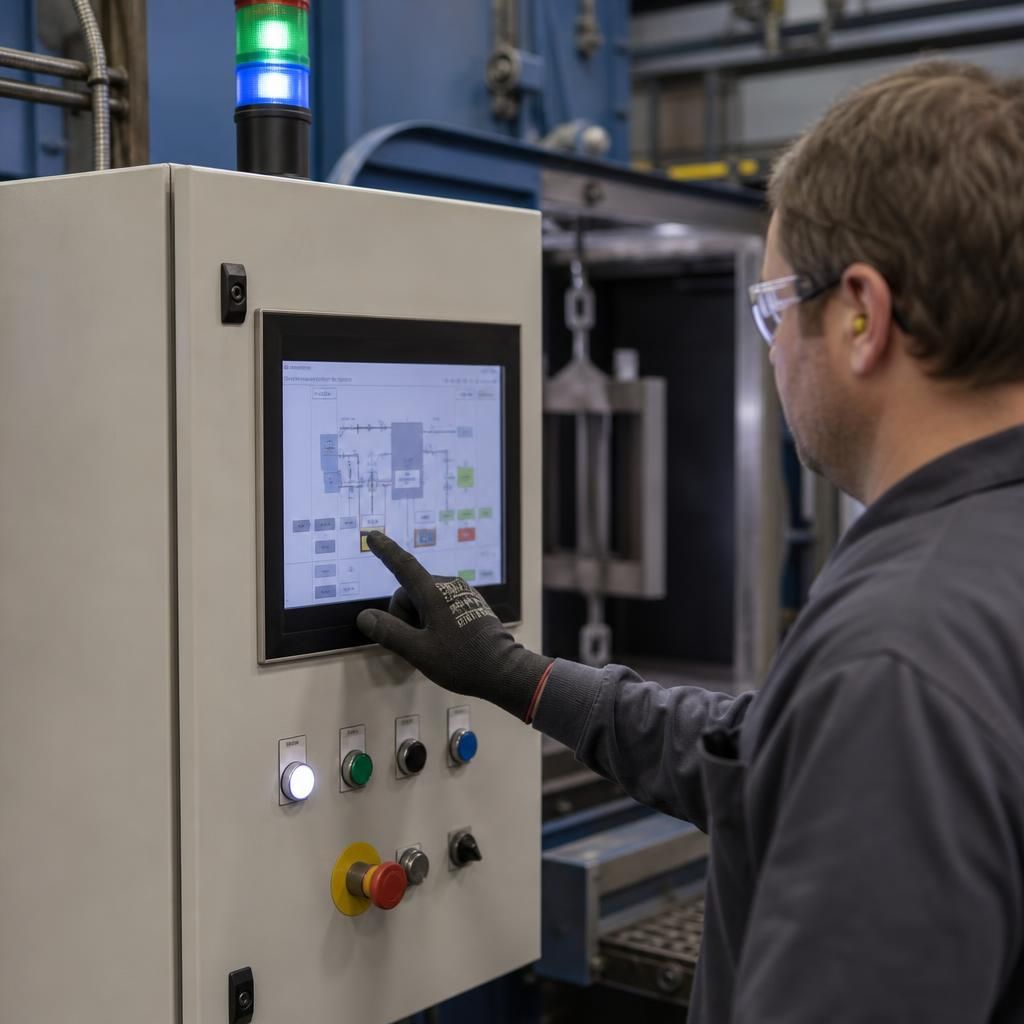
The control system coordinates the shotblasting equipment and prevents the process from running outside its intended settings. Industrial installations may use a control panel or programmable controller to manage blast duration, turbine or conveyor speed, abrasive flow and extraction. This helps repeat the same treatment across batches when the components are loaded in a consistent way.
Interlocks are also important. Door switches, access controls and emergency stops can prevent blasting when an enclosure is open or a component is not correctly positioned. On automated systems, cycle controls can link the blast operation with component movement, reducing the risk of over-processing one area while leaving another insufficiently prepared. The control arrangement should be matched to the machine type, component geometry and required coating specification.