

What factors influence the choice of powder material for stainless steel electrostatic coating?
The choice of powder material for stainless steel electrostatic coating depends on the component’s service environment, required corrosion and chemical resistance, operating temperature, appearance, and expected durability. The powder must also be compatible with the prepared stainless steel surface and curing process, while meeting the project’s colour, texture, film thickness, and production requirements.
The powder material for stainless steel electrostatic coating is selected by matching the coating chemistry to the component’s functional requirements, application method and downstream use. Stainless steel does not automatically require one specific powder; the correct choice depends on whether the finished coating needs to provide mechanical protection, electrical insulation, flexibility, low-friction properties or a particular resistance to wear.
Powder chemistry is the first major consideration. Thermosetting powders form a permanent cross-linked film during curing and are commonly selected where a hard, stable protective finish is required. Polyester-based systems are widely used for general industrial applications, while epoxy-based systems can be appropriate where strong adhesion and resistance to certain chemicals are important. Hybrid powders combine resin types to balance properties, although their suitability depends on the exact operating conditions. Thermoplastic powders, including nylon-based materials, melt and form a film without the same cross-linking reaction. They can be considered where flexibility, abrasion resistance, low friction or a thicker protective layer is required.
Mechanical demands can change the preferred material. Components that are frequently handled, assembled or exposed to impact may need a coating with sufficient flexibility and resistance to chipping. Parts subject to sliding contact may require a harder or lower-friction powder rather than a purely decorative finish. The shape of the component also matters: sharp edges, threaded areas, recesses and mating faces can affect how much material is deposited and how the coating behaves during assembly.
Electrical requirements may determine the resin and additives. Some stainless steel components need the coating to act as an electrical insulator, whereas others must retain a degree of conductivity or provide electrostatic dissipation. This distinction affects the formulation, film build and testing requirements. A powder chosen without considering earthing, insulation or static-control requirements may perform correctly as a surface finish but fail its functional purpose.
Powder particle characteristics influence application quality. Particle size distribution, flow behaviour and charging response affect transfer efficiency and deposition on the stainless steel surface. Fine powders may assist with detailed coverage but can require tighter process control. Heavier or coarser particles may behave differently around corners, apertures and recessed areas. The powder must also be suitable for the spray equipment and recovery arrangements used for the job, particularly where consistent results are required across a batch of components.
Component design and assembly tolerances should be reviewed before selection. Powder coating adds a measurable film to a surface, so close-fitting threads, bearings, press-fit locations and contact points may need masking or exclusion. A powder material that is suitable for the exposed areas may not be appropriate on faces that must remain electrically or mechanically conductive. Identifying these areas before coating helps prevent interference with assembly and avoids unnecessary removal of the finished film.
Compliance and end-use restrictions can also narrow the options. The selected powder may need to meet requirements relating to contact with particular substances, hygiene, fire performance, emissions or restricted chemicals. Documentation should be checked for the intended application rather than relying only on a generic product description. Where a component forms part of regulated equipment, the coating specification may need to be considered alongside the requirements for the complete assembly.
Repair and future recoating should be considered at specification stage. Some coating systems are easier to identify, touch up or remove than others, and a repair method that works for one resin family may not be suitable for another. The specification should record the powder type, colour reference, surface finish, target film thickness and curing requirements so that future work can be matched more reliably. This is particularly important for replacement parts that must integrate with an existing coated assembly.
In practice, powder selection is best confirmed through the coating manufacturer’s technical data, the component drawing and the intended service specification. A coating specialist can then check whether the proposed material is suitable for stainless steel, the chosen electrostatic process, the component’s geometry and the required curing conditions before production begins.
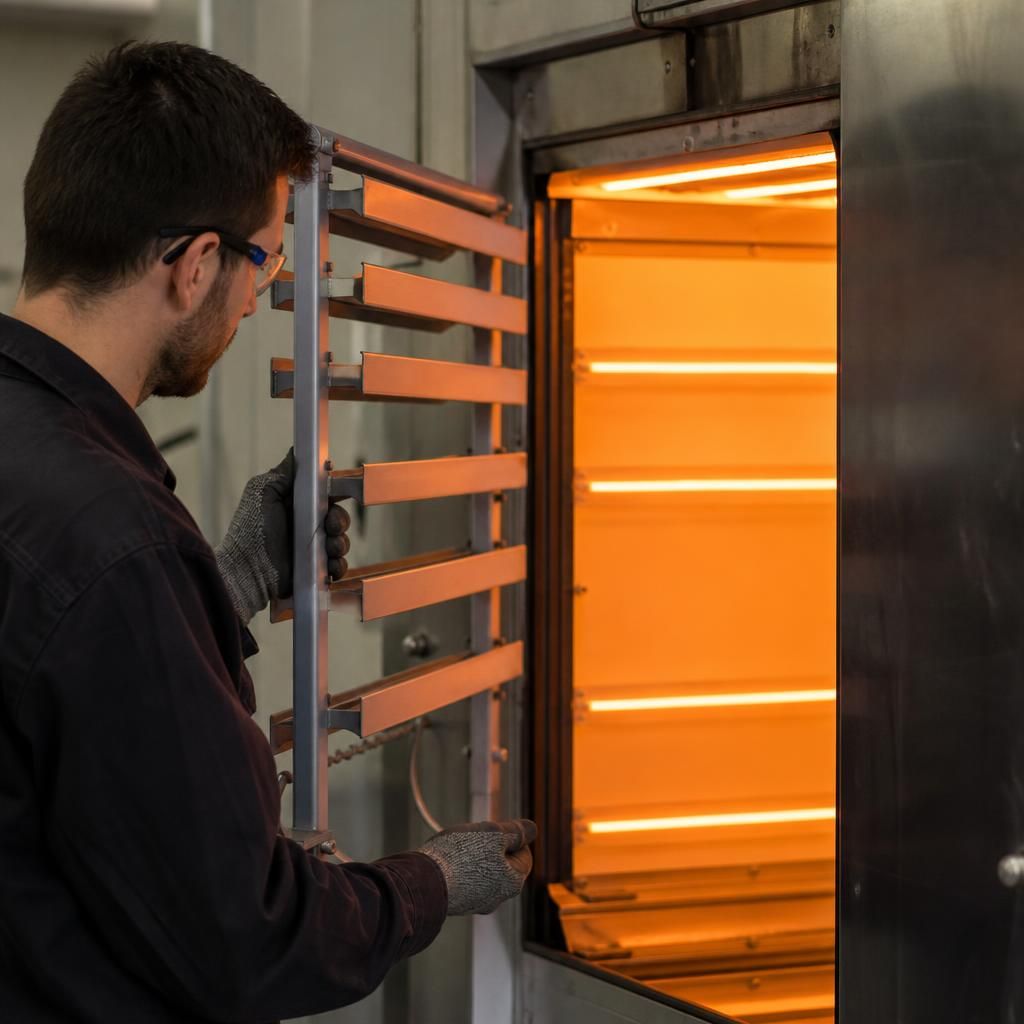
Temperature requirements should be assessed in two separate stages: curing and service. The powder must cure correctly within the available oven conditions, while the finished coating must remain stable at the component’s lowest and highest operating temperatures. A material that cures successfully but softens, becomes brittle or loses adhesion during use is not suitable for the application.
Temperature cycling also matters. Stainless steel components that repeatedly move between hot and cold conditions can place stress on the coating because the metal and coating expand and contract at different rates. The powder specification should therefore be checked for its recommended curing window, continuous-use temperature and resistance to the expected thermal changes, rather than selected solely by colour or general-purpose classification.
Discuss your powder material requirements
Discuss your powder material requirements with the coating team, providing the component drawing, service conditions and any performance specifications. This allows the proposed powder system to be assessed against the stainless steel component and its intended use before production.