

How do powder coating and traditional rust removal methods compare in effectiveness for protecting steel?
Powder coating generally provides more durable long-term protection than rust removal alone because it creates a tough, continuous barrier against moisture and corrosion. Traditional methods such as abrasive blasting or chemical treatment are effective for removing existing rust, but the steel usually needs a suitable coating afterwards; powder coating is most effective when applied to thoroughly prepared, rust-free metal.
Powder coating is generally more effective for the long-term protection of steel than rust removal used on its own. Rust removal deals with the existing corrosion, whereas powder coating forms a cured protective finish that separates the prepared steel from moisture, oxygen and contaminants. The most reliable approach is therefore to assess rust removal and powder coating as complementary stages rather than as competing alternatives.
Rust removal methods have a limited protective role when used alone. Abrasive blasting, grinding, wire brushing and chemical treatments can remove corrosion products and expose a cleaner steel surface. This can restore the surface condition and help reveal pitting, cracks or areas of section loss. However, cleaned steel remains vulnerable if it is left uncoated, particularly in damp, polluted or heavily used environments. Rust removal can also leave a textured surface or residual contamination that affects the performance of any subsequent finish.
Powder coating changes the protection mechanism. The powder is applied to prepared metal and cured to create a continuous film with good resistance to abrasion, impact and general environmental exposure. This makes it better suited to components that need a durable finish as well as corrosion protection, such as fabricated parts, frames, guards, brackets and other industrial steelwork. Its effectiveness depends on the coating being applied evenly and bonded to a properly prepared substrate.
The main comparison points are:
- Protection: rust removal removes the active corrosion but does not, by itself, provide a lasting barrier. Powder coating supplies the barrier required after the steel has been cleaned.
- Mechanical resistance: a correctly cured powder finish is generally more resistant to routine handling, abrasion and knocks than an uncoated, cleaned surface.
- Consistency: an industrial coating process can provide a uniform finish across batches of components, while manual rust removal may produce varying surface profiles and levels of cleanliness.
- Appearance: powder coating provides a controlled decorative finish, whereas rust removal alone leaves the underlying steel exposed and may highlight pitting or other previous damage.
- Repairability: rust removal can often be carried out locally on fixed steelwork, while powder coating usually requires the component to be suitable for controlled preparation, application and curing. Local damage to a powder-coated part may also need separate repair treatment.
Neither method removes every risk of corrosion. Powder coating can be compromised by sharp edges, inaccessible recesses, weld contamination, trapped moisture, poor pretreatment or damage that reaches the steel. Existing pitting may remain after surface cleaning, so removing visible rust does not necessarily restore the original strength or profile of the component. A coating should not be used to conceal serious structural deterioration; the steel should first be assessed for whether it remains fit for service.
Traditional rust removal may be the more practical option where the steel cannot be removed from its installation, where heat curing could affect an assembly, or where only a small local area requires treatment. It can also be an essential first step before another protective system is applied. For detachable steel components and repeat production work, powder coating normally offers a more complete protection system because surface preparation, coating thickness, curing and inspection can be managed as part of one controlled process.
The service environment should guide the choice. Indoor components exposed to limited moisture may have different requirements from steel used outdoors or around chemicals, road contamination, condensation or frequent handling. Component design matters too: enclosed sections, threaded areas, joints and drainage points require particular attention because they can retain moisture or make uniform coating difficult. The selected powder formulation and preparation specification should match these conditions rather than being chosen solely for colour or appearance.
For previously corroded steel, the strongest comparison is therefore between rust removal alone and a prepared, powder-coated system. Removal alone may improve the immediate condition but leaves the steel dependent on further protection. A properly prepared powder-coated surface provides the additional barrier and mechanical durability needed for longer-term service, provided the component is suitable for the process and the finish is not subsequently breached or poorly maintained.
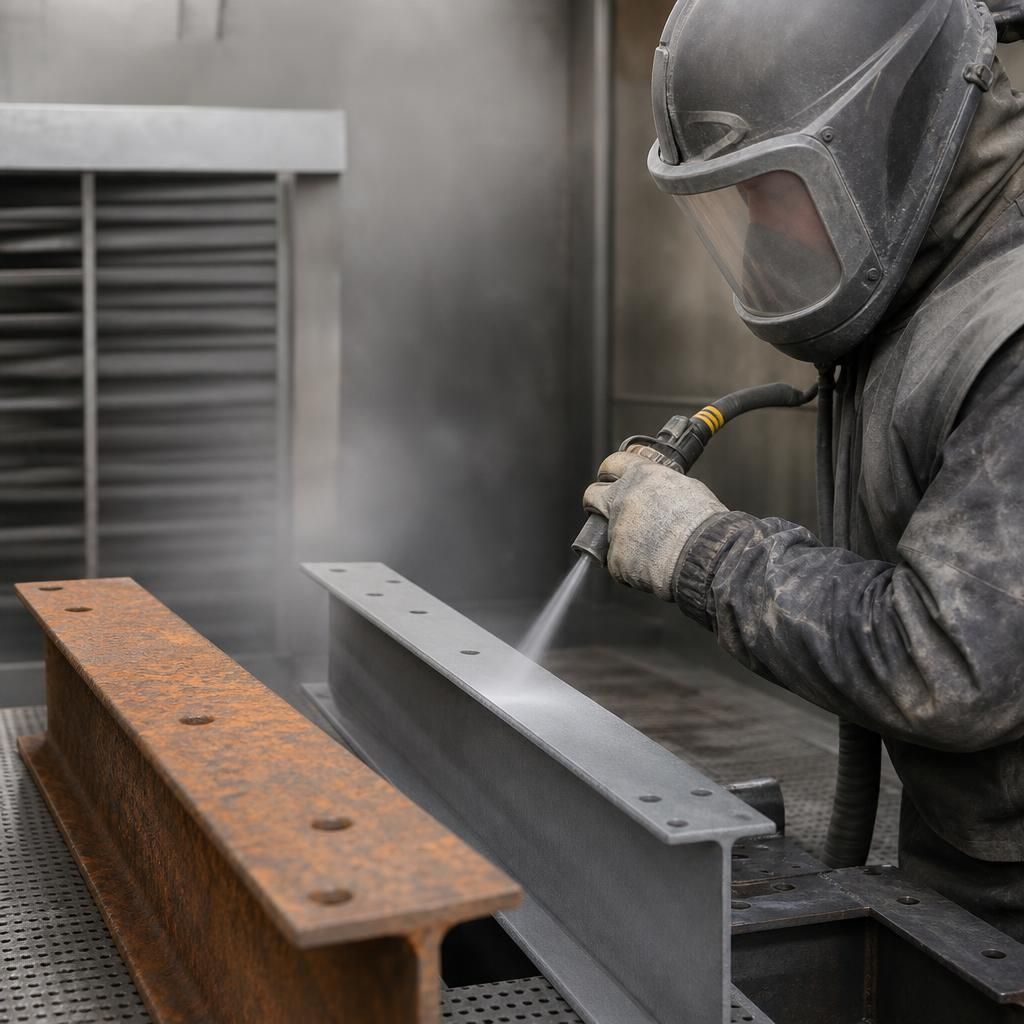
Not all rust removal methods provide the same foundation for a protective finish. Chemical rust converters can stabilise remaining corrosion in areas that are difficult to abrade, but they may leave a chemically altered residue or film on the steel. If that layer is incompatible with powder coating, adhesion can be reduced and the finish may fail prematurely.
For this reason, the effectiveness of a treatment should be judged by the condition and cleanliness it creates for the next stage, not simply by whether the surface appears visually improved. Steel intended for powder coating should meet the specified pretreatment requirements, with any converter residues removed or confirmed as compatible before the powder is applied. This distinction helps explain why a traditional treatment may be useful as a standalone repair in some situations but unsuitable as the direct base for a durable powder-coated system.