

Can powder coating be applied directly to newly galvanised metals?
Powder coating can be applied to newly galvanised metal, but it should not be coated straight from the galvanising process without suitable preparation. The surface must be clean, dry and appropriately profiled, with residues, passivation treatments or white rust addressed before a compatible powder coating is applied and cured.
Newly galvanised steel can receive powder coating as part of a duplex coating system, but its suitability depends on the condition of the zinc surface and the treatment used after galvanising. The age of the galvanised coating alone does not determine whether powder coating is possible; the coating must be assessed and prepared so that the powder layer can adhere without trapping contaminants or gases.
Why newly galvanised surfaces need particular attention
Hot-dip galvanising can leave a surface that differs considerably from ordinary mild steel. It may contain traces of flux, oils from handling, zinc oxides or post-galvanising treatments. Some galvanised products are also passivated to reduce the formation of surface staining. These conditions can interfere with adhesion if they are not identified before coating.
Fresh zinc can also be relatively smooth, which gives the powder film less mechanical key. A suitable preparation method is therefore selected according to the zinc finish, the component’s geometry and the required service environment. This may include controlled sweep blasting or another approved method that creates an appropriate surface without unnecessarily removing the zinc layer.
There is no universal waiting period
Newly galvanised components do not automatically need to be left for a fixed length of time before powder coating. In some cases, coating can proceed after the galvanised finish has stabilised and the required preparation has been completed. In others, storage or exposure may have allowed moisture-related zinc corrosion products to develop, requiring additional treatment before coating.
The important consideration is the actual surface condition at the point of powder coating. Components should be protected from contamination during transport and storage, and the galvaniser’s records should be checked to establish whether a passivation treatment or other post-treatment has been applied.
Process points that affect the finished coating
- Surface assessment: The zinc coating should be examined for uneven areas, sharp runs, heavy deposits, corrosion products and other features that could show through the powder film.
- Controlled abrasion: The preparation method must provide a suitable key while preserving the protective zinc beneath the powder coating. Excessive blasting can damage the galvanised layer and create an unnecessarily weak area.
- Outgassing control: Zinc-coated steel can release trapped air or gases when heated during curing. On larger or more porous components, this may cause pinholes, bubbling or small craters in the powder film. A suitable pre-treatment or heating approach may be required.
- Component design: Hollow sections should have correctly positioned vent and drain holes. Enclosed spaces, overlapping parts and unsealed crevices can retain moisture or release gas during the coating process.
- Edges and fabricated areas: Welds, cut edges, repaired sections and areas contaminated during fabrication may require treatment different from the main galvanised surface.
- Powder and curing compatibility: The powder type and cure schedule should suit both the intended environment and the galvanised substrate. The curing cycle must be sufficient to develop the powder’s properties without causing avoidable defects in the zinc coating.
What can happen if powder is applied without the correct preparation?
Applying powder directly over an unsuitable galvanised surface can result in poor adhesion, blistering, pinholing, cratering or localised lifting. These defects may not be obvious immediately after coating and can become more significant when the component is exposed to moisture, temperature changes, impact or chemicals. Failures are particularly difficult to correct on large fabricated items because the defective coating may need to be removed before the preparation and coating process can be repeated.
How the specification should be agreed
For a reliable result, the galvanising and powder-coating requirements should be considered together rather than treated as unrelated operations. The coating specification should identify the intended environment, appearance requirements, acceptable surface condition and any areas that must remain free from powder, such as threads, mating faces or machined interfaces.
A trial area or representative test component can be useful for complex work, unusual galvanised finishes or parts with a high risk of outgassing. Adhesion, appearance and coating coverage can then be checked before the full batch is processed. This is especially relevant for fabricated components with enclosed sections, extensive welds or a demanding outdoor application.
Accordingly, newly galvanised metal should not normally be sent straight into powder coating without assessment. When the galvanised surface, preparation method, powder specification and curing conditions are coordinated, the two coatings can work together: the zinc provides sacrificial protection to the steel, while the powder layer adds a continuous decorative and protective barrier.
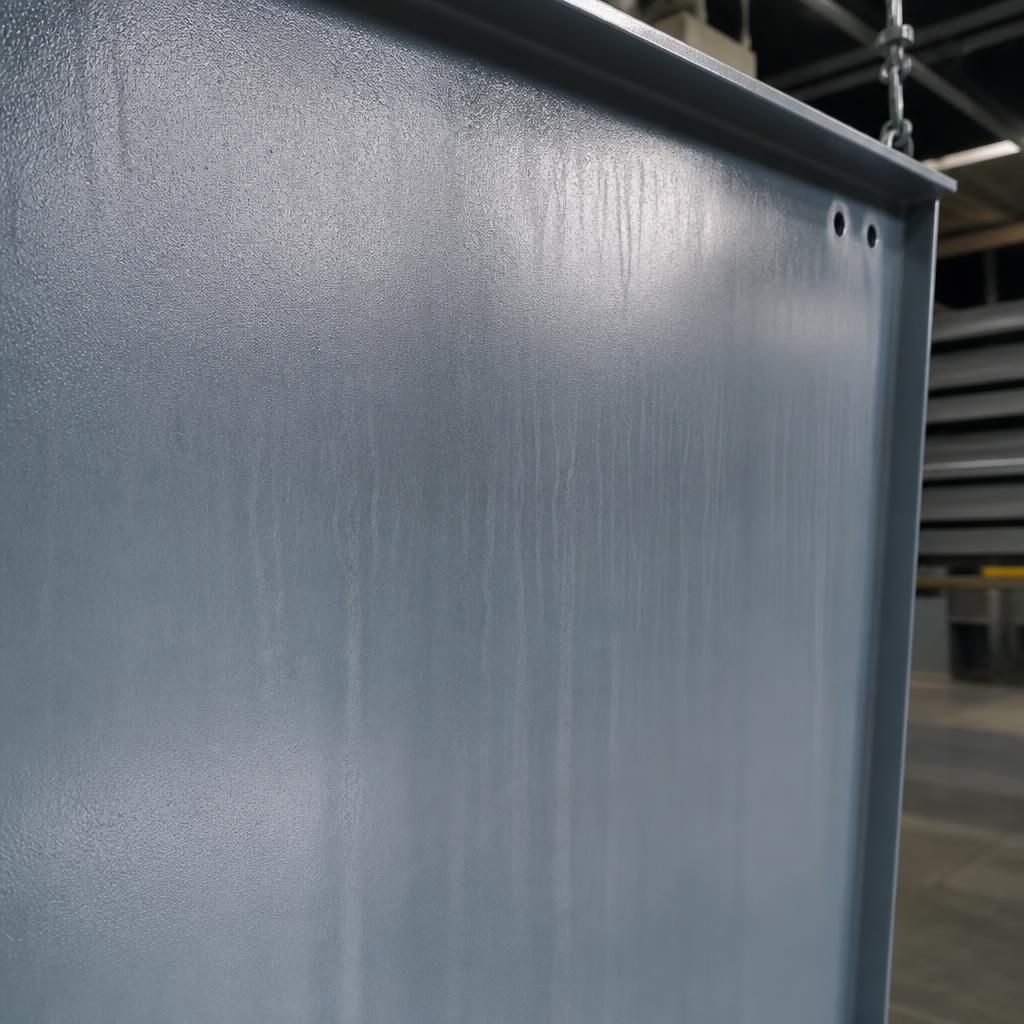
Powder coating does not make the underlying galvanised surface visually uniform. Zinc runs, drainage marks, texture changes and local variations in the galvanised finish may remain visible through the powder layer, particularly on large panels or prominent fabricated parts. Where appearance is important, the acceptable finish should be agreed before production and checked on a representative section of the actual galvanised material.