

What are the benefits of using anti-corrosion powder coating in the manufacturing industry?
Anti-corrosion powder coating protects manufactured metal components from moisture, chemicals and other conditions that can cause rust and surface deterioration. It provides a durable, consistent finish that can reduce maintenance requirements, support longer component service life and help manufacturers maintain reliable product quality.
Anti-corrosion powder coating benefits manufacturing by combining a protective barrier with a controlled, repeatable finishing process. For manufacturers, its value extends beyond preventing visible rust: it can improve part consistency, simplify production planning, support safer handling and provide a finish that remains suitable for demanding industrial use.
Improved production consistency
Powder coating is applied as a dry, measured coating and cured under controlled conditions. This helps produce a more uniform film across batches than many manual liquid-paint applications, provided the metal is correctly prepared and the coating specification is suitable for the component. Consistent coverage is particularly important where parts are produced repeatedly for assembly, installation or onward supply.
Protection for components used in demanding environments
Manufactured metal parts may be exposed to condensation, handling, road contamination, industrial pollutants or cleaning chemicals. An appropriately selected anti-corrosion powder coating creates a continuous barrier that helps limit contact between the metal and these external influences. It can therefore be useful for fabricated assemblies, machinery parts, construction products, automotive components and other items whose performance depends on maintaining the condition of the underlying metal.
Protection is not determined by the powder alone. Metal type, design, coating thickness, edge treatment, preparation method and curing conditions all affect the result. Components with unsealed joints, sharp edges or areas that retain water may require design or preparation measures in addition to the coating.
Efficient coverage of complex batches
Powder can be applied to many shapes and component sizes, including fabricated items with profiles, brackets, frames and formed sections. A defined coating process makes it easier to treat batches to the same specification and inspect them against agreed requirements. This is useful where several parts must have a compatible finish or where coated components are incorporated into a larger manufactured product.
Reduced reliance on solvent-based application
Powder coating is supplied as a dry material rather than a solvent-rich liquid system. This can reduce the need to manage solvent evaporation during application and may support cleaner production arrangements. Uncured overspray can also be collected in suitable systems, although recovery and reuse depend on the equipment, colour, material and process controls in place. Manufacturers should assess the complete coating operation rather than assume that every powder system has identical environmental characteristics.
Finish and product presentation
Anti-corrosion coatings are available in different colours, textures and levels of sheen. This allows manufacturers to combine protective performance with visual identification, brand requirements or a specified appearance. A defined finish can also help distinguish product variants, identify access panels or create a consistent appearance across components supplied by different production runs.
Practical handling and maintenance advantages
Once correctly cured, the coating provides a hard, bonded surface that is generally easier to handle and clean than unprotected steel. It can help reduce the likelihood that routine contact, storage or transport will leave the metal exposed, although heavy impact or cutting can still damage the film. Any chips or exposed areas should be assessed and repaired using a method appropriate to the component and its operating environment.
For the manufacturing industry, the main benefits are therefore process control, repeatable batch finishing, improved resistance to environmental exposure, flexible product presentation and reduced dependence on solvent-based application. The best outcome comes from matching the powder formulation and preparation process to the metal, component design and conditions in which the finished part will be used.
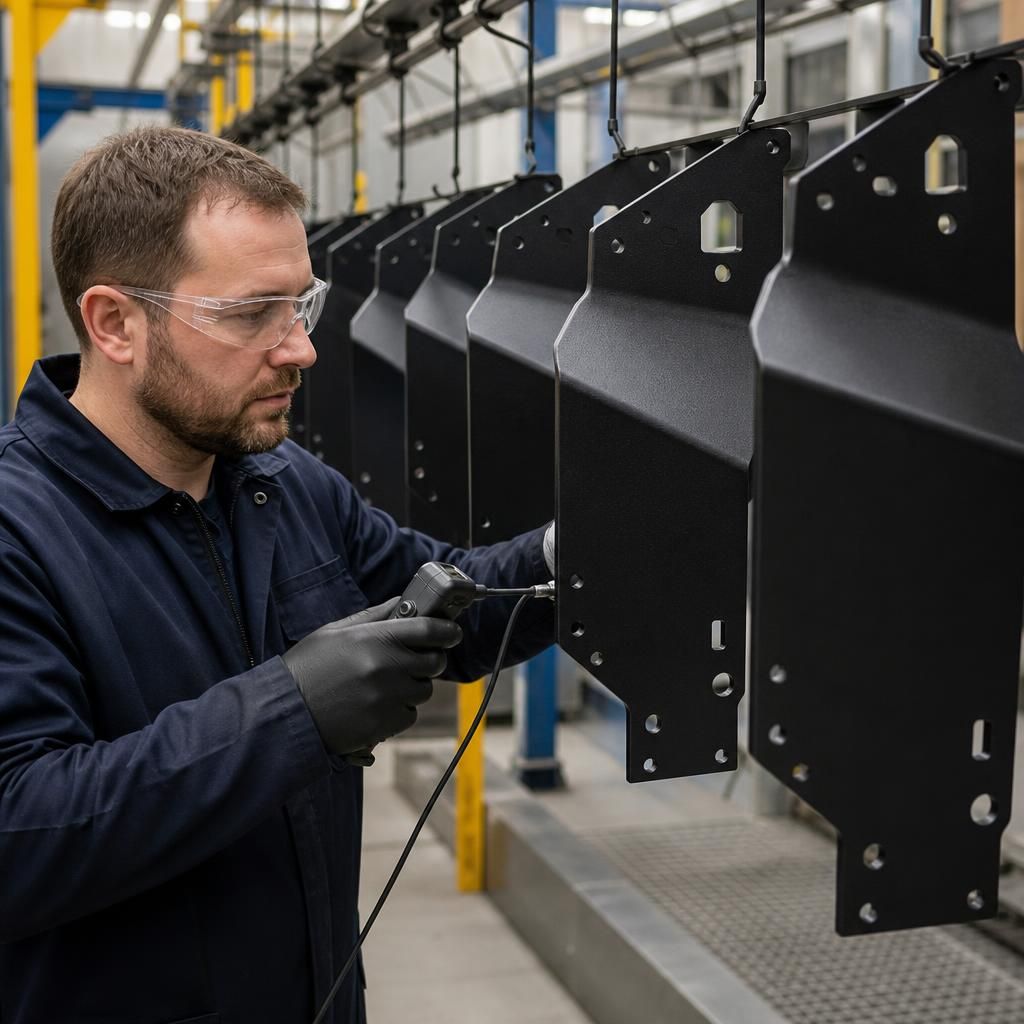
A further benefit of anti-corrosion powder coating in manufacturing is that its finish can be assessed against defined quality requirements before components move to assembly or dispatch. Checks may include coating coverage, film appearance, adhesion, thickness and curing, depending on the component specification and service conditions.
This gives manufacturers a structured way to identify defects such as missed areas, contamination or incomplete curing while parts are still within the finishing process. Early inspection can help prevent unsuitable components from being incorporated into larger assemblies and provides a clearer basis for deciding whether a part requires repair, recoating or further technical review.
Discuss anti-corrosion powder coating for your components
Discuss your component material, dimensions and intended service conditions with our powder-coating specialists to establish whether an anti-corrosion coating is suitable. We can advise on the coating specification and preparation requirements for your manufacturing application.