

What makes UV resistant powder coatings suitable for challenging environmental conditions?
UV resistant powder coatings are suitable for challenging environmental conditions because they combine resistance to sunlight-driven fading and degradation with a durable finish that protects metal substrates during outdoor exposure. Their performance can help coatings retain their appearance and protective function where components face prolonged UV radiation, rain, temperature changes and general weathering.
UV resistant powder coatings are suitable for challenging environmental conditions because their formulation, film structure and application process can be selected to address several forms of exposure at the same time. Rather than relying on colour alone, a suitable coating combines a weather-resistant resin system with stable pigments, effective additives, sound surface preparation and a correctly cured film.
Formulation controls how the coating responds to exposure. Standard powder coatings can lose gloss, chalk or change colour when exposed to sustained outdoor conditions. UV-resistant systems are designed to slow the chemical reactions that occur when ultraviolet radiation and oxygen interact with the coating. Suitable resin chemistry and light-stable pigments help the film retain its intended properties for longer, although the exact level of resistance depends on the product specification, colour and exposure category.
This distinction is important because environmental conditions rarely act in isolation. A metal component may experience moisture, airborne pollutants, salt deposits, abrasion, temperature cycling and sunlight simultaneously. A coating that is suitable for one of these factors may not automatically be suitable for all of them. Selecting a UV-resistant powder coating therefore involves assessing the complete service environment rather than choosing a product solely because it is described as suitable for outdoor use.
Moisture resistance depends on the complete coating system. Rain and condensation can expose weaknesses in the film, particularly where there are pores, incomplete coverage, damaged edges or contamination beneath the coating. Properly prepared and cured powder coating forms a continuous barrier that limits direct contact between the environment and the metal. This helps reduce the conditions that contribute to corrosion, but it does not remove the need for suitable drainage, sealed joints and appropriate treatment of cut edges or concealed areas.
Locations affected by coastal air, road salt or industrial pollution require additional consideration. Deposits can remain on horizontal surfaces and around joints, concentrating moisture and contaminants against the coating. A system selected for these conditions may need a higher level of corrosion protection, more rigorous pretreatment or a multi-layer specification. Routine cleaning can also be relevant because removing accumulated deposits reduces the time that aggressive substances remain in contact with the film.
Resistance to temperature change is another reason these coatings are used in demanding settings. Outdoor metalwork may heat in direct sunlight and cool rapidly after shade, rain or night-time conditions. Repeated expansion and contraction can place stress on the coating and its bond with the substrate. A well-selected and correctly applied system accommodates this movement more effectively than an unsuitable film, helping to limit cracking, flaking or loss of adhesion. The design of the component still matters: sharp corners, thin edges and areas that retain water can remain vulnerable regardless of coating type.
UV-resistant powder coatings can also be specified where the finish must withstand limited physical or chemical attack. Industrial equipment, fabricated parts and external structures may be exposed to handling, contact, cleaning agents or airborne particles. Resistance varies considerably between formulations, so the coating supplier needs information about the substances involved, their concentration, contact time and operating temperature. A coating intended for general weather exposure should not automatically be treated as a chemical-resistant specification.
Application quality is as important as the powder formulation. The following factors have a direct effect on performance:
- Substrate preparation: Oil, rust, mill scale, dust and other contaminants must be removed using a preparation method appropriate to the metal and the intended environment.
- Pretreatment: A compatible conversion or preparation system can improve adhesion and support corrosion protection, particularly where the component will face moisture or contaminants.
- Film thickness: The coating must be applied within the product’s specified range. Excessively thin areas may provide inadequate coverage, while excessive build can affect appearance, curing and mechanical performance.
- Curing: The powder must reach the required metal temperature for the specified time. Under-curing can leave the film with reduced performance, while over-curing may affect colour or other finish characteristics.
- Coverage and design: Recesses, welds, edges, fixings and complex geometries require attention because they can be difficult to coat consistently and may collect water or debris.
These considerations explain why UV resistance should be treated as one part of a performance specification, not as a standalone guarantee of suitability. The intended service life, orientation, local exposure, colour, substrate, cleaning regime and risk of impact should all be reviewed before the coating is selected. Where appearance consistency is important, the specification should also define the acceptable finish and acknowledge that different colours and gloss levels can weather at different rates.
For manufacturers, fabricators and other businesses coating outdoor metal components, the practical approach is to provide details of the component’s environment and use before production begins. A coating specialist can then help match the powder system, pretreatment and application controls to the actual conditions. This joined-up assessment is what makes UV-resistant powder coating appropriate for demanding outdoor metalwork rather than simply choosing a coating labelled for external use.
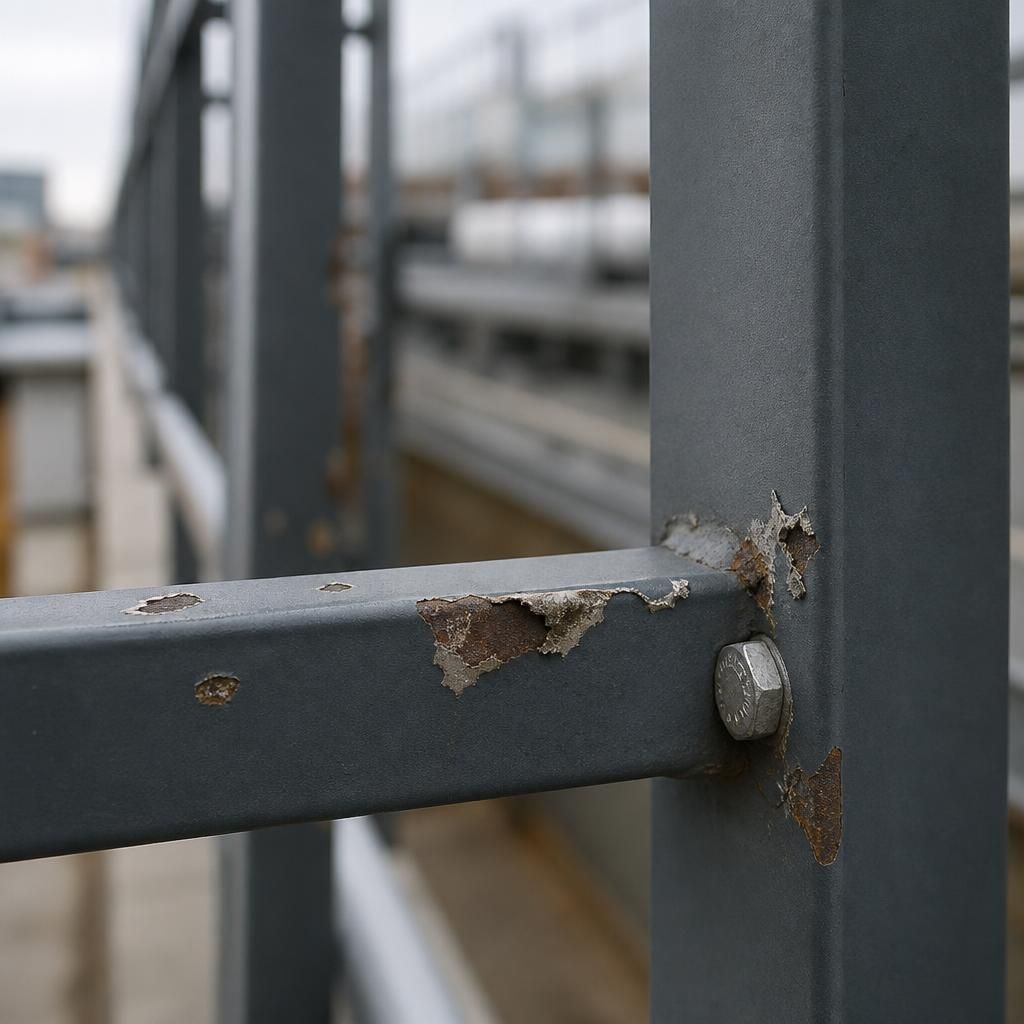
A UV-resistant powder coating remains effective in challenging conditions only while its protective film is intact. Impact, abrasion, sharp contact or movement at fixings can create small breaks in the coating, allowing moisture and contaminants to reach the metal beneath. These local defects may become more significant than general surface weathering because corrosion can develop from a single exposed area and spread beneath the surrounding film.
For this reason, outdoor components should be checked periodically for chips, deep scratches, blistering and damage around edges or fixings. Any repair method should be compatible with the original coating system and suitable for the exposure conditions. Touch-up materials may not match the original colour or gloss exactly, so repair requirements and acceptable appearance should be considered when the component is specified. Protecting the coating from avoidable impact during transport, installation and service also helps preserve the performance expected from a UV-resistant finish.
Discuss UV-resistant powder coatings for your environment
Discuss your component’s environmental conditions with a powder coating specialist to identify a suitable UV-resistant system. Include its substrate, exposure, dimensions, finish requirements and any contact with salt, chemicals or abrasion when requesting an assessment.