

What are the environmental benefits of powder coating aluminium sections compared to traditional painting methods?
Powder coating aluminium sections generally has a lower environmental impact than traditional liquid painting because it uses little or no solvent and produces far fewer volatile organic compound (VOC) emissions. Unused powder can often be collected and reused, while the durable cured finish can reduce the need for frequent recoating and the associated material consumption.
Powder coating aluminium sections can reduce environmental impact through efficient material use, long service life, and compatibility with aluminium’s established recycling cycle. The benefit is not automatic: it depends on the powder formulation, pre-treatment, curing process, application controls and the way the coated sections are used and maintained.
Reduced solvent use is only one part of the comparison. Traditional liquid painting commonly relies on solvent-based or water-based coatings, with the latter still containing some organic constituents in many formulations. Powder coating is applied as a dry material, so it does not require the same solvent carrier to spread the coating across the aluminium. This reduces the handling and management of solvent-containing materials and can simplify control of airborne emissions during application.
Powder application can use the coating material more efficiently. Electrostatic application attracts charged powder particles to the earthed aluminium section, helping the material adhere to the intended surface. Overspray may be collected, and suitable unused powder can sometimes be reclaimed for controlled reuse. This reduces the amount of coating material sent for disposal, although recovery and reuse must be managed carefully to avoid contamination or inconsistent colour and finish. Powder that cannot be reused still needs to be handled in accordance with the relevant waste requirements.
The dry application process can also reduce packaging and waste associated with liquid paint systems, such as solvent containers, mixed-product residues and cleaning materials. The exact outcome depends on the coating specification and the plant’s procedures. For example, colour changes, contamination, masking and the geometry of the aluminium section can all affect how much powder is recoverable.
A durable finish can extend the useful period before refurbishment is needed. Powder-coated aluminium sections can provide resistance to weathering, corrosion and everyday wear when the alloy, pre-treatment, powder chemistry, film thickness and curing conditions are correctly matched to the application. Avoiding unnecessary stripping, repainting and replacement reduces the raw materials, energy, packaging and transport associated with additional coating cycles. This is a life-cycle benefit rather than an immediate saving at the application stage.
Aluminium itself is also well suited to recycling. Powder coating does not remove the metal from the recycling stream at the end of the section’s service life. In practice, recyclability depends on the section being recovered through an appropriate waste route and on the coating and any attached materials being managed by the recycler. Keeping aluminium sections identifiable and avoiding unnecessary composite attachments can help support better recovery.
Energy use requires a balanced assessment. Powder coating requires an oven to cure the applied film, so the curing stage has an energy demand that liquid painting may not share in the same form. The environmental comparison should therefore consider the complete process rather than assuming that powder coating is always lower-carbon. Factors include:
- the oven design, insulation and heat recovery arrangements;
- the temperature and time required by the selected powder;
- how fully the oven is loaded during each batch;
- the length and profile of the aluminium sections;
- the efficiency of the spray and powder-recovery equipment; and
- the expected service life of the finished component.
Efficient loading and correct curing are important. Under-curing can shorten the finish’s service life, while unnecessary over-curing wastes energy and may affect coating performance. Matching the powder to the aluminium application and following the specified curing window helps avoid rework and repeat processing.
Pre-treatment should also be included in an environmental assessment. Cleaning and conversion stages may use water, chemicals and energy, and their residues require controlled treatment. These inputs are necessary because inadequate preparation can lead to poor adhesion, premature failure and an avoidable replacement coating. Responsible process control aims to use only the treatment stages required for the substrate, maintain them correctly and manage rinse water and chemical waste through suitable systems.
For a fair comparison with traditional painting, assess the whole life cycle: preparation, application, overspray, curing or drying, cleaning, packaging, transport, maintenance, recoating and end-of-life recovery. Powder coating is generally most environmentally advantageous where its material efficiency and durable performance outweigh the energy used for curing. A coating plant can support that outcome by selecting an appropriate powder, controlling film thickness, recovering usable overspray, reducing rework and processing aluminium sections in well-planned batches.
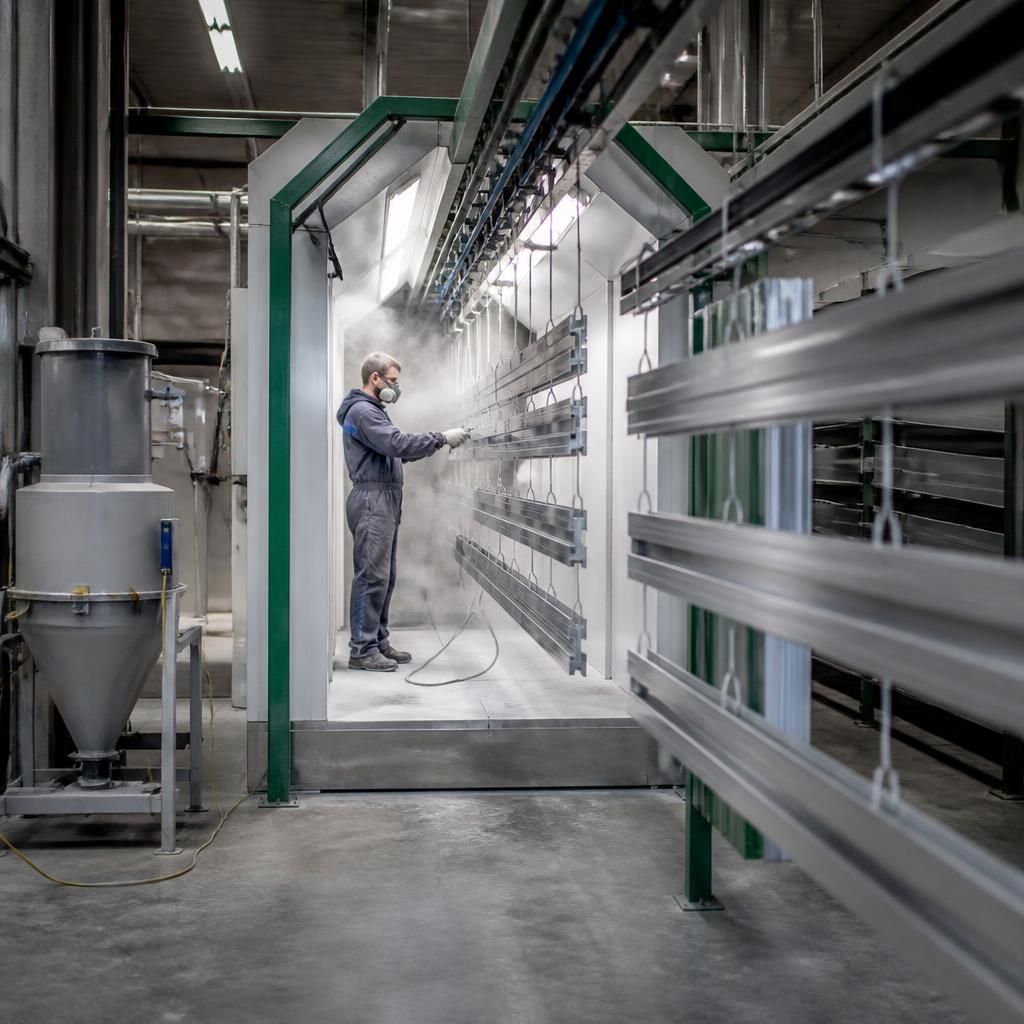
Powder coating can also reduce the risk of liquid coating residues entering wastewater systems. Unlike liquid painting, the application stage does not involve a wet paint carrier that can drip, spill or require solvent-based equipment washing. This does not eliminate water use: aluminium sections still require appropriate cleaning and pre-treatment, and those rinse streams must be controlled. The environmental advantage comes from separating essential substrate preparation from the coating application, making it easier to identify, contain and manage each waste stream correctly.